







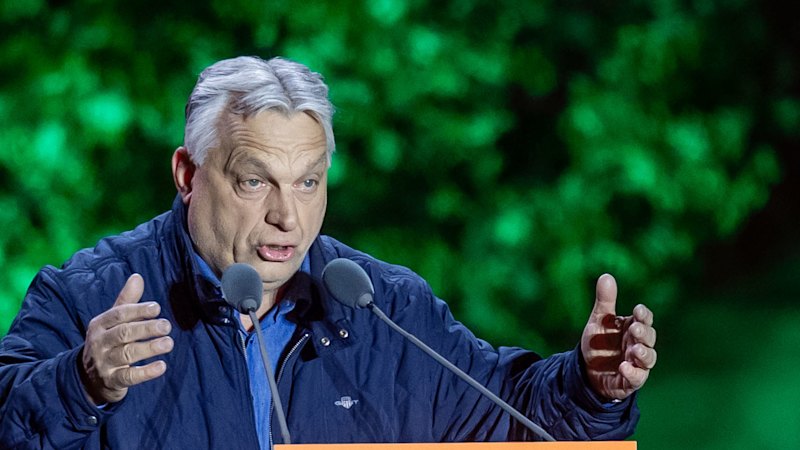


Budapest: When Hungarian Prime Minister Viktor Orbán held his final rally in the country’s hard-fought election campaign, he warned his supporters to expect unprecedented foreign interference in the popular vote.
Orbán told them that foreign spy services were intervening in the election to try to stop him from winning because he represented a different model to the European Union.
Before thousands of loyal adherents in Budapest, he railed against “woke” politics and gender ideologies and declared that he would stand up for the family, making this a contrast of his values against those decided in Brussels.
But he was not alone in complaining about foreign meddling. His chief opponent, Peter Magyar, used his final rally to ensure voters were aware of another source of interference: Moscow.
Magyar’s supporters tried to brand Orbán as an agent of the Kremlin when they gathered on Friday night in the capital.
“Russians go home,” the crowd chanted, reprising the historic call of Hungarians in 1956 when they tried to stop Russian troops from taking control of the country.
The competing claims highlight the way this parliamentary election has been dominated by anxiety about outside interference. (The polls close at 7pm on Sunday, local time, or 3am on Monday AEST).
Whatever the election result, the loser has already laid the groundwork for blaming a foreigner for shaping the outcome.
One of Orbán’s main advertising campaigns, for instance, ran grim-looking photographs of Magyar next to Ukrainian President Volodymyr Zelensky and told voters that both men are dangerous.
Orbán, who opposes EU funding for Ukraine and has good ties with Russian President Vladimir Putin, sought to position himself as a voice for peace and his opponent as an advocate for war.
Advertising for Orbán has been everywhere in Budapest, and one theory is that billboard companies are aligned with the prime minister and his party, Fidesz. After 18 years in office, in two stints as prime minister, he has used patronage to build a powerful network of allies in business.
The claims about foreign loyalties were complicated, however, when voters were reminded of Orbán’s friends – and not only those in Moscow.
In a late jolt to the campaign, Orbán gained further endorsements from US President Donald Trump in the final full day of campaigning.
Trump issued a pledge that addressed doubts among the Hungarian electorate about which side was best at managing the economy and the national budget.
“My Administration stands ready to use the full Economic Might of the United States to strengthen Hungary’s Economy, as we have done for our Great Allies in the past, if Prime Minister Viktor Orbán and the Hungarian People ever need it,” Trump said in a social media post.
Orbán made sure Hungarian voters knew about the promise. “America stands with us,” he told them. “Hungary is proud to be a great ally.”
Trump’s message came only a few days after US Vice President JD Vance visited Budapest to appear alongside Orbán, a few weeks after a similar visit by US Secretary of State Marco Rubio.
The American interest in the Hungarian race even prompted two Republican congressmen, Chris Smith and Andy Harris, to issue a letter on Thursday urging European Union President Ursula von der Leyen to stop foreign interference in the election.
Orbán’s supporters distributed the letter claiming US support against a foreign threat to the election from the European Union.
It is true that the foreign interest in Hungary is intense. A series of leaked phone intercepts has appeared in the media in recent months, showing that Orbán’s foreign minister, Péter Szijjártó, was often in touch with Moscow.
The intercepts were said to come from a European intelligence service. When the news stories appeared, one of those to comment on social media was Polish Prime Minister Donald Tusk.
Everyone appears to have a stake in the election outcome. Tusk does not hide his antipathy for Orbán, while Czech Prime Minister Andrej Babiš and Slovak Prime Minister Robert Fico endorsed Orbán on social media.
‘Given the current global situation, campaigning on the message that Fidesz is the safe choice and will ensure stability and peace is not easily reconcilable with being endorsed by President Trump.’
Bulcsu Hunyadi, Political Capital Institute, Budapest
In the past, convention dictated that leaders looked neutral about an election next door. That has been thrown overboard, and not only by Trump.
Expert observers question the real value of these endorsements, anyway. Did Orbán really benefit from the Vance visit? Analyst Bulcsú Hunyadi of the Political Capital Institute in Budapest doubted it had any significant impact on the campaign.
Mixed messages
“While it probably reinforced the message among Fidesz’s core electorate that Orbán is a respected leader with powerful supporters, I haven’t seen any signs of this message resonating with wider audiences,” Hunyadi told this masthead.
“Also, given the current global situation, campaigning on the message that Fidesz is the safe choice and will ensure stability and peace is not easily reconcilable with being endorsed by President Trump, who has been a major source of instability in recent months.”
Magyar, who was a Fidesz member before breaking with the party and taking the leadership of the rival Tisza movement, attacked Orbán for being corrupt.
One of Magyar’s final campaign videos warned of election fraud. He told voters not to succumb to pressure from employers or community leaders who told them how to vote. As with the foreign interference concerns, each side has prepared for the argument about the election outcome.
There is an overload of irony in the way Orbán has accused others of foreign interference while enjoying the visits from Vance and Rubio, while acclaiming the endorsements from Trump.
What stood out most, however, was the sheer scale of the gamble. Many leaders have sought to put more distance between themselves and the White House, especially during the war with Iran. Orbán, however, wanted to stay as close as possible to Trump. The Hungarian prime minister chose the foreign interference he wanted. And he bet his future on it.
Get a note directly from our foreign correspondents on what’s making headlines around the world. Sign up for our weekly What in the World newsletter.


