







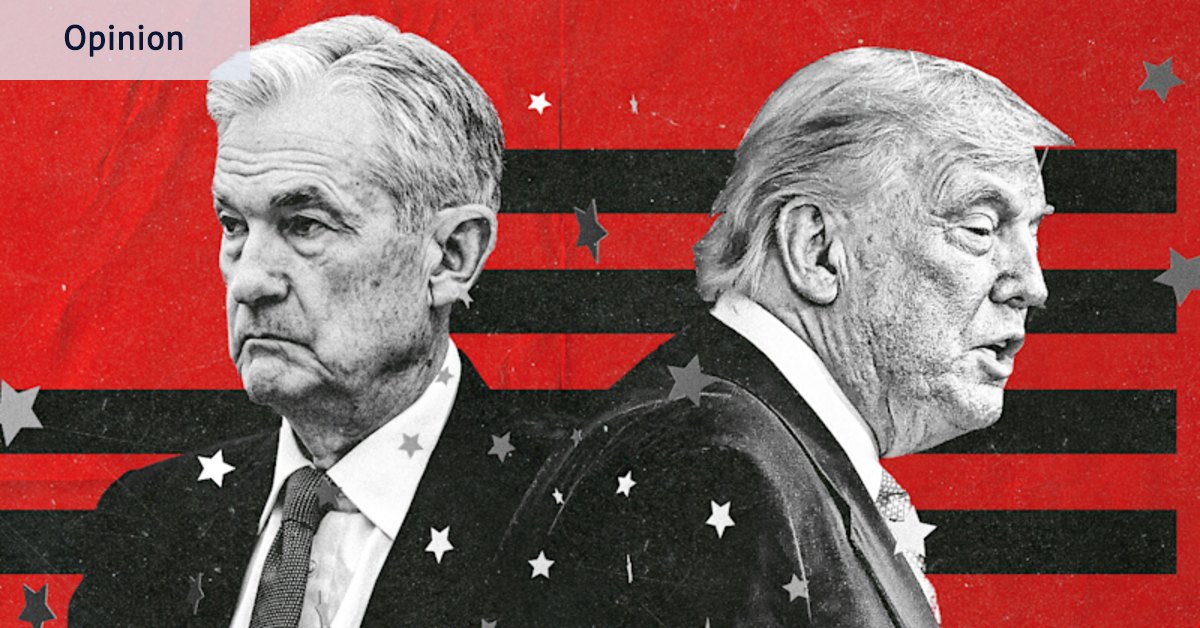
Jerome Powell may have chaired his last Federal Reserve Board meeting on Wednesday, but he’s hanging around while he remains at personal legal risk and the Fed’s independence remains under threat from US President Donald Trump.
At the last press conference of his eight-year stint as chairman of the Fed, Powell, whose term as a governor doesn’t formally expire until January 2028, revealed that he will become the first Fed chair since 1948 to remain on the board of governors after their term as chair.
“After my term as chair ends on May 15, I will continue to serve as a governor for a period of time to be determined,” he said.
Powell has, throughout his term, been subjected to an escalating series of attacks from Trump, who has been unhappy that the Fed hasn’t cut US interest rates more. Those attacks culminated in a criminal investigation of Powell over cost overruns in the renovation of the central bank’s Washington headquarters.
While the Justice Department suspended that investigation last week, the US Attorney for the District of Columbia, Jeanine Pirro, has said she would not hesitate to restart a criminal investigation should the facts warrant doing so.
Powell said he had decided to stay on as a governor because of the legal attacks on him and another Fed governor, Lisa Cook, whom the Trump administration has accused (without presenting any evidence) of mortgage fraud as an obvious pretext for removing her and creating an opening for another Trump appointee.
“They left me no choice,” Powell said.
“I worry that these attacks are battering the institution and putting at risk the thing that really matters to the public, which is the ability to conduct monetary policy without taking into consideration political factors.”
He warned that the Fed’s independence was at risk and said he would remain a governor, albeit with a “low profile”, while “waiting for the investigation to be well and truly over, with finality and transparency. I’m waiting for that and I will leave when I think it is appropriate to do so,” he said.
Asked where the concept of the Fed’s independence emanated from, Powell said it was the law.
“We’ve had to go to court, successfully, to defend it. It goes beyond that, though. There’s a set of customs. There’s a set of boundaries between the Fed and the administration.”
Those are boundaries that Trump, in particular, and an administration that places loyalty to him above conventions – or indeed the law – don’t recognise.
Powell’s decision to hang around rather than depart quietly will inevitably incense Trump, who has said he would fire Powell if he didn’t retire when his term as chair ended.
Trump’s ability to do so is dubious.
Fed governors can only be removed “for cause” and, while the overspend on the Fed’s renovations provided a pretext for the criminal investigation, it is extremely doubtful that it would convince a court that Powell has done anything criminal.
US Treasury Secretary Scott Bessent, who said it was highly unusual for Powell to remain on the board, said it would be an insult to Powell’s Trump-nominated successor, Kevin Warsh, and “a violation of all Federal Reserve norms”.
The administration’s own actions, however, have led to Powell’s departure from convention. Powell said he had planned to retire as a governor when his term as chair ended – until the legal action was initiated.
Warsh is expected to be confirmed on May 11. Without the vacancy that Powell’s retirement would have created, he will have to replace Stephen Miran, a committed Trump loyalist, on the board.
Trump, and his administration, have made no secret of his desire to stack the Fed board and force it to accede to his yearning for lower interest rates, which could stimulate growth (and inflation) and lower the escalating cost of servicing the government’s near-$US40 trillion of debt.
While the dropping (temporarily?) of the investigation of Powell clears the way for Warsh’s confirmation (after a key Republican senator had threatened to hold up the vote while the probe remained afoot), Powell’s decision to stay on will change the dynamics within the Fed.
He might have promised to be a low-profile governor – “I’m not looking to be a high-profile dissident” – but Powell, with his demonstrated dedication to preserving the Fed’s independence and willingness to defy Trump, will provide a focus for any opposition within the Fed to attempts to impose a White House agenda on its decision-making.
There are two other Trump-nominated governors on the board as well as Miran, but they have shown a readiness to resist Trump’s calls for rate cuts. Miran is the only governor to have voted for a rate cut at every meeting since he was appointed to fill a casual vacancy on the board last September.
He was, again, the only member of the Federal Open Market Committee (FOMC), the body that decides US monetary policy, to vote for a 0.25-percentage-point rate cut at this week’s meeting. Three FOMC members actually voted against language in the Fed’s statement that suggested a bias towards easing rates.
There are 18 members of the FOMC, with 11 voting members. Warsh, a former Fed governor who does have the credentials for the role, will be chair of the committee, but with only one vote.
He will need to be convincing to achieve a favourable consensus for the rate cuts Trump is demanding, or the large-scale changes to the way the Fed deliberates, operates and communicates that he envisages.
The internal politics of the Fed, already messy for Warsh as he takes the chair while his predecessor remains at the board table – for which he can blame Trump for politicising the institution and targeting Powell and Cook – will be further complicated by the economics.
The Fed has left rates on hold because it is uncertain about the outlook for the economy and because core inflation, just above 3 per cent, remains above its target of 2 per cent and has been above-target for more than five years.
‘I worry that these attacks are battering the institution and putting at risk the thing that really matters to the public, which is the ability to conduct monetary policy without taking into consideration political factors.’
Jerome Powell
The full impact of Trump’s tariffs is still feeding into prices even as the war in Iran is causing oil prices – and gasoline and diesel prices – to soar. The oil price jumped 10 per cent to more than $US122 a barrel on Wednesday as the prospect of a near-term negotiated end to the war receded.
The longer the war is prolonged, the more higher energy costs will feed into supply chains and prices and the more embedded those higher costs are in inflationary expectations, the less transitory the effects will be.
Having misjudged how transitory the impact of the pandemic would be on global supply chains and US inflation, which reached 9 per cent at its peak, the Fed is reluctant to risk making the same mistake twice.
There is a risk, and it’s one confronting most of the major economies, that the soaring cost of energy and the potential for significant shortfalls in supply will lead to lower economic growth and job losses even as inflation rates climb.
“You can develop any number of scenarios that you want, but we really won’t know until we know,” Powell said of the current economic uncertainties.
Whatever Warsh might want to do, or Trump demands, that’s likely to be the prevailing sentiment within the Fed, until most of its officials are comfortable that they know what they believe they need to know.
The Business Briefing newsletter delivers major stories, exclusive coverage and expert opinion. Sign up to get it every weekday morning.


