











Australians stranded overseas following the eruption of hostilities in the Middle East have been warned it will be difficult to organise emergency repatriation flights, as the federal opposition accuses the Albanese government of failing to provide enough notice to leave the region before the United States launched strikes on Iran.
Foreign Minister Penny Wong on Monday said there were around 115,000 Australians in the Middle East, with approximately 11,000 people transiting through the region’s airports every day when flights were operating.
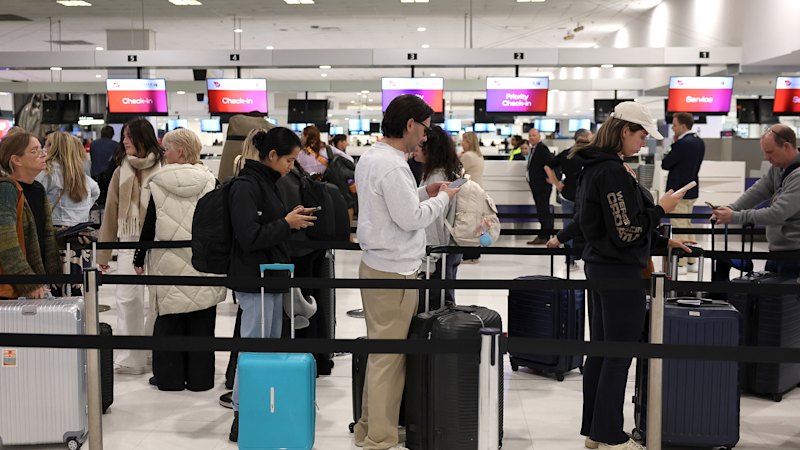
Flights to and from the United Arab Emirates, Qatar, Israel and Bahrain have been cancelled, causing chaos at major air travel hubs.
The Coalition is calling on the government to do whatever is necessary to help evacuate Australians from dangerous locations such as Israel, including by organising emergency military flights as it did from Lebanon in 2024 and Israel in 2025.
“I’m not sure there were sufficient warnings for Australians in the region in the recent days and weeks given the likelihood of military action,” opposition defence spokesman James Paterson told reporters in Canberra.
“I think many Australians have been caught by surprise and might have chosen to leave had they been warned to do so.”
Paterson said that if repatriation flights using Australian military assets were necessary because of airport closures, Paterson said they would “have our unqualified bipartisan support”.
“Yes, the Australian government should be doing everything they can to assist Australians to leave the region,” he said.
Wong said: “Obviously, it’s very difficult at the moment for government to provide a great deal of assistance in circumstances where flights are being cancelled, disrupted and airspace is closed.”
She continued: “Given the numbers of people in the region, people will get home most quickly if we can facilitate people getting onto commercial flights. At the moment, the issue is not who is flying, it’s that people are not flying.”
After the US launched strikes on Iran on Saturday night Australian time, the Department of Foreign Affairs and Trade advised Australians not to travel to Qatar, Iraq, Yemen, Syria, the United Arab Emirates, Bahrain, Kuwait, Israel and Lebanon.
Liberal senator Dave Sharma, a former Australian ambassador to Israel, said there should have been more forceful warning earlier, accusing Prime Minister Anthony Albanese and Wong of not doing enough to warn Australians to leave the Middle East ahead of the strikes.
“This military conflict in the Middle East was entirely foreseeable. The risks have been building for weeks, but the Labor government failed in its duty to properly warn the Australian public,” he said.
Sharma added that angry travellers were “right to be upset”.
“Prime Minister Albanese devoted hours of airtime last week to talking about the threat of a King Andrew — and no time talking about the more immediate and serious threat of a war in the Middle East,” he said.
“Penny Wong did not mention Iran or the risk of conflict in the Middle East once during the past month of media appearances … The government simply failed to warn them of the risks. If that had been done, at least the Australian public would have been forewarned. This is a serious failure of national security preparedness.”
A spokesperson for Wong defended the government’s communications strategy, saying: “Australia’s travel warnings for the Middle East have been in line with the warnings given by Australia’s partners.
“Our travel advice has consistently warned that the security situation in the Middle East could deteriorate quickly with little warning.
“It’s disappointing that rather than being constructive during an international crisis, the Liberals are just engaged in their usual petty political point scoring.”
Wong said at a January 15 press conference: “Regional tensions are high in the Middle East. The security situation could deteriorate rapidly. This may result in airspace closures, flight cancellations and other travel disruptions.”
On February 19, DFAT updated its advice for countries in the Middle East to exercise a high degree of caution and warned about the volatile situation.
When the government organised repatriation flights from Beirut during the 2024 war between Israel and militant group Hezbollah, many of those who had registered interest in a seat did not show up to make the journey.
During the previous war between Israel and Hezbollah in 2006, the Australian Defence Force evacuated almost 7000 people by boat from Lebanese ports to Cyprus.
Read more on the US-Israel-Iran war
Cut through the noise of federal politics with news, views and expert analysis. Subscribers can sign up to our weekly Inside Politics newsletter.


