






Race comments trigger outcry
Watson drew condemnation later in life for disparaging comments about women, black people, LGBTQ people and the obese. He was criticised as sexist for downplaying the role of Franklin in the DNA discovery.
In 2014, he said he would sell his Nobel Prize medal as his controversial remarks had made him an outcast in the scientific community. Watson also said he needed the money and would donate some of the proceeds to scientific research. The medal sold at auction for $US4.8 million.

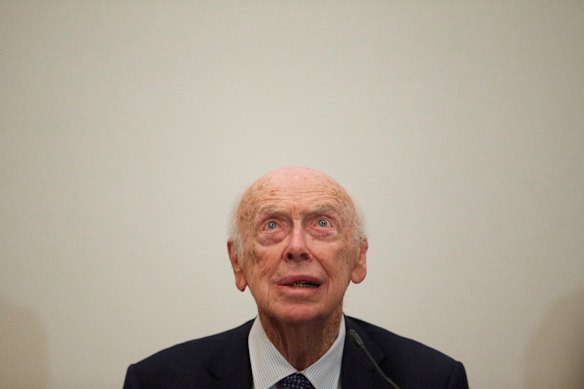
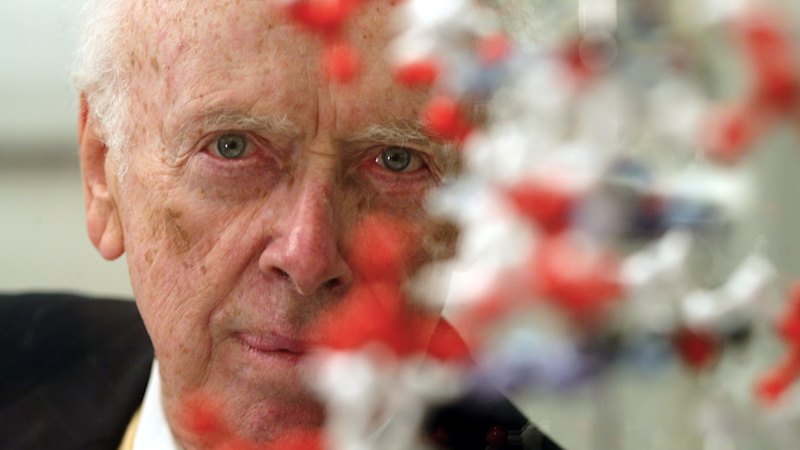
Watson’s later remarks on race and intelligence triggered an outcry.Credit: AP
“Because I was an ‘unperson’, I was fired from the boards of companies, so I have no income, apart from my academic income,” he said, according to the Financial Times.
The medal’s buyer was Russian billionaire Alisher Usmanov, who later returned the medal to Watson to acknowledge his contribution to science.
James Dewey Watson was born on April 6, 1928, in Chicago. He won a scholarship from the University of Chicago and graduated with a zoology degree in 1947 at age 19. He received a doctorate from Indiana University three years later.
“Until one has cleared high school, there is little to be gained by questioning what your teacher wants you to learn,” he said in the 2007 book Avoid Boring People: Lessons From a Life in Science. “Save flights of rebellion for when authority does not have you by the throat.”
‘Secret of life’
He spent a year in Copenhagen as a postdoctoral fellow before attending a symposium in Naples in 1953, where he saw Wilkins’ X-ray diffraction results using crystalline DNA. Watson then focused on nucleic acids and proteins, working at Cambridge University’s Cavendish Laboratory, where he joined forces with Crick to solve the problem of DNA’s structure.
On February 28, 1953, Crick announced at the Eagle pub in Cambridge, England, that they had just “found the secret of life”. Earlier that day, the two had uncovered the self-replicating double helix.
“This structure has novel features which are of considerable biological interest,” Watson and Crick wrote in an April 1953 letter to Nature. It was widely regarded as one of the biggest understatements in science. Crick and Wilkins both died in 2004.
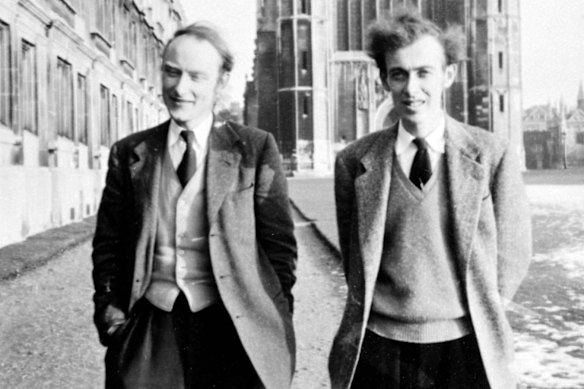
Watson (right) with Francis Crick at Cambridge University in the 1950s.Credit: AP
Watson’s 1969 account of the discovery was published under the title The Double Helix and was criticised for his treatment of Franklin and for revelations about the selfish motives of scientists.
Watson joined the biology department at Harvard University, where he became a professor in 1961. He resigned in 1976 to work as director of the Cold Spring Harbour Laboratory in New York, a centre for biomedical research and education. He was the centre’s president from 1994 to 2003, when he became chancellor, according to the laboratory’s website.
He served as director of the National Centre for Human Genome Research at the National Institutes of Health from 1989 to 1992. He spearheaded the effort to chart the genetic code of the human species, enabling the development of tests and potential cures for inherited diseases.
Public outcry
Watson was strongly criticised in 2007 over comments he made in London’s Sunday Times about the intelligence of black people, implying they were genetically inferior.
Loading
“All our social policies are based on the fact that their intelligence is the same as ours – whereas all the testing says not really,” he was quoted as saying. While he hoped that everyone was equal, “people who have to deal with black employees find this not true”.
Cold Spring Harbour Laboratory suspended Watson from his position as chancellor, and a book tour of the UK was cancelled. Watson announced his retirement from his duties at Cold Spring the following week.
“I am mortified about what has happened,” he said in response to the public outcry. “More importantly, I cannot understand how I could have said what I am quoted as having said. I can certainly understand why people, reading those words, have reacted in the ways they have.” He added: “There is no scientific basis for such a belief.”
The laboratory stripped him of his titles in 2019 after further comments about race and intelligence.
Watson was awarded the Presidential Medal of Freedom in 1977, held honorary degrees from more than a dozen universities and was a member of the National Academy of Sciences.
He was married to Elizabeth Lewis, with whom he had two sons: Rufus and Duncan.
Bloomberg


