


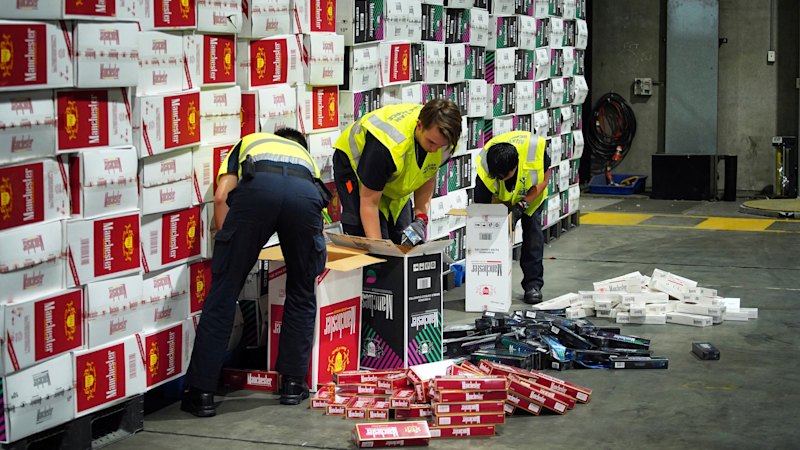

Border Force has warned the fight against illegal tobacco and its links to organised crime will not be won without dealing with the high prices of legal products, despite the agency revealing it is seizing almost 6 million illicit cigarettes a day.
In a submission to a parliamentary committee examining the explosion in the illicit market and a collapse in federal tobacco excise collections, Border Force said simply beefing up policing of the illegal trade was not enough to offset “strong consumer demand”.
Treasurer Jim Chalmers is under internal political pressure to give the states and territories an extra $300 million to target illicit tobacco sales, while the legal tobacco trade is calling for a cut in excise rates, which many experts believe have encouraged the illegal trade.
Tobacco excise, which as recently as 2020 was the federal government’s fourth-largest tax source, has collapsed over the past five years. By 2029-30, an estimated $65 billion in excise will have been lost despite tougher border controls and large increases in the tax rates on cigarettes.
Border Force said that, through the second half of last year, it and many state-based agencies had sharply increased their policing activities.
This had netted 7500 detections of illicit tobacco, or 41 a day. More than 1 billion illicit cigarettes and 147 tonnes of loose-leaf tobacco, worth almost $1.9 billion in excise, had been seized in just six months.
Despite this increase in policing, Border Force warned just trying to target the illegal trade would not address the “strong consumer demand” for cheap, illicit cigarettes.
“Operational data and market estimates indicate that strong consumer demand remains a critical driver of illicit tobacco,” the agency’s submission said.
“The ABF notes that absent demand-reduction measures, enforcement activity alone will continue to be offset by sustained consumer willingness to purchase illicit product.
“Understanding consumer motivations, substitution behaviours and price sensitivity is therefore important in informing complementary policy responses aimed at reducing the demand pull that sustains the market.”
While excise has been increased to make it too expensive for smokers to continue their habit, economists believe the huge gap between legal and illegal cigarettes of up to $40 a pack has created a financial incentive for people to tap the illicit market.
Some politicians, including NSW Premier Chris Minns, believe the excise needs to be reduced, but that idea has been rejected by the Albanese government.
Border Force said despite its success in seizing illegal product, the organised criminal networks underpinning illicit trade were able to continue due to high profitability, which enabled them to absorb any losses as the “cost of doing business”.
Criminal networks, it said, “appear more willing to form alliances” that covered the logistics and financing of the illegal trade.
Border Force said there appeared to be three plausible scenarios for illicit tobacco, based on its current threat assessments.
Most likely is that organised criminals will diversify into other commodities, probably illicit e-cigarettes. It also believes it is likely that criminal syndicates will seek to expand their control over existing supply channels, which would lead to more “turf wars” over tobacconists and convenience stores.
A plausible scenario, according to Border Force, is that as it gets more difficult for gangs to import illegal cigarettes, they will seek to grow their own domestic tobacco.
The agency said efforts to bring the illicit trade under control will need to be broad, covering policing activity, local supply and efforts to reduce demand by legal smokers.
“Enduring reductions in illicit tobacco activity will require a co-ordinated policy and operational effort that addresses supply, demand and the financial systems that enable the trade,” it said.
“Strong collaboration with offshore partner agencies and sustained enforcement across the border continuum remain essential, but their impact will be greatest when supported by robust financial disruption, consistent regulatory settings across jurisdictions, improved intelligence sharing and evidence-based measures to reduce consumer demand.”
But Liberal MP and co-chair of the Coalition’s illegal tobacco taskforce, Mary Aldred, said the Border Force submission was proof the government was ignoring key factors in the growth in the illicit trade.
“When the Australian Border Force is saying enforcement alone won’t work because demand is being driven by price, it’s a flashing red warning sign,” she said.
“The prime minister has got this badly wrong, and he needs to start listening to his own frontline agency and not his weak cabinet ministers.
“This is as close as you’ll get to the Border Force saying the policy settings are completely broken. If criminals can absorb enforcement losses as a ‘cost of doing business’, then the government’s approach isn’t just failing – it’s fuelling the problem. It’s time they swallowed their pride and fixed it.”
Cut through the noise of federal politics with news, views and expert analysis. Subscribers can sign up to our weekly Inside Politics newsletter.
 Shane Wright is a senior economics correspondent for The Age and The Sydney Morning Herald.Connect via X or email.