


He was surrounded by hardline China hawks in that first term. They wanted to cut off access to leading-edge US technology, notably advanced semiconductors, to try to hobble China’s rapid development of 21st century technologies. They saw Trump’s tariffs through a national security lens.
When that trade stoush ended in 2020 with Trump’s “first phase” deal – with China agreeing to buy more US products, notably oil and soybeans – some of Trump’s tariffs and trade restrictions were left in place.

There’s now a level of global mistrust in the US that will outlive the Trump presidency.Credit: Getty Images
The Biden administration maintained them and significantly tightened the restrictions on semiconductor exports in a “small yard, high fence” policy stance that was far more heavily tilted towards national security than the trade balance.
In Trump’s second term, threats of even tighter technology restrictions appear less driven by national security concerns than by Trump’s fixation with US trade deficits, his suspicion that those deficits reveal something sinister (rather than a US savings rate that is lower than it needs to be to finance American living standards) and his desire to use his beloved tariffs as leverage to do commercial deals. He does love a deal.
He got one last week, one that injects a pause of at least 12 months into the US-China trade conflict.
The US got a promise of some soybean purchases by China, Xi’s pledge to try to throttle the supply of precursor chemicals used in fentanyl production and an agreement that China wouldn’t implement its tighter controls of rare earth and magnet exports while the truce is in place.
Loading
China won a winding back of the extension of America’s “black list” of Chinese companies to cover subsidiaries, which would have expanded the number of companies prohibited from acquiring advanced US technologies from about 1300 to more than 20,000.
It was only the announcement of the vastly increased list – in breach, China thought, of a standstill agreement reached earlier this year – that caused it to toughen its restrictions on rare earths and magnets.
The US has agreed to halve the 20 per cent tariff on China’s exports related to its role in fentanyl production and also to halt the imposition of steep port fees on Chinese ships docking at US ports. (China has similarly removed its retaliatory duties on US-financed ships using its ports.)
What the deal struck last week highlights is the imbalance in power within the trade relationship.
Trump thought access to America’s vast consumer marketplace gave him unmatchable leverage –until Xi responded by threatening to use its near-monopoly on the rare earths and rare earth magnets to almost instantly cripple US manufacturing and its defence capabilities.
By slashing China’s purchases of soybeans from farmers in Trump’s midwestern political strongholds to zero in the current harvest season, Xi also showed he understands how to exploit the vulnerability of politicians in a democracy. Those soybean farmers were becoming increasingly desperate and angry.
It will take the US and its allies up to a decade to build the mines and processing infrastructure that would shield them from China’s stranglehold over critical minerals. Meanwhile, Xi has a far more potent weapon in his trade arsenal than anything Trump can call on; one he can roll out anytime the US tries to flex its muscles.
It’s not the only one. China has an equally dominant position in, for instance, some key pharmaceutical products and ingredients and has the best part of a decade, and the advantages provided by a state-directed economy that is less concerned about productive uses of national capital than in its geopolitical ambitions, to develop other areas of dominance.
What began as an attack on China’s exports to the US, along with an effort to stifle its technological advancements, also developed into a trade war on everyone else.
China might have agreed to buy 12 million tonnes of soybeans from the US this season (though it has already secured supplies into the first part of next year) and 25 million tonnes a year for three years, but it bought about 22.5 million tonnes in the same harvest period last year.
Before Trump’s 2018-19 trade war, China used to buy more than 40 per cent of the US crop. If it makes good on last week’s commitments, it will buy less than 25 per cent.
China has demonstrated that it can acquire all the beans it needs from Brazil, where it helped develop soybean production and the infrastructure to export it after the 2018-19 trade war, and more recently Argentina. Where its soybeans once represented trade leverage for the US, the roles have now been reversed.
After Trump’s truly great deal with China, China still has an effective average tariff rate of about 47 per cent, though most of that relates to tariffs imposed during Trump’s 2018-19 trade war.
Loading
Leaving those aside, it still has a 10 per cent fentanyl-related tariff, a 10 per cent “reciprocal” tariff and exposures to Trump’s global sectoral tariffs which, relative to where it stood when Trump regained office, actually leaves it better positioned against other trading nations, who generally face US tariffs of 15 to 20 per cent (though some are 50 per cent) than it was back in February.
This week, the US Supreme Court will start hearing a case brought against Trump’s reciprocal tariffs, which could force the unwinding of his reciprocal tariffs and potentially the return of billions of dollars of duties already collected.
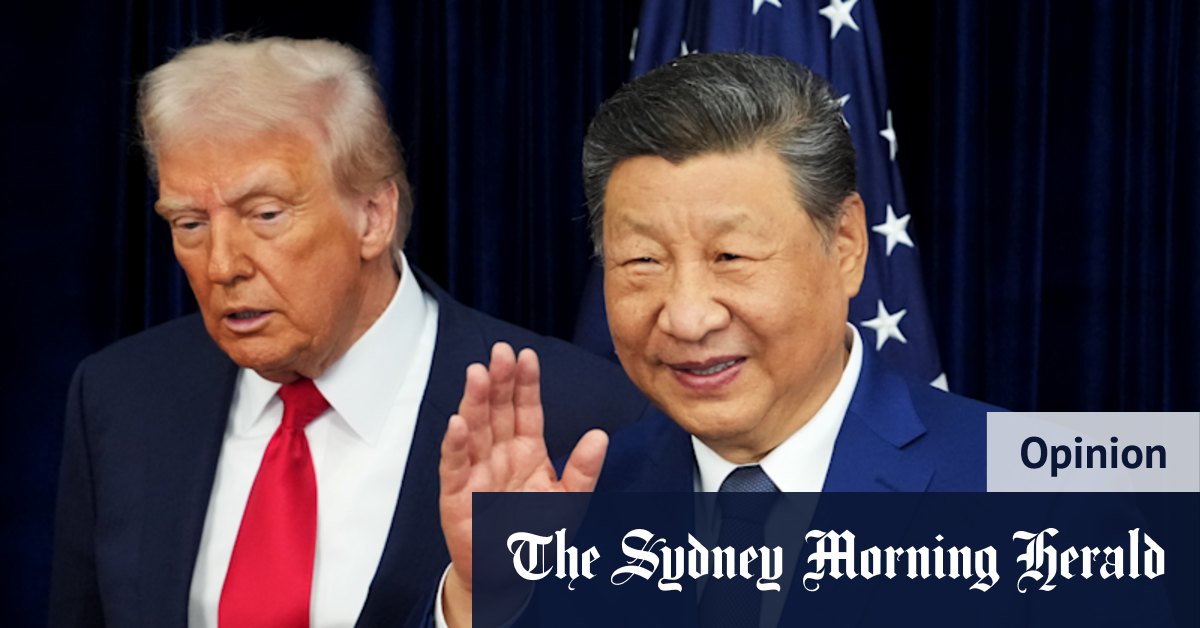
Still, for the moment at least, Trump has his “truly great” deal and Xi, having got what he wanted from the negotiations and having demonstrated that he, not Trump, holds the trump cards in future, is quite happy to allow him to maintain the delusion that the great dealmaker has triumphed again.
The Business Briefing newsletter delivers major stories, exclusive coverage and expert opinion. Sign up to get it every weekday morning.
