


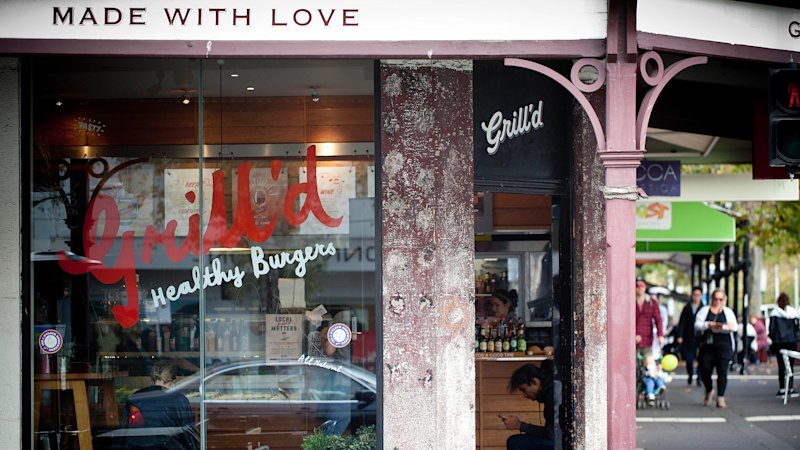

Grill’d is planning to roll out new stores at an “aggressive” pace, despite the burger chain’s latest set of accounts showing rising business costs that are climbing faster than burger sales, impacting its bottom line.
The restaurant chain recorded an 11 per cent revenue increase to $441.3 million during 2025 but growth in revenue was outpaced by growth in the cost of doing business, such as ingredients, which rose 16.9 per cent to $181.5 million.
The fast-food business’ latest financial report filed to the Australian Securities and Investments Commission (ASIC) showed it posted a loss of nearly $9 million in the 2025 financial year, marking the second annual loss in a row for the business, which made a loss of $1.5 million the year prior.
A spokesperson for the company said the accounts filed with ASIC did not reflect the full picture for the business and denied that the company was loss-making, saying all 175 restaurants, most of which are corporate-owned, were generating profits.
“Grill’d is a very profitable business. We operate a number of separate companies, some of which are interrelated, and only one of these meets reporting requirements with ASIC,” the spokesperson said in a statement.
Grill’d has been profitable every year of its 22-year history, the spokesperson added, while declining to provide alternative financial figures. “Our reporting to ASIC does not reflect an accurate picture of the entire financial performance for the Grill’d group of companies.”
Grill’d was founded by director Simon Crowe, who opened the first store in Hawthorn, Melbourne, in 2004, and employs more than 6000 people. He also owns artisan chocolate maker Koko Black.
The burger chain has had a turbulent year that included protracted negotiations with the fast-food union, a wages deal that was blocked by the national industrial relations umpire, and a class action.
In May 2025 the Fair Work Commission rejected an enterprise agreement that set penalty rates as flat dollar amounts and offered annual pay rises of just 1 per cent. Despite 94 per cent of staff supporting the agreement, Fair Work Commission deputy president Bernadette O’Neill found Grill’d had not given staff adequate explanations and had painted a “rosy picture” of the agreement to workers, offering some of them just 77 cents a week above the minimum award. In October the commission ultimately approved a deal that requires Grill’d to top up pay over the life of the agreement.
The company is also facing a class action lawsuit on behalf of past and present employees, filed by Gordon Legal and backed by the Shop, Distributive and Allied Employees’ Association (SDA). The suit claims the burger chain did not give thousands of workers 10-minute rest breaks on shifts of four hours or longer between December 2019 to December 2025. Grill’d is defending the case. When the action was launched last year the company said it took its obligations to staff seriously and it pointed to the recently approved enterprise agreement.
Grill’d’s expansion plans include adding 10 new stores in the current financial year, 20 new stores next year and 25 stores every year after that.
New restaurants and drive-thru sites are notching sales “far higher” than existing restaurants, and Grill’d is planning to hire new franchise partners to grow the national network, said the company spokesperson.
“We are working hard to further increase sales by 20 to 30 per cent within the next 12 to 18 months by focusing on new lines and products including snacks, drinks, desserts, late-night offerings and our membership program called ‘Relish’,” the spokesperson said.
Grill’d struck a year-long partnership with Formula 1 star Oscar Piastri that led to two new burgers that are now driving more than 5 per cent of sales, and a range of two-pack branded wagyu patties sold in Coles.
“The Piastri sponsorship has been and continues to be a huge success. Piastri is an approachable, humble, performance-driven young Australian achieving success on an international stage. These qualities very much reflect the Grill’d brand,” said the company spokesperson.
The financial accounts show the company spent $9.1 million on marketing in 2025, a decrease of 14.7 per cent from the year before. Grill’d’s costs for employee benefits rose 9.4 per cent to $145.8 million.
“Marketing efficiency has increased but by decreasing it in the short term, overall sales are slowing, which is messy when you have such a high-growth leasing/depreciation model,” said influencer marketing expert Jordan Michaelides. “Their gross margin is getting squeezed hard.”
Contributing to the loss in fiscal 2025 were higher depreciation expenses, according to the director’s report, included in financial accounts, which might include building and construction costs and equipment.
The accounts showed that earnings before interest, tax, depreciation and amortisation, another measure of financial performance, were $10.7 million, down from $15.5 million a year earlier.
After the 2025 financial year ended, the company moved $15 million to a related entity owned by Crowe, which the spokesperson said was used to fund the opening of four new stores in Queensland, South Australia, Victoria and Tasmania.
“Our 22 years of experience provides us confidence in the future of our brand, which involves reinvesting profits in new restaurant openings and providing long-term hospitality career paths to our staff in every state across the country,” the company said.
 Jessica Yun is a business reporter covering retail and food for The Sydney Morning Herald and The Age.Connect via X or email.