


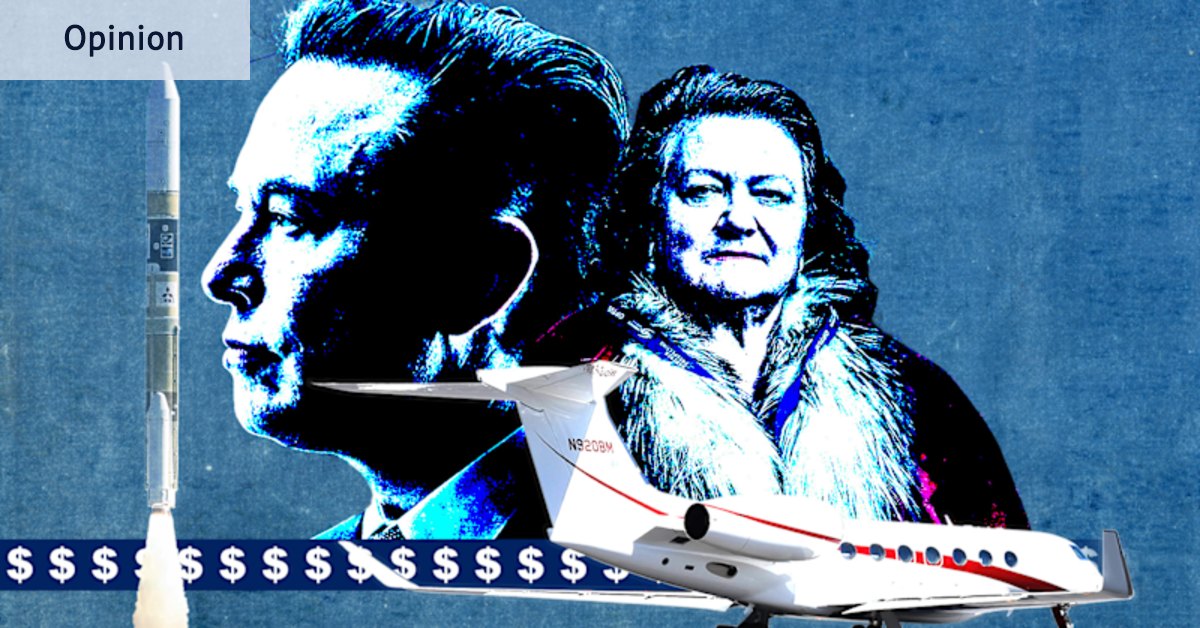
Pauline Hanson has been somewhat slow, or forgetful, in declaring the flights she has taken in the private jet belonging to Australia’s richest woman, billionaire Gina Rinehart.
In February, when Hanson was asked by reporters if she had received any free Gina-funded flights to travel to an event in Geelong, she said she couldn’t remember. That afternoon, her memory sparked, she updated her register of interests to include a Melbourne-Sydney flight on Rinehart’s dime. (Several other flights gifted by the billionaire have been declared outside the Senate’s 35-day period for disclosures.)
When asked about the free flights, Hanson tetchily points out that she is taking pressure off the taxpayer by having her flights paid for privately. It must require a high tolerance for cognitive dissonance – to found a movement on taking the fight to the elites, while simultaneously taking flights from elites. But like all populist movements, One Nation needs to stay within calling distance of wealthy donors.
The Trump administration has woven billionaire donors and backers into the fabric of its administration like never before in history.
The major donor to Reform UK, the Nigel Farage vanity-vehicle that Hanson hopes to emulate, is Christopher Harborne, a Thailand-based British billionaire and cryptocurrency investor. Farage has promised that his party would turn the UK into a cryptocurrency hub, slashing capital gains tax on it. Harborne says he has not asked for anything in return for his donations.
Suddenly, the world seems to be teeming with the ultra-rich, from those who project wealth on social media, to the tech-bro billionaires who actually make wealth through social media, to the brief-but-catastrophic intrusion of Elon Musk, the world’s richest man, into the US government. And then there is, in popular culture, television shows like Succession and the new JFK Junior/Carolyn Bessette-veneration vehicle, Love Story, which throws fame on the bonfire of family money.
But it is the shudder- and rage-inducing Epstein files that offer the best possible (by which I mean the bleakest possible) illustration of the moral hazard of extreme wealth. Priapic cruelty and wealth-enabled predation were not just features of Epstein’s lifestyle, they were its defining traits.
All the people, chiefly powerful men, named in the Epstein files were drawn into his web through a system of grace-and-favour that was fundamentally transactional. Epstein offered the trappings and ineffable glamour of extreme wealth. He offered houses, rich dinners, entry into exclusive private schools and colleges, trips to his private island, yachts, luxury stays in houses abroad, and access to other powerful people. In return, he required their silence, or, as it is better termed in the world of the ultrawealthy, discretion. It was granted.
The idea that the people who visited his house or partied on his island walked away unaware of the fundamental exploitative cruelty of his lifestyle (let alone its illegality), is thoroughly implausible.
Of course, not all the ultra-wealthy are paedophile pals or brats. In fact, scratch a little deeper, and you might end up feeling sorry for the private-jet set.
Recently, New York Magazine ran a fascinating feature about the seriously-monied, entitled “What does extreme wealth do to the brain?” The question has special potency in the United States, where the number of billionaires has tripled since 2010.
Its author interviewed high-net-worth individuals about how their mindsets were changed by their money. As you would expect, there is a divergence between people who made their own money, and those who inherited it (the “lucky sperm club”, as per self-made billionaire Warren Buffett).
The latter are more likely to struggle with feelings of low self-worth and a lack of internal drive that has them drifting between jobs.
The self-made centimillionaires and billionaires are confident they could make all the money again if they lost it. And they are paranoid about losing it.
In 2011 Australian rich-lister Gerry Harvey told The Australian Financial Review he has a deep terror of losing his money and having to rely on handouts like his parents did (his dad lost all his money and both parents ended up on the pension).
He also was terrified his wife would leave him. “My secret fear is that [my wife] will leave me when I get really old,” he told the Financial Review. “When I’ve got dementia, and I’m dribbling, she’ll put me in a home and the kids will say: ‘We don’t have to visit him again, do we?’”
The super-wealthy who spoke to New York Magazine highlighted the isolation their money can bring; how it cuts them off from us “normies”, who cannot sympathise with their problems.
If you do continue to hang out with normal (or less rich) people, there is the restaurant bill problem – when it is set down on the table after a meal with friends of lesser means, should you split it, or pay it? If you pay, your pals might think you’re trying to be a big shot, but if you don’t, you might look cheap.
If you’re a sensitive person who doesn’t want other people to feel indebted to you, you start to worry that your friends only hang out with you because you pay. In the case of many ultra-wealthy, this must be often true.
The comfort that wealth brings also serves to cut you off from others.
“When you get a bigger house, your neighbours are further away. In a nice hotel, the people that service you are going to be more polite and less personal,” said one European entrepreneur. “And you don’t meet anyone in a private jet.”
The wealthy also discussed the problem of hedonic adaptation – where the fancy purchases and experiences that once gave you pleasure lose their allure on repetition.
In 2011, Boston College’s Centre on Wealth and Philanthropy released a study of the super-rich (quaintly, back then, that meant anyone with $25 million or more). The survey respondents worried their children would become brats, but struggled to impose any normal values on them.
“We try to get our kids to do chores,” one survey respondent said. But it was hard to get them to mow the lawn when “we have an almost full-time gardener”. (Another study, the longitudinal multi-generational Harvard study, found that being made to do chores as a kid strongly correlated with success in adulthood).
Robert A. Kenny, a psychologist who helped design the study, ended up feeling quite sorry for some of its respondents, who, he said, were just as likely as the rest of us to be good people searching for meaning.
Speaking to The Atlantic about the study, he said that “sometimes I think that the only people in this country who worry more about money than the poor are the very wealthy”.
Kenny’s observations of the super-wealthy forced him to conclude that wealth “isn’t always worthy of envy” and was not worth sacrificing your life to attain.
Along with the moral hazard of ultra-wealth, comes the moral hazard of envying or resenting ultra-wealth, which, ironically, is the basic instinct that energises the populist parties that seem to love billionaires so much.
It’s worth reminding ourselves of that, even as we suffer in cattle class and take our budget holidays, safe in the knowledge that, happily, no one loves us for our money.
Jacqueline Maley is an author and columnist.
Start the day with a summary of the day’s most important and interesting stories, analysis and insights. Sign up for our Morning Edition newsletter.
