








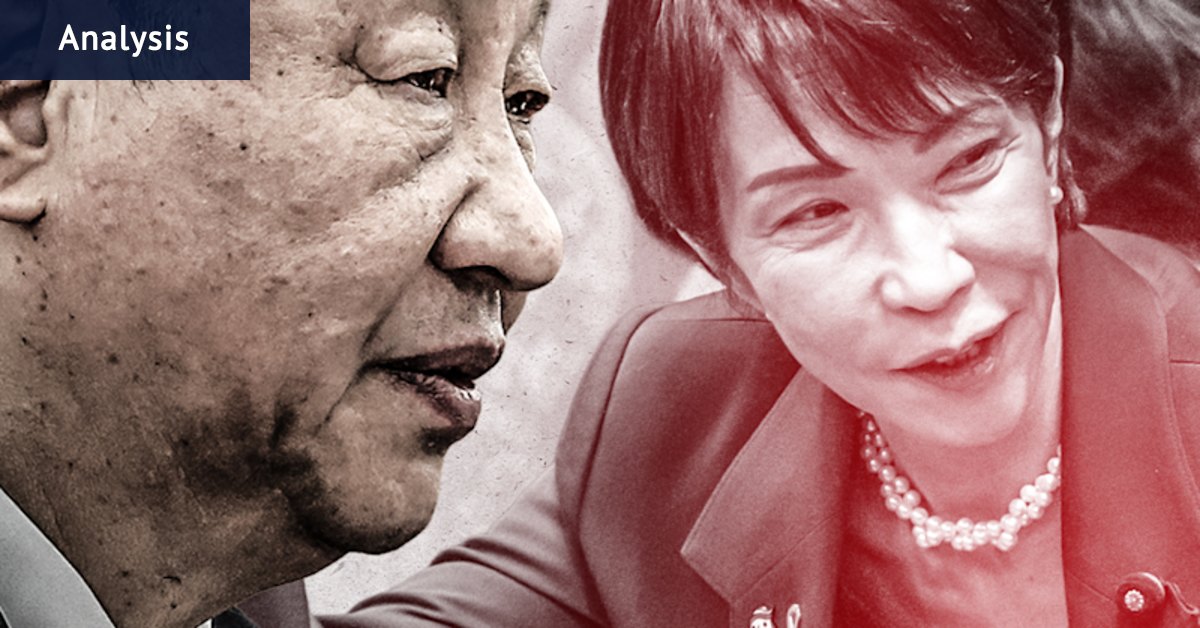

To an extent, it has worked. Takaichi hasn’t withdrawn her comments, but nor has she found much high-level international support – an early lesson for the new prime minister that few countries have any appetite for wading into the minefield of Taiwan’s future, particularly in defence of comments some will judge as incautious at best.
It wasn’t until Beijing went stratospheric with its fury and flexed its military coercion in the skies over the Sea of Japan in the past week that Australia, and then the United States, swung in with a show of support, albeit hardly a full-throated one.
US strategic bombers flew alongside Japanese fighter jets on Wednesday – a message clearly directed at Beijing, a day after Chinese and Russian jets conducted joint military drills near Japan’s southern islands.
A few days earlier, Japan accused Chinese fighter jets of aiming their radars at its military planes. Beijing has blasted Tokyo’s version of events as “false”.
Defence Minister Richard Marles made clear whose account he believed when, during a press conference with his Japanese counterpart, Shinjiro Koizumi, on Sunday, he said Australia was “deeply concerned” by China’s actions.
Loading
It was not tenable for Marles to say nothing, and not only because he was coincidentally in Tokyo when the radar incident occurred, but because Australia, too, has repeatedly complained about unsafe encounters with the People’s Liberation Army in international airspace and waters.
But he steered clear of weighing in on the economic pressure Beijing has been piling on Tokyo. Over the past month, China has weaponised its powerful tourism dollar by warning its citizens to avoid travel to Japan, and its airlines have cancelled some 2000 flights to the country. It has banned imports of Japanese seafood, halted the release of Japanese films, cancelled concerts by Japanese artists, increased its military patrols, and marshalled its diplomatic and state media apparatus to lambast Takaichi on a near-daily basis.
It took until Tuesday for the US, through a State Department spokesperson, to denounce the radar incident as “not conducive to regional peace and stability”, after reports leaked into American media that Japanese officials were aghast at the silence of their key ally, whose military bases are dotted across Japan’s islands.
In Australia, similar concerns were aired by former Japanese ambassador to Australia Shingo Yamagami, a confidant of Takaichi’s. When Australia faced Beijing’s economic wrath in the form of $20 billion in trade sanctions from 2020, “Japan stated out loud that Australia was not walking alone”, he wrote in The Australian earlier this month.
Loading
In putting Tokyo in its crosshairs, Beijing has tapped a deep vein of anti-Japan nationalism in China, which it has stoked all year as it has commemorated the 80th anniversary of the end of World War II, or what it calls “the Chinese People’s War of Resistance Against Japanese Aggression”.
In doing so, it has probably had some success in redirecting anger among its citizens over China’s flagging domestic economy, which has been in the doldrums for years, squeezing households.
But it has also reminded the world of China’s temper, undercutting leader Xi Jinping’s efforts this year to remake its image as a stable, measured superpower compared to US President Donald Trump’s chaotic, capricious America.
“China the scary dragon, not China the huggable panda,” as Sung from the Atlantic Council puts it.
It has also seemingly bolstered Takaichi’s domestic political stocks with a rally-around-the-flag effect. Her approval ratings for November soared past 64 per cent, according to polling by Japan’s top media organisations – a stark reversal of the dismal public support for her male predecessors.
For a hawkish leader looking to convince her wary nation of the need to revise its postwar pacifist constitution and ramp up its military spending, Beijing might just be handing her the script.
Get a note directly from our foreign correspondents on what’s making headlines around the world. Sign up for our weekly What in the World newsletter.


