


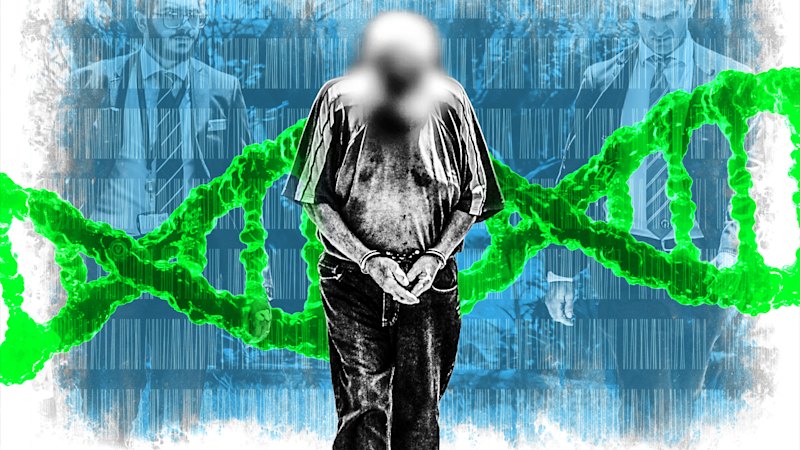

Robert Wayne Kwan’s thumbs, forced together by handcuffs, twiddled in fits as detectives marched him down the long curve of a grassy driveway towards waiting police cars in South Kempsey, north of Port Macquarie, on Wednesday.
The alleged child rapist, 77, has been charged over a raft of historical sex crimes spanning more than a decade, from the targeting of an 11-year-old girl in Sydney’s west in 1991 to the sexual assault of a 26-year-old woman at Devil’s Hole Reserve near Dubbo in 2002.
His arrest is the latest chapter in the story of a technology that has jailed fabled serial killers, set those wrongfully convicted of murder free and granted anonymous bones the dignity of personhood.
The investigative tool, called Forensic Investigative Genetic Genealogy (FIGG), relies on people who have spat in a tube for commercial DNA tests choosing to dismiss privacy concerns and make their data available to investigators.
They become “genetic informants”, helping police build sprawling family trees that lead them to alleged perpetrators such as Kwan. His was the first arrest in NSW made using the technology.
Here’s how it works. Traditional genetic profiling targets sections of human DNA where sequences of the four base letters – A, C, G and T – always repeat. Everyone, for example, has a repeating sequence of “AGAT” on their third chromosome. But the number of times that sequence repeats varies between people, acting as a kind of genetic “fingerprint”.
Standard DNA testing focuses on about 20 of these sequences – called short tandem repeats, or STRs – and the pattern of those repeats can match a suspect’s DNA to a drop of blood at a crime scene.
A problem arises, however, when investigators don’t have a reference sample of DNA. Police held DNA samples from Kwan’s alleged crimes, for example, but had nothing to match them to.
That’s where FIGG comes in. Instead of zeroing in on a handful of STRs, the test picks up a different kind of DNA variation called single nucleotide polymorphisms, or SNPs (pronounced “snips”). These are single-letter differences at specific points across our DNA – where you might have an A, someone else has a G – and we can detect over a million of them using specialised sequencing technology.
The key advantage for detectives is that this DNA map of more than a million SNPs is sensitive enough to identify someone’s very distant relatives – their third or fourth cousins, for example. (Think about that – do you even know who your fourth cousins are?) Finding family can help tie anonymous DNA to an actual person.
To do that, investigators match up the DNA profile of a perpetrator or victim to distant relatives using online genealogy databases, made up of people who have used commercial ancestry tests and consented to law enforcement using their data. The databases have about 1 million to 2 million genetic profiles. That’s exponentially larger than DNA databases owned by law enforcement.
Once police find a relative, they turn to investigative genealogy – part genetic analysis, part family history sleuthing – to build a family tree linking the owner of the DNA and their distant relatives in the database.
Experts trawl back through the generations to find the last direct ancestors shared by the person of interest and their identified relatives, narrowing the search to a specific branch of the family tree. The process might take days or, in some cases, years. It’s how detectives can now find the owner of an unknown bone or semen sample.
This is how FIGG caught Kwan. An SNP profile was made using DNA gathered after his alleged crimes more than two decades ago. That profile matched a relative in the genealogy databases. Then police used what they knew about Kwan’s sex, age and location to prune the branches of the family tree until he was the only person left as a suspect.
This process famously busted the Golden State Killer, unveiling the serial murderer in 2018 as former California police officer Joseph James DeAngelo Jr. As put by human identification specialist Dr Jodie Ward, FIGG turns decades-old cases from cold to solvable.
FIGG has solved cold cases and tragic mysteries across Australia too.
Take the example of the “woman in the wall”. Her decade-old remains were discovered in 2022 by cleaners behind a wall in a Brisbane unit complex. She left a glass eye, prescription glasses, and size 10 clothes. But there was no DNA match in the police database and no linked missing persons report.
Using FIGG, police and forensic experts, including Ward, identified the remains as those of 38-year-old woman Tanya Glover. A woman was arrested over Glover’s death last year.
“What price can you put on restoring someone’s identity?” Ward, a DNA forensics expert, said. “You are providing answers to families, you are providing the deceased with a dignified burial, you are keeping the community safe because criminal investigations can ensue.
“At the moment, DNA testing is only offered by law enforcement or government forensic labs in Australia and not everyone can access those technologies, unfortunately.”
The process is expensive – about $10,000 compared to routine DNA testing which might cost $100, she said. That’s why, in 2024, Ward founded the Forensic Human Identification Co., a social enterprise which provides the only independent end-to-end FIGG service in Australia.
Through the enterprise, Ward aims to help families find missing loved ones, exonerate those wrongfully convicted of crimes, advance cases of disappeared First Nations people, and use techniques borrowed from the study of ancient DNA to identify forgotten and degraded remains.
“Our goal is to make sure that it’s not just agencies with deep pockets that can access this technology, because we want to see every unknown deceased person given the opportunity to be identified,” she said.
Following Kwan’s arrest, police have called for people to consider uploading their DNA profiles to databases investigators can use for FIGG, including GEDmatch PRO and FamilyTreeDNA.
People can choose to upload their genetic information to those databases after using a commercial service like 23andMe or AncestryDNA, which police cannot generally access. About 5-10 per cent of the profiles on the databases are believed to be Australian.
There were privacy issues when FIGG first came to prominence. Some genealogy services automatically opted users in to have their data used by police. A lack of transparency meant some of the “genetic informants” used to catch the Golden State Killer did so unwittingly – they uploaded data to track down relatives and ended up identifying a murderer. Since then, most databases have switched to a more transparent opt-in system, although in Germany, FIGG remains largely banned due to privacy concerns.
Any DNA data uploaded to GEDmatch PRO is opted in to identify human remains, but users must opt in manually for their data to be used to find the perpetrators of violent crimes.
“FIGG is only used for homicides, sexual assaults or unidentified human remains,” Detective Superintendent Jayne Doherty, Sex Crimes Squad Commander at NSW Police, said after Kwan’s arrest.
“People thinking about opting in – you could be helping us to solve those serious problems.”
Examine, a free weekly newsletter covering science with a sceptical, evidence-based eye, is sent every Tuesday. You’re reading an excerpt – sign up to get the whole newsletter in your inbox.
 Angus Dalton is the science reporter for The Sydney Morning Herald.Connect via X or email.