








One of the design strategies was to create an attached wing along the home’s eastern boundary that not only loosely references other additions in the street but also provides the more utilitarian functions – including an electric bike storage area at the front, a laundry and, as is typical for many houses built in the 1950s, a shed for pottering.


The kitchen shows a sense of restraint and consideration, with its bagged brick walls, timber joinery and stone benches.Credit:
However, unlike the original floor plan, SSdH’s design includes a contemporary open-plan kitchen, dining and living area pavilion, with a courtyard-style garden on one side and the north-facing back garden on the other.
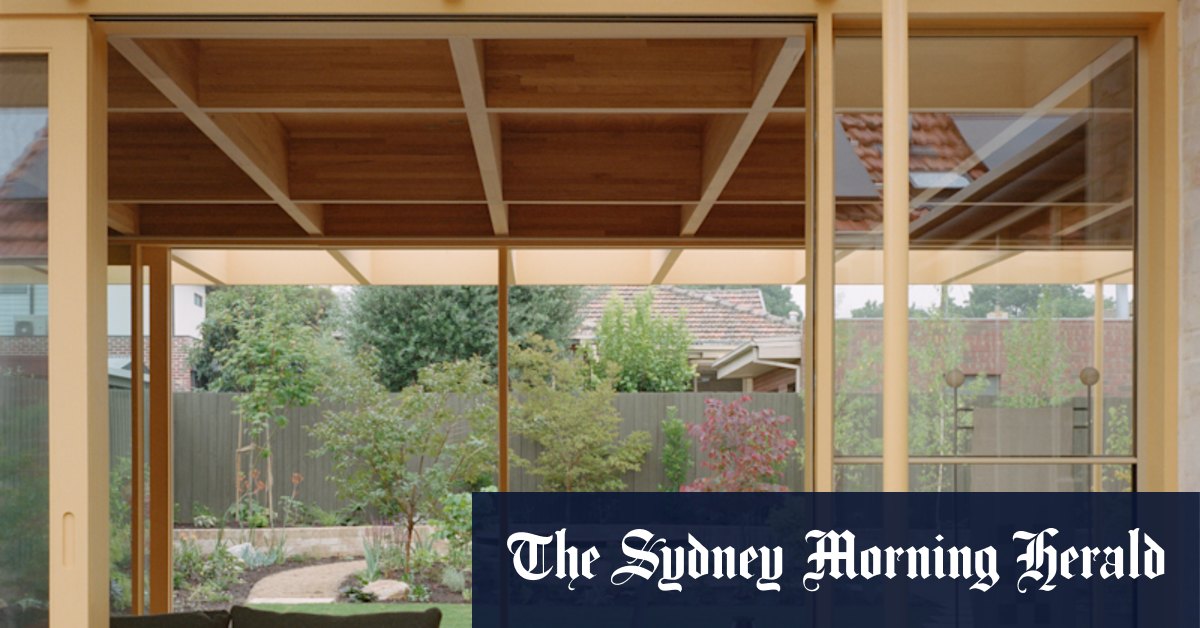
When the large sliding doors on both sides of this pavilion are retracted, there’s a strong sense of being outdoors yet protected. “We wanted to use materials as honestly as possible and keep things, in the spirit of the original home, fairly simple,” says Smart, pointing out the fine creamy-yellow painted steel pole and timber painted windows that also delivered the practice a Dulux award.
While the design could be said to be “simple”, there’s also a level of complexity in the design. A chunky timber-offered ceiling in the new wing extends to the painted timber pergola, also in a pale yellow, lengthening the sight lines and drawing one’s eye into the garden, created by McNuttndorff Landscapes.
A similar sense of restraint and consideration was given to the kitchen, with its bagged brick walls, timber joinery and stone benches.

Used for storing coats, keys and umbrellas, the green cupboard also comes with a built-in seat for putting on shoes.Credit:
However, with this restrained design there’s also a level of detail, including the sunken home office adjacent to the new wing, conceived to be aligned to the height of the planting in the courtyard. There’s also quite an unusual organic shaped cupboard in the new foyer, made from timber and painted green. Used for storing coats, keys and umbrellas, it also comes with a built-in seat for putting on shoes.
“We were conscious of not just how things were going to be made but also the way the spaces were going to be used,” says Smart, who stills sees the home as being relatively modest in scale, originally being 100 square metres to about 200 square metres now.
“We also wanted to show that even with a simple heritage house you can still move forward but, at the same time, ensure the streetscape is preserved.”


