


Andrew Conway
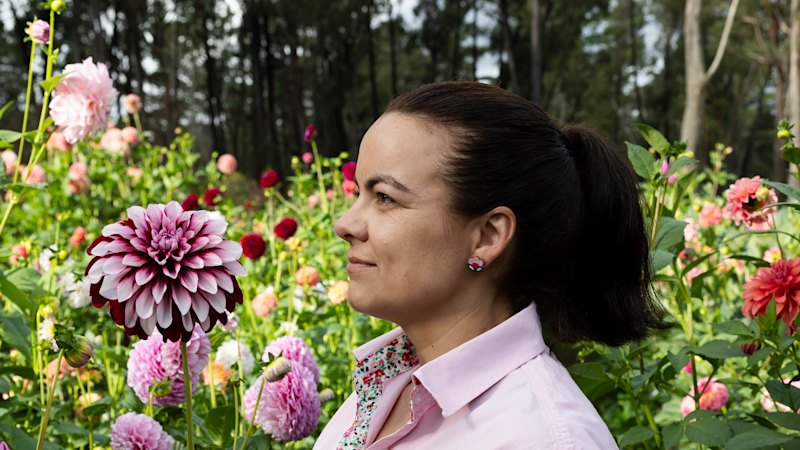
There’s more than a touch of a steel magnolia about Jen Foster. Having traded a high-flying corporate tech job in 2019 for the more earthly clods and clippers of cut flower farming, she knows only too well the muscle-aching work and wild unpredictability of horticultural life.
The daily to-do list of jobs at her NSW Southern Highlands Flower Farm – and home – at Penrose, a small village near Bundanoon, is an ever-changing, dawn-to-dusk, boots-and-all passion project, leading her down a garden path of perennial multitasking.
“It’s an obsession, 100 per cent,” she says of the two-hectare property that produces more than 50,000 plants and 1000-plus varieties of dahlias, peonies, ranunculus, chrysanthemums and anemones, among other glorious blooms, each year, and also supports a thriving agritourism business.
It’s a similar seed-to-success story at Fleurs de Lyonville, a micro-farm at Lyonville, in the picturesque Daylesford and Macedon Ranges region northwest of Melbourne, where Janae Paquin-Bowden and her husband, Chris, cultivate more than 50 varieties of seasonal flowers, cottage blooms and native Australian wildflowers to sell to local, regional and city markets and florists.
Inspired by the grower who supplied flowers for her 2014 wedding, Paquin-Bowden began planting and selling her own flowers to local buyers, initially in bunches, then by the bucketload. Two years later, during maternity leave from teaching, she launched the flower farm that later grew to the point where Chris could leave his assistant school principal job and join the business.
Foster and Paquin-Bowden, aged 46 and 43, respectively, are among a rapidly growing number of women working in Australia’s burgeoning floriculture industry. It’s an often joyful trade but also tough, labour-intensive work they manage with the age-old challenges of juggling children and home commitments.
As all primary producers are acutely aware, Mother Nature – the greatest female farmer of all – isn’t always a benevolent force. The threat of bushfires, hailstorms, floods, drought, frosts and pests can wipe out entire – expensive – crops overnight.
Increasingly erratic weather patterns trigger seasonal blooms to peak too early or too late. Wastage of perishable stems, fluctuations in the national economy and changes in consumer flower tastes add to growers’ stress levels.
“This is not hobby-farming,” Foster says. “It’s a full-time, year-round business operation that can be really hard work, physically, mentally and emotionally, especially in peak season. You just have to be flexible and be prepared to roll with the challenges.”
Accurate and reliable data about the size and value of Australia’s cut flower industry is hard to source. The Australian Horticulture Statistics Handbook, published in 2024 by not-for-profit research and development corporation Hort Innovation, put annual production value at $289 million and supply wholesale value at $404 million (with a caveat about inconsistencies in measurements).
‘Women are traditionally the recipients of flowers, this gives them an informed insight to market preferences.’
Jess Eckford-Aguilera, founder of The Flower Summit: Women Who Bloom
Various other reports quote its annual retail value at about $800 million. Victoria, Western Australia and NSW are the three largest cut flower producers, with hundreds of large-scale commercial and family-run micro-farms, many of which are now run by women.
According to some industry insiders, women will soon outnumber men in what has always been a male-dominated field. They expect women will do this across multiple sectors: growers, suppliers, retailers, florists, floral designers, educators and industry leaders.
“I am in awe of female flower growers,” says Jess Eckford-Aguilera, a 25-year veteran of the floriculture industry, herself a floral designer, educator and the owner of Newcastle Food & Flower Markets and Botanicals Flower Tours.
“The way they nurture their florals to get that beautiful end result for the consumer, often in very challenging conditions, is incredible to watch. If it wasn’t for them, I wouldn’t have a business.”
Eckford-Aguilera is founder of “The Flower Summit: Women Who Bloom”, a two-day industry event in Newcastle in November featuring international guest speakers, panel discussions, masterclasses and networking opportunities.
With consumer demand on the rise for locally grown Australian wildflowers such as waratah, banksia and flannel flowers, many farmers are planting native varieties in greater numbers. Anthea Henningsen, a South Australia-based florist, grower and board member of leading industry association WildFlowers Australia, is a standard-bearer.
“Female flower growers play an incredibly important part in the industry because they generally have great attention to detail,” she says. “As women are traditionally the recipients of flowers, this gives them an informed insight to market preferences. The nature of flower-growing production is also seasonal, providing flexibility to many family lifestyles.”
Foster and Paquin-Bowden have both diversified their businesses over time from traditional plant-harvest-sell models into agritourism, offering farm experiences, workshops and even “floral therapy” to widen their income streams beyond flower markets, florists and weddings.
“It’s still a very small industry, but it’s changing for women,” Foster says. “There are a lot more opportunities out there now and there’s room for all of us.”
Andrew Conway is a freelance journalist.
Start the day with a summary of the day’s most important and interesting stories, analysis and insights. Sign up for our Morning Edition newsletter.
