


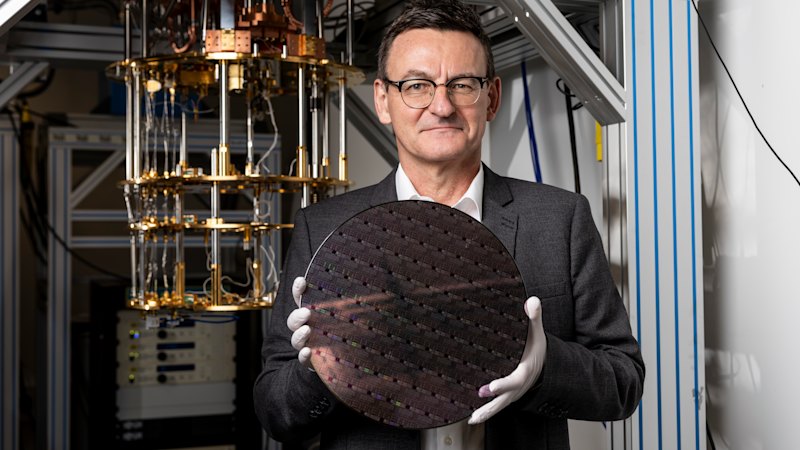

Australian taxpayers are putting $20 million into a Sydney start-up’s quest to build a new generation of computer using nascent quantum technology, with the federal government’s National Reconstruction Fund Corporation taking a major stake in the firm called Diraq.
Quantum technology advocates hope it will provide machines many times faster than traditional computers, which could be vital in areas from medicine to AI, and Diraq says it is on track to have a commercial computer on the market in 2029.
But the investment pales in comparison to the nearly $1 billion the federal and Queensland governments have committed to PsiQuantum, a US-based company co-founded by Australian scientists, which has pledged to build the world’s first “useful” quantum computer in Brisbane by 2027.
Diraq founder Andrew Dzurack said he was friendly with PsiQuantum co-founder Jeremy O’Brien and that there was room for both companies to succeed, but that Diraq’s method — using standard chip-making facilities to produce quantum chips with millions of qubits each — would result in smaller, cheaper and easier to scale computers.
“We are looking to have many Diraq quantum computers inside a single data centre. In contrast, most of our competitors are building systems that are physically large and very power hungry,” he said.
“The thing [PsiQuantum] is building in Brisbane is nearly the size of a football field, consuming many megawatts of energy. We’re looking at building systems that are a fraction of the size, a fraction of the cost and a fraction of the energy usage.”
The reconstruction fund joins investors in Diraq including several super funds, CSIRO’s Main Sequence, and the University of New South Wales, from which Diraq launched in 2022. Reconstruction fund chief executive David Gall said Australia could be a world leader in quantum computing, and that it was important that the commercial benefits be retained in Australia.
“It’s fantastic to have world-leading universities [making these breakthroughs in Australia]. But we also want to capture the financial benefits, and the whole ecosystem benefits, of the commercialisation phase as well,” he said.
“And if you think about some of the cybersecurity benefits associated with quantum, certainly having that capability here in Australia, owned by Australian businesses, is important.”
A quantum industry source, who spoke on condition of anonymity, said that Dzurack was widely respected in the fractious sector. But they were concerned that the company had started late, needed massive sums of money to catch up, and could struggle to grow relative to its competitors.
“Their approach is quite sound technically but they’ve got a long way to go,” the source said. “Heat dissipation is going to be a real challenge for them … and the procurement of the silicon that they need.”
Dzurack said that keeping temperatures low was an industry-wide engineering challenge, but cited Diraq’s inclusion among 11 companies in progressing through the US government’s Quantum Benchmarking Initiative as a vote of confidence that its own solution was effective. He said Diraq had access to many suppliers of isotope-enriched silicon, and rejected the idea it had started late: the technology was being developed from 2014 at UNSW, before Diraq launched in 2022.
“It’s not so much where we are and where [other companies] are now, it’s how rapidly you can scale. And our technology is natively designed to scale incredibly rapidly because the basic technology of making these quantum bits is proven chip manufacturing technology.”
Get news and reviews on technology, gadgets and gaming in our Technology newsletter every Friday. Sign up here.

