



In the final game of this year’s Six Nations Championship, with the clock in the red, France five-eighth Thomas Ramos lined up a long-range penalty not only to win the match, against England, but also to clinch his country’s second successive title.
Despite the impossible tension of the moment, Ramos laughed with the confidence of a man who kicks at a success rate of over 84 per cent – before calmly slotting the ball between the posts.
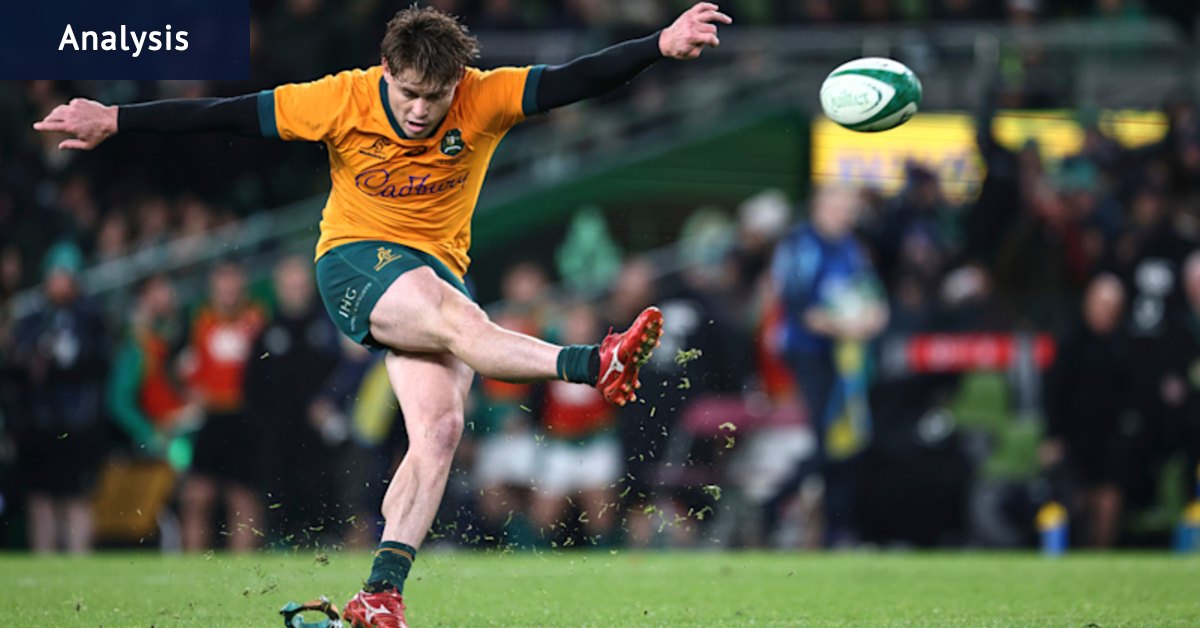
Wallabies coach Joe Schmidt could only watch on in envy. Australia have long lacked a truly reliable place kicker, and Wallabies great Matt Burke believes it has become something of a forgotten art Down Under.
The former five-eighth said rediscovering reliability from the tee is paramount if the Wallabies are to maximise their chances at next year’s World Cup. “If you can get a kicker running at 75 per cent or better, it gives you great comfort,” Burke said. “It’s a bit like Moneyball – you must take the points on offer, especially in Test rugby.”
Gordon without the kicking tee
Carter Gordon’s early-season Super Rugby form for the Reds underlined his credentials as a Wallabies five-eighth. Gordon provides physicality in defence, a long-range passing game to open the opposition defence and a dangerous running game. The glaring issue is that he is still not place-kicking.
On the Wallabies’ November tour, his try-scoring comeback against Italy was blighted by a quad injury that kept him off goal-kicking duties, with Andrew Kellaway stepping up in his absence. Kellaway’s two conversions against Italy were his first in professional rugby, and it highlighted the absence of a place-kicking pipeline for the Wallabies.
Injury has restricted Gordon to just three Super Rugby games this season, with kicking duties left to Benetton-bound halfback Louis Werchon and veteran fullback Jock Campbell in his absence.
But the skill has never been a reliable part of his armoury. In the 2024 Super Rugby season, his last before a spell with Gold Coast in the NRL, he slotted just 69.4 per cent of his goal attempts. Burke believes goalkicking is something Gordon needs to own.
“As a complete player, he needs to kick the ball,” Burke said. “He hits it well, he’s shown that [in the past], but he’s the kind of player who needs to own that responsibility … there are 14 other players who could take a place kick, but there’s also 14 who don’t want it and at Test level, you’ve got to want to be the one standing there wanting to own that responsibility.”
A thin pipeline to the top
In the Wallabies’ 1999 World Cup winning team, Burke was a world-class kicker, with captain John Eales also able to take game-deciding penalties. The kicking depth in the side freed up Stephen Larkham to concentrate on the playmaking role. Today, the kicking depth at Test level is a lot shallower.
An alternative to Gordon is Ben Donaldson, who was left out of the Wallabies’ spring tour of Europe after last playing in the third Lions Test. Donaldson was told to work on his defence by Schmidt, and he has missed just 0.8 tackles per game in Super Rugby this season.
Donaldson is by far the best Australian place kicker in Super Rugby, boasting an impressive 88 per cent record from 30 attempts at goal.
Donaldson kicked five out of his five attempts at goal for the Wallabies last season. He has also created three try assists in five games in Super Rugby.
“Your best goal kicker is nearly one of the first chosen in your team,” Burke said. “Donaldson, in his own right, can play well, and he’s obviously got some skill. If it means getting him on the park to kick your goals and turn your fives into sevens or kick your threes, then you find him a spot.”
By contrast, the Australian player with the next most attempts at goal (30), Brumbies halfback Ryan Lonergan, is struggling – kicking at just 66.7 per cent.
Lonergan was given his long-awaited Test debut last year in the first Bledisloe Cup match against New Zealand at Eden Park. His leadership ability and skill as a halfback will likely place him in a Wallabies match-day squad come the first Test against Ireland in July, but, on current form, it won’t be for his goalkicking.
After playing four Tests last November, starting in two, former NSW playemaker Tane Edmed’s move to the Brumbies to work under Larkham looked a sound one.
But it remains a work in progress. In six games for the Brumbies this season, Edmed has been selected to start just once, with in-form Declan Meredith preferred. Notably, Meredith hasn’t taken a single place kick this season, having booted just 37 points for the Brumbies last year.
Lynagh’s return and the emergence of Sid Harvey
Six Wallabies shared the kicking tee last year: Donaldson, Edmed, Kellay, Noah Lolesio, Tom Lynagh and James O’Connor.
O’Connor is currently in Leicester, where he recently won the Premiership Cup against Exeter. The veteran playmaker kicked at 73.9 per cent for the Wallabies last season. In an interview with this masthead, O’Connor said he hasn’t given up on a Wallabies recall, but it remains to be seen whether Schmidt feels the same way.
Lynagh makes his long-awaited return from injury against the Hurricanes on Saturday, playing 18 minutes as a replacement, but long-term, he faces a challenge in Brisbane, given Gordon’s preference to play five-eighth rather than inside centre.
There are also some untested options. Joseph-Aukuso Suaalii has not been used once as a place kicker at the Waratahs, but can step up once recovered from his injury, while Force recruit Zac Lomax was a dependable kicker in the NRL.
In the Waratahs’ loss against the Blues in Sydney a fortnight ago, young utility back Sid Harvey kicked four out of four shots at goal before helping guide his team to victory against the Brumbies in Canberra last Friday with three nerveless late penalties.
Harvey is only 20 years old and his professional rugby career is still in its infancy, but his kicking abilities and assured all-around game could potentially catapult him into an extended Wallabies squad sooner rather than later.
The audition for a reliable and regular goal kicker in Australian rugby continues. Ahead of a World Cup where the margins are so often razor-thin, it will be more essential than ever.
