







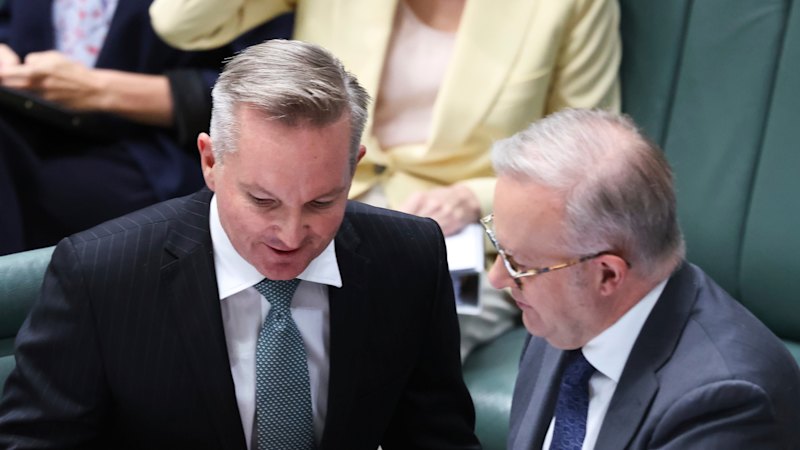


Energy Minister Chris Bowen has moved to assure Australians that fuel will keep flowing into the country for a month, but fears of a shortage within weeks has prompted importers to look to Africa and the US for new sources of supply.
As the opposition warned of an Easter crunch for fuel supply, the Albanese government on Tuesday did not rule out the prospect of rationing fuel as it seeks to bring spiralling demand in line with supply, though it said it was not intending to enact emergency measures.
Days of panic-buying has caused some service stations to run dry, mostly in regional areas. Supply remains solid yet there is rising anxiety that a prolonged Middle East conflict and shutdown of the strait of Hormuz, through which 20 per cent of global fuel passed, might force Asian refineries to cut supply to Australia.
After meeting with truckers, farmers and petrol bosses, Bowen said oil companies had told him they “fully expect all deliveries all through March and well into April”.
“But we are in an internationally uncertain time and that’s why we’re doing such planning at the moment,” he said. “Every ship that we have expected to arrive has arrived, whether it’s diesel, petrol or jet fuel.”
Three Australian industry sources, not willing to speak publicly about commercial decisions, said contracts for the first weeks of April were locked in before the US-Israel strikes on Iran and the theocracy’s missile barrage.
Since then, China, which supplies a third of Australia’s jet fuel imports, has clamped down on exports, while refineries in Singapore, another big supplier to Australia, have scaled back supply.
“So when minister Bowen says we are OK until some time in April, that masks the fact that things might get quite hairy from that time onwards,” one source said.
“People across the industry are looking at contingencies from places like West Africa and the Gulf Coast in the US.”
Wary of the consumer pain sparked by oil remaining above $100 a barrel, US President Donald Trump continued to put pressure on NATO allies to send forces to the Middle East to protect the Strait of Hormuz, adding that nations such as Japan, South Korea, and China “should be thanking me” for trying to reopen the waterway.
Trump said he would “soon” announce countries that have agreed to help the US reopen the strait. Nations including the UK and Germany have declined his request; Australia has said it would not send a ship to the region, although it has not received a formal request to do so.
Trump was vague when asked if the war could end this week: “I don’t think so. But it’ll be soon. Won’t be long. We’re gonna have a much safer world when it’s wrapped up. It’ll be wrapped up soon.”
The global energy watchdog is considering releasing more emergency oil stocks into the global market, warning on Tuesday that it would take time for markets to readjust once the conflict ended.
Defence Minister Richard Marles said on Tuesday morning that rationing fuel could not be ruled out.
“Obviously, this is a function of how long this conflict continues, and that’s not something that I can answer in terms of what’s going to happen,” he said. “But we are taking the measures that we’re taking right now, and it is a matter of people just going about their business normally and calmly.”
Coalition energy spokesman Dan Tehan said Australia was facing a supply crunch and argued Labor needed to enunciate its solutions.
“The biggest risk would seem to be what will happen to our fuel supply in April, beginning around Easter,” he said.
“The government has not ruled out rationing. The government needs to come clean as to whether future contracts are being cancelled and what they’re doing to help industry source fuels.”
The Reserve Bank raised the cash rate on Tuesday due to inflation that was already too high before the oil crisis, which has heightened inflation expectations.
Treasurer Jim Chalmers said suppliers and retailers were “hauled in” to a roundtable with regulators on Tuesday. He sent them a clear message that the Australian Competition and Consumer Commission, which the opposition has described as toothless, would punish brazen profiteering.
“Our message, once again, is very simple: suppliers and retailers must not treat motorists as mugs. They are on notice if they do the wrong thing, the ACCC will throw the book at them,” Chalmers said.
Cut through the noise of federal politics with news, views and expert analysis. Subscribers can sign up to our weekly Inside Politics newsletter.


