



Australian red meat exports to Europe are set to rise tenfold under a historic free trade pact that has been eight years in the making, while producers will be able to use names such as prosecco, feta and halloumi despite a longstanding European push to restrict the use of these so-called “geographic indicators”.
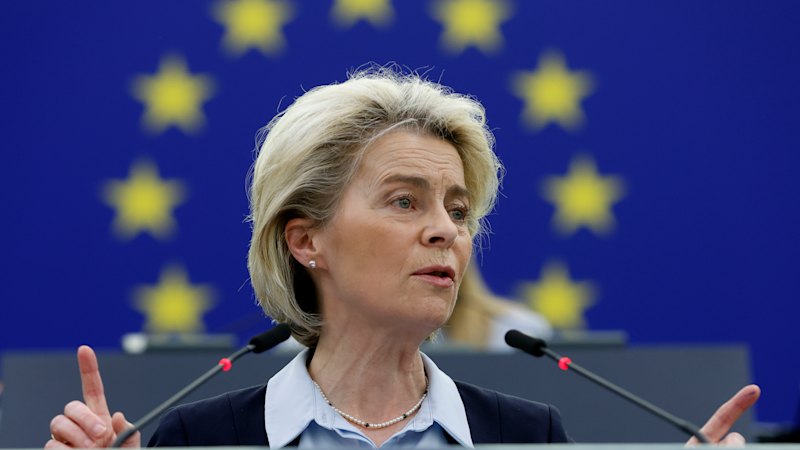
European Commission President Ursula von der Leyen will meet with Prime Minister Anthony Albanese on Tuesday to finalise the long-awaited Australia-EU free trade deal before becoming the first woman to address a joint sitting of the Australian parliament.
As well as the free trade pact, Australia and the EU are expected to strike a new defence and security partnership while securing access for Australian universities and companies to the world’s largest research and innovation program.
The biggest point of contention in the free trade negotiations has been Australian producers’ freedom to sell beef, lamb, sugar and cheese to Europe’s 450 million consumers without punishing tariffs and quotas.
Sources familiar with the negotiations said Australian exporters would now be able to sell between 30,000 and 35,000 tonnes of beef to Europe a year, up from the current annual quota of 3389 tonnes.
Meat and Livestock Australia has pushed for the quota to be lifted to at least 50,000 tonnes a year, a level fiercely resisted by the powerful European farming sector.
“This is a missed opportunity is the kindest way to say it,” a source in the agricultural sector said, speaking on condition of anonymity to discuss sensitive negotiations. “Industry will not be happy.”
Andrew McDonald, chair of the Australia-EU red meat market access taskforce, said last month: “It is not a good deal for Australia if the government agrees with the EU to continue punitive restrictions on Australian red meat.
“We are counting on Trade Minister Don Farrell and the government to maintain their resolve and secure an outcome our industry can support.”
Irish Farmers’ Association president Francie Gorman has said he fears Australian red meat will flood the Irish market, leaving his nation’s farmers as a “sacrificial lamb”.
The current 5 per cent tariff on goods imported from Europe to Australia – including cars – is expected to be axed in the deal, which former trade minister Craig Emerson has said could add an extra $10 billion a year to the Australian economy.
The luxury car tax, which disproportionately affects European brands such as BMW and Mercedes-Benz, is also expected to be axed.
Farrell met his European counterpart Maros Sefcovic in Sydney on Monday to finalise the details of the agreement, but this was largely a formality.
“All the big sticking points have been resolved,” a senior government source said.
Negotiations for an EU-Australia free trade pact began in 2018 and stalled in 2023 before being revived after Donald Trump’s return to the White House.
The European Union has moved to strike a series of new trade pacts since Trump imposed his sweeping “liberation day” tariffs on American imports last year.
The free trade deal with Australia follows recent breakthroughs in EU negotiations with Latin America and India, two of the world’s biggest markets.
Farrell has argued that the EU and Australia needed to seize an opportunity to show the world that free trade was preferable to Trump-style protectionism.
“Europe and Australia talk about the importance of the rules-based order, and we have to demonstrate to the world that free and fair trade is good for prosperity,” Farrell told this masthead last year.
This will be the second free trade agreement struck since the Albanese government came to power in 2022, following a pact made last year with the United Arab Emirates.
In a separate agreement to be announced on Tuesday, Australia will be put on a fast track to enter Horizon Europe, a $170 billion research and innovation program.
Gaining associate status will allow researchers at Australian universities and industry to apply for funding and lead research projects.
The move will be applauded by Australia’s biggest research universities, which have lobbied hard to gain access to the scheme.
The defence and security pact, which von der Leyen raised with Albanese at the inauguration of Pope Leo XIV last year, could see Australia and the EU conduct joint naval exercises and work closer together on defence procurement.
Cut through the noise of federal politics with news, views and expert analysis. Subscribers can sign up to our weekly Inside Politics newsletter.
 Matthew Knott is the foreign affairs and national security correspondent for The Sydney Morning Herald and The Age.Connect via X, Facebook or email.