







“It was made a while ago and nobody did anything about it,” Trump told this masthead. “It was going too slowly. We do actually have a lot of submarines, we have the best submarines anywhere in the world.”


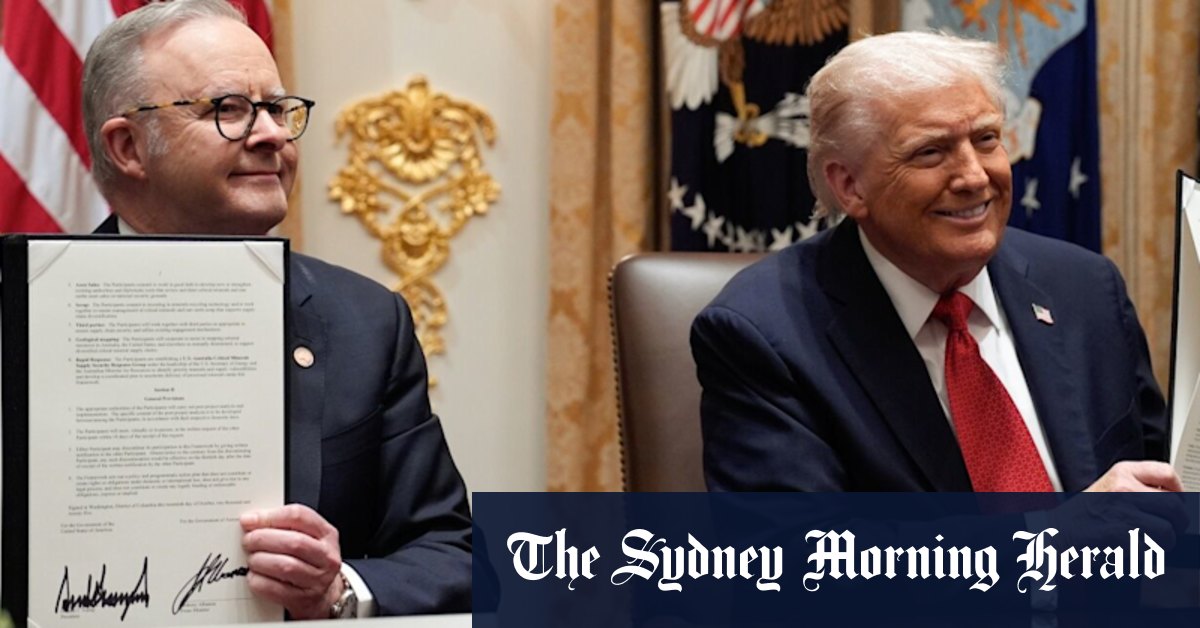
Anthony Albanese received a warm welcome from Donald Trump at the White House.Credit: Bloomberg
“We’re building a few more, currently under construction, and now we have it all set. With Anthony [Albanese], we’ve worked on this long and hard. We’re starting that process right now. I think it’s really moving along very rapidly, very well.”
Asked to guarantee Australia would get the boats – due in the 2030s – despite the lagging rate of production, Trump said: “Oh, they’re getting them.”
US Navy Secretary John Phelan was one of half a dozen senior US officials to join the meeting, along with Vice President J.D. Vance, Secretary of State Marco Rubio and War Secretary Pete Hegseth. Phelan said US submarine production was “getting better” but hinted at ambiguities in the deal to be sorted out.
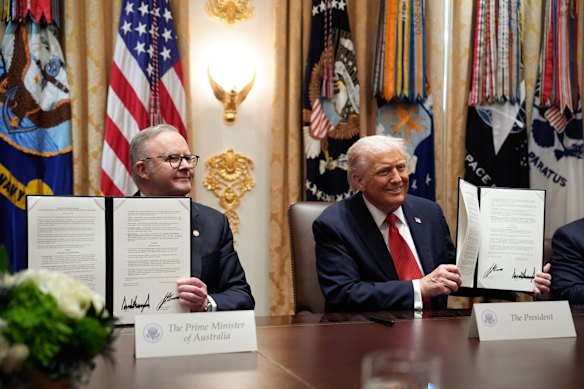
Albanese and Trump sign the rare earths deal.Credit: Bloomberg
“What we’re really trying to do is take the original AUKUS framework and improve it for all three parties, make it better and clarify some of the ambiguity that was in the prior agreement,” he said. “So it should be a win-win for everybody.”
Trump replied: “There shouldn’t be any more clarifications because we’re just going now full steam ahead building.”
Former prime minister Scott Morrison, who spearheaded the creation of AUKUS, said Trump’s commitment to the pact was “welcome but not surprising”.
“Important to now just get on with it,” he said in a post on Linkedin.
Lowy Institute executive director Michael Fullilove said: “Trump has sent the clearest possible signal to the Pentagon and the US system that he wants AUKUS to proceed at pace.
“If you are a sceptic of AUKUS in the administration, it’s probably time to focus on other issues.”
Peter Dean, the chair of military studies at the Australian Defence College, said: “Trump has the opportunity to rip AUKUS up or substantially renegotiate it, and that hasn’t happened. This has laid the issue to bed.”
Albanese and Trump unite to combat China
On critical minerals, the leaders signed a framework to unlock Australia’s vast supplies of rare earths and combat the stranglehold China enjoys over the refining and supply of the minerals vital to chips, phones, military equipment, electric vehicles and other goods.
Albanese said each country would provide $US1 billion ($1.5 billion) over the next six months towards a $US8.5 billion ($13 billion) pipeline of projects involving the mining, separation and processing of rare earths.
Australia will start with $200 million in concessional finance for the Alcoa-Sojitz Gallium Recovery Project in Wagerup, Western Australia, and $100 million for the Arafura Nolans project in the Northern Territory.
Trump said the deal had been in train for five months. “In about a year from now we’ll have so much critical mineral and rare earths that you won’t know what to do with them. They’ll be worth about two dollars,” he said.
The arrangement, though, is not enforceable. A framework document distributed by the parties notes that it “does not constitute or create rights or obligations under domestic or international law.”
China’s state-owned Global Times responded defiantly to the announcement, arguing that the deal “cannot shake China’s dominant status” in the supply chain for rare earths because of its pre-eminence in the refining of critical minerals.
Former US ambassador Kim Beazley said he was delighted by the critical minerals agreement, saying: “The Americans have realised they have an extreme vulnerability and we can almost entirely fill it.
“The Chinese have overplayed their hand very badly and entrenched a reputation as an unreliable supplier.”
There was also no immediate sign of tariff relief in exchange for the minerals deal. Trump noted Australia received the equal lowest general tariff rate of any country – 10 per cent – and said tariffs had been “amazing” for the US economy. The UK has the same general tariff rate as Australia and lower imposts on steel and aluminium.
Despite expectations that Trump might press Australia to increase defence spending to 3.5 per cent of GDP, or 5 per cent in line with NATO allies, he showed no interest in pushing the matter when asked.
“I’d always like more, but they have to do what they have to do,” he said. “You can only do so much. I think they’ve been great.” Trump also said the shipyards Australia was building for the AUKUS submarines were impressive and expensive.
Australia currently spends about 2 per cent of GDP on defence, including a $12 billion investment in submarine shipyards in WA, and is on track to raise it to 2.4 per cent by the middle of next decade using a more stringent measure than NATO countries.
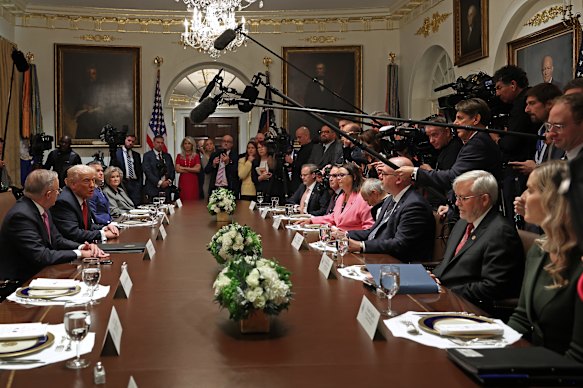
Trump told Rudd: ‘I don’t like you either, and probably never will.’Credit: Getty Images
Rudd cops it from Trump – but is all well that ends well?
The much anticipated meeting, which took place in the middle of the night Australian time, came exactly nine months after Trump was sworn into office for a second time. The Coalition had criticised Albanese for the long wait, suggesting it indicated a souring of relations.
Trump was asked by a reporter whether the delay had anything to do with the Australian government’s position on climate change or Palestine, or old tweets by now-ambassador Rudd, who had disparaged Trump during his first presidency.
The president indicated he was unfamiliar with the comments and then asked if the ambassador still worked for the government. It was then revealed to him that Rudd was sitting at the table.
Loading
“You said bad?” Trump asked Rudd, who replied: “Before I took this position, Mr president.” Trump cut him off and said to laughter: “I don’t like you either, and I probably never will.”
Later, according to Australian sources in the room, Rudd apologised again and Trump told him all was forgiven.
The awkward confrontation prompted Opposition Leader Sussan Ley to call for Rudd’s dismissal, telling Sky News his position as ambassador had become “untenable”.
Overall, this was a success for Albanese
The Rudd moment aside, the meeting was greeted warmly by Australia’s friends in Washington.
Michael McCaul, a Republican congressman who co-chairs the Friends of Australia Caucus, said it proved the alliance was as strong as ever.
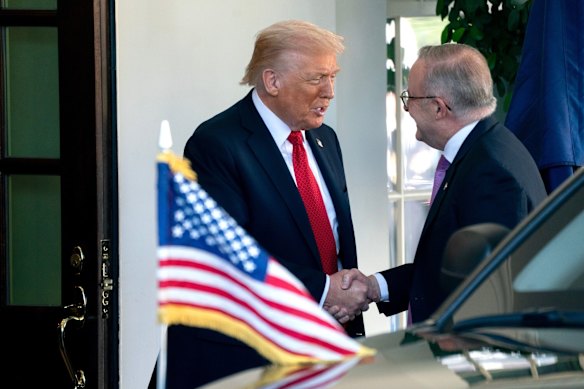
Trump greets Albanese outside the White House.Credit: Bloomberg
“The timely new mineral deal will strengthen both of our economies and bolster US national security by reducing our reliance on the Chinese Communist Party, just as it works to wreak havoc by cutting off the West from its critical minerals supply,” he said.
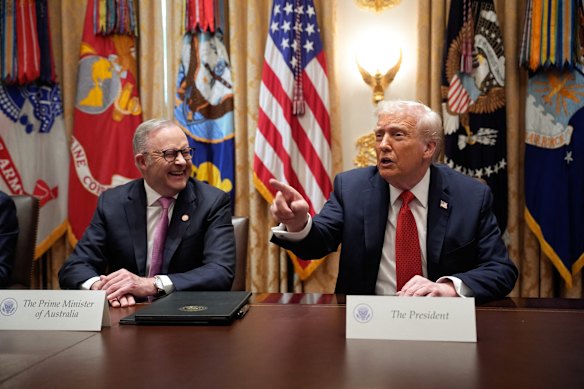
Prime Minister Anthony Albanese and President Donald Trump appeared to share genuine camaraderie.Credit: AAP
The group’s Democratic co-chair Joe Courtney said the powerful endorsement of AUKUS ended the uncertainty hanging over the agreement and “ensured that it will be an enduring success for a free and open Indo-Pacific”.
Charles Edel, Australia chair at the Centre for Strategic and International Studies, told Nine News – which owns this masthead – the two leaders seemed at ease with each other.
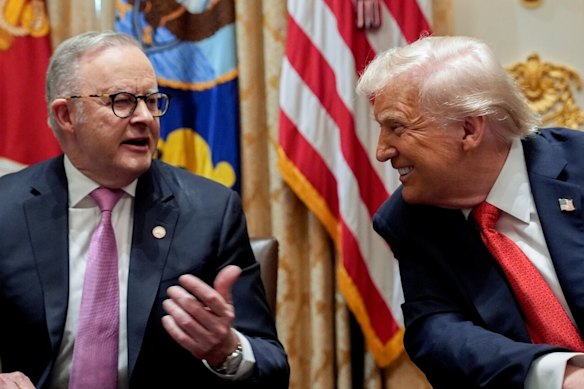
Albanese draws a smile from Trump.Credit: Bloomberg
While there were still details to be fleshed out about the critical minerals deal, it was clearly “moving forward”, Edel said, while Trump’s imprimatur for AUKUS was “really important”.
Get a note directly from our foreign correspondents on what’s making headlines around the world. Sign up for our weekly What in the World newsletter.


