


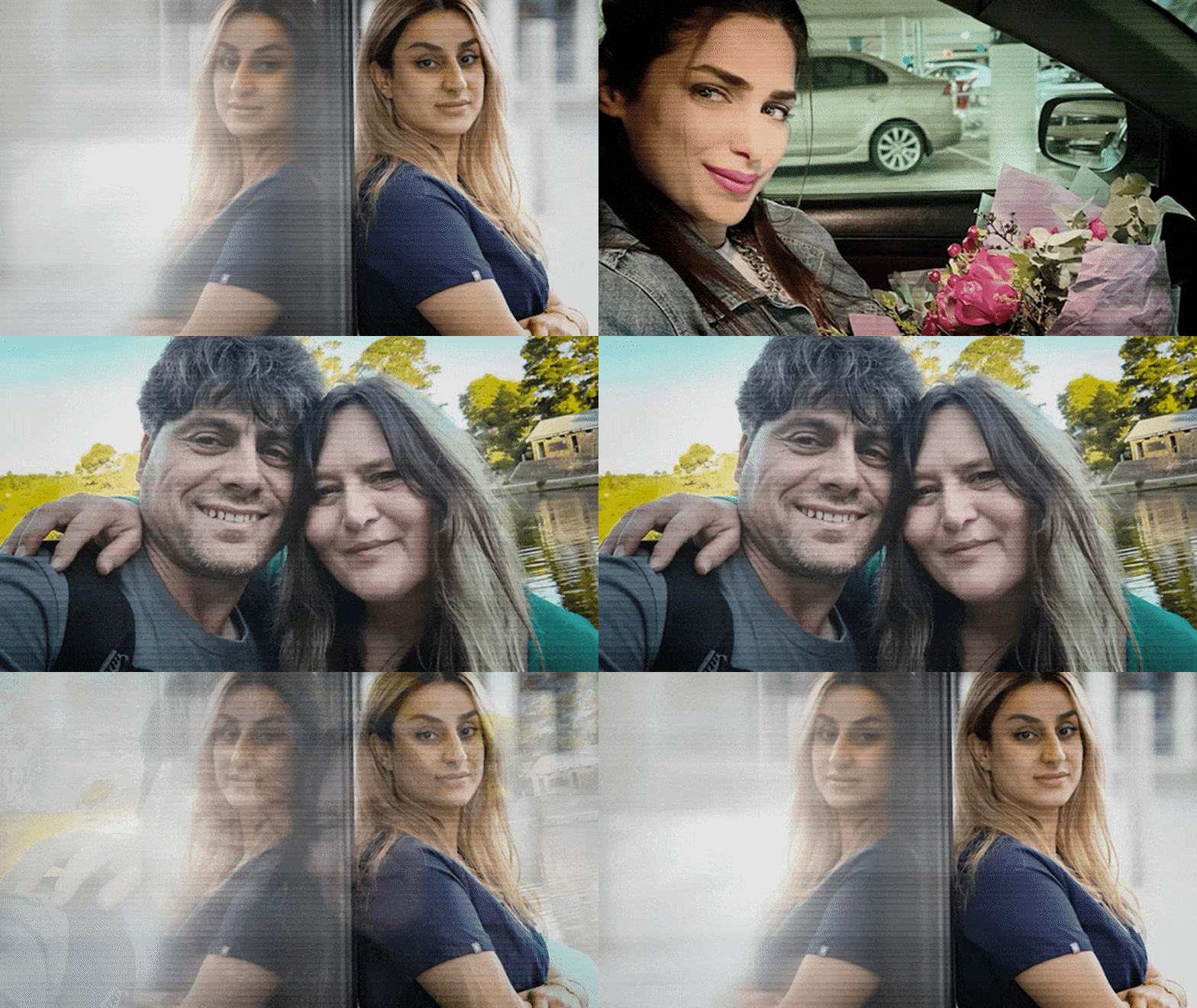
With the stroke of a pen, life changed in an instant for a handful of players from Iran’s women’s soccer team. As a media and diplomatic storm erupted over their future, Home Affairs Minister Tony Burke met and granted asylum to those too fearful to return home. Already pre-vetted by domestic spy agency ASIO, the players were offered protection, a humanitarian visa and a pathway to permanent residency. A photographer was on hand for the happy ministerial moment to be shared with the world.
Burke’s intervention was swift, decisive and celebrated around Australia. But it was bittersweet for other refugees entangled in a system not known for speed or intimate levels of political involvement. None begrudges the players; they share the same plight and all understand the dangers of the regime – particularly now as the ayatollahs fight for survival.
However, they struggle with the stark contrast between the overnight granting of asylum for high-profile cases and the many others whose stories do not play out in the public eye.
“I am so happy for the women who can stay in Australia and have been granted a humanitarian visa, but at the same time I feel so disappointed by the government,” says Narges, a 27-year-old Iranian refugee who lives and works in north-east Melbourne.
“Because if you really say ‘we stand with the people of Iran’ and ‘we are very proud of them’ but then you don’t look at what the Iranian people already living in our community need, that is not fair.”
After “running for our lives” in 2013, the then-14-year-old Narges, her 12-year-old sister, 10-month-old brother and their parents made their way by boat to Christmas Island, before being transferred to Nauru for two years. She can’t shake the memories of a childhood defined by the horrors of the island.
As war rages in Iran, thousands of Iranians and Kurds across Australia are waiting for an answer on whether they can stay to build a new life. While the number of days to process a new protection claim has fallen sharply under Labor, the wait is still torturous. The system is slow, complicated, and very often cruel to those most in need of help.
About 50 Iranians apply for protection every month after arriving by plane, and hundreds like Narges, who arrived by boat and live in the community on six-monthly bridging visas. Their bona fides are not in doubt – most have been recognised as genuine refugees – but any permanent settlement is banned because they arrived by boat after Kevin Rudd declared in July 2013 that no refugee who arrived by sea would be settled in Australia.
The official government policy is for members of this group to move to a third country or return to Iran.
“I feel very stuck,” says Narges, who asked for her surname not to be published due to safety concerns. “Sometimes it’s almost impossible to see any light at the end of the tunnel.”

The thought of landing in Tehran terrifies Mahsa Mazaheri, who fled the regime with her mother in 2013.
“I feel so happy for the Iranian soccer team members because I know how risky it is for them to return home,” she says. “But at the same time, it is so heartbreaking for me to see the discrimination that the Australian government has shown against us as asylum seekers.
“Simple things that many people take for granted like planning ahead or feeling secure are very difficult when your legal status is always uncertain. Each day I wake up with hope, but also with the heavy feeling of not knowing what tomorrow will bring for us.”
There’s another good reason why Mazaheri can’t leave. After being transferred from Nauru to the mainland for medical treatment, she was put on bridging visas which must be renewed every six months. While in Australia, she met her husband, and the couple have two daughters under the age of five. Asked if she had a message for Burke and the Albanese government, Mazaheri replies: “I would simply ask them to see us as human beings with real lives, families, and futures.”

Fatemeh Lahmidi, who fled Iran more than 13 years ago, says of the decision to grant instant asylum to the soccer players: “You can feel joy for them and heartbreak for yourself at the same time.”
As an aged care worker, Lahmidi pays taxes and contributes to a sector desperate for dedicated staff. Her husband is a landscaper and her sons are thriving in school.
“Leaving your country feels like leaving a part of your heart behind,” she says of her decision to flee the regime. “You leave your family, your culture, your language, and the life you once knew. Even when you know it is necessary, it is still deeply painful. You arrive in a new country carrying both hope for the future and grief for everything you lost.
“We are not asking for special treatment; we just want to live with dignity, safety and certainty.”
Refugee support services around Australia have reported a surge in asylum seekers and refugees contacting them distressed about the hypocrisy of a government sparing high-profile sports stars from returning to a dangerous country, while at the same time insisting others like Narges, Mazaheri and Lahmidi should go back there.
The soccer saga shows the life-changing nature of ministerial interventions – provided the politics are in favour. If they’re not, refugees are left to fight for their cause away from the public eye and the blaze of positive headlines. Abul Rizvi, a former deputy secretary of the Department of Immigration, says the immigration minister’s powers are often described as “God-like”.

“The minister has in many senses far more power than the prime minister,” Rizvi says.
Reverend Meredith Williams, a Uniting Church minister, has been helping one Sydney-based asylum seeker who this masthead has not named for safety reasons. The man fled Iran after being lashed 80 times in a dimly lit room in the basement of a courtroom. “The memory of that room, and the feeling of standing there knowing what was about to happen, has never left me,” the man recalls.
“For a month, my mother applied cream from my back down to my legs so the wounds could heal. During that time, I could only sleep face down because the pain in my back was unbearable. Moments like these made it clear that my beliefs about freedom did not align with the theocratic government that ruled my country.”
The first stage of his search for freedom ended when a Border Force vessel intercepted the small boat he was on.
The night he fled, the man hugged his mother the longest of those who had gathered in secret to say goodbye. “I tried to reassure her, telling her that somehow I would find a way to see her again. I wanted her to believe it.”
During last December’s mass protests in Iran and subsequent internet blackout, his mother fell ill and died. Her son didn’t find out until the blackout ended.
Those on bridging visas are generally prohibited from international travel, meaning any reunion with the man’s remaining family is out of the question.
Williams, the minister helping the man navigate the system, says she has no doubt the soccer players needed asylum. “That it took only a few days for Tony Burke to offer protection to members of the Iranian women’s soccer team shows what our government can do when it wants to,” she says. “Surely, my friend’s plight is just as deserving of ministerial intervention.”
Iranian asylum seekers have an abnormally large success rate of about 75 per cent – much higher than applicants from countries such as China, Pakistan, Malaysia and even war-torn Iraq.
While bridging visas offer relief of sorts, they also deliver challenges for those living in the community. Some are barred from working, while others who are allowed to work report potential employers being put off by the uncertainty. The process of constantly reapplying is long and expensive, and study beyond secondary education is typically prohibited.
The study ban hits Narges hard. At the end of year 12, she watched as friends went on to university. She was banned from chasing her dream job as a dentist.
“I’ve been here for so long that I feel Australian,” Narges says. “I can’t remember what it feels like to live anywhere else. All my friends have been able to move on with their lives, pursue their dreams and be whatever they want to be. And my future is on hold.”

Her employer, George Malliaros, shares her frustration. He has big plans for Narges in his practice, but is constrained by her inability to train and study.
“We are talking about young people who have aspirations and would make excellent citizens,” he says. “You could not ask for better people if you were to draw a list of criteria for people who would make great migrants.”
There are about 12,332 Iranians in Australia with temporary visas. Some 3938 are on student visas, 3252 on visitor visas and 1500 on skilled temporary visas. The government is bracing for a surge of applications from many of these people seeking asylum.
Visas have also been issued to about 7200 Iranians who aren’t in Australia, but have the approval and documentation needed to come here temporarily. But last week, the government introduced laws which would give it the power to block these people from travelling to Australia while the war is raging.
At an emergency parliamentary hearing last week, Greens senator David Shoebridge said to immigration officials: “We had the government today trumpeting the fact that they’d granted five visas to incredibly brave Iranian women from the football team, and of course, if they seek asylum, they should. Yet, on the exact same day, the government is shutting the door to 7200 other Iranians who currently have temporary visas to make sure that that cannot happen again.
“Nobody leaves their parents, siblings, nieces, nephews and homeland unless there is no other choice.”
Farhad Bandesh
“Does anyone in the government look at doing the two things in the same 24 hours and say this is incoherent, inconsistent policy?”
Burke’s office was approached for comment.
Farhad Bandesh, a Kurd who came to Australia by boat in 2013 and spent six years in hellish conditions on Manus Island, says the new laws are cruel.
“Imagine it yourself – a war broke out, just as your parents were granted visas, and through no fault of theirs they were barred from joining you in safety. Imagine if there was nothing you could do about it – what would that do to your heart?”

Bandesh, who was on Manus during the siege that killed Reza Barati and injured hundreds of others, has spent the past five years building a life from scratch in Melbourne. An artist, musician and winemaker, he and his partner Jenell Quinsee have a dog, Ciya, named after the mountains in Kurdistan.
“Nobody leaves their parents, siblings, nieces, nephews and homeland unless there is no other choice,” he says. Dealing with pain, trauma and hardship when your family is far away, having to build new relationships, and learn a new language “is the hardest thing anyone can do in their life”.
“But it also brings me pride and happiness to know that I have survived this. It makes me proud to be part of this community.”
But constantly reapplying for bridging visas feels like “being ignored over and over again, by a machine, for years on end”. Living in limbo “haunts me and sits in the back of my mind”.
“It is there, no matter how much I try to focus on the things in front of me that I love – my partner, my family, our home, fixing up our garden, our dog. It is another form of prison that is impossible to escape.”
Bandesh has a plea for those who have the power to change lives in an instant, as the home affairs minister did last week. “You can’t turn away from us. We are here, we are loved, we are part of this place, as much as you are. We have lives here, families and futures.
“Let us live in the homes that we have built.”
Start the day with a summary of the day’s most important and interesting stories, analysis and insights. Sign up for our Morning Edition newsletter.
