



Maryland: Janet Stolba keeps a close eye on petrol prices. “These two gas stations used to be the cheapest gas around, and everybody came,” she says as she fills up near a major intersection in Hyattsville, Maryland.
“But now they’re exactly equal with everyone else, and there’s nothing that’s cheap.”
Today, she is paying $US3.60 a gallon ($1.36 a litre); she says it was $US2.87 the other day. And she knows what’s to blame. “The war is tying up the ships, and the ships have the oil, and so here we are.”
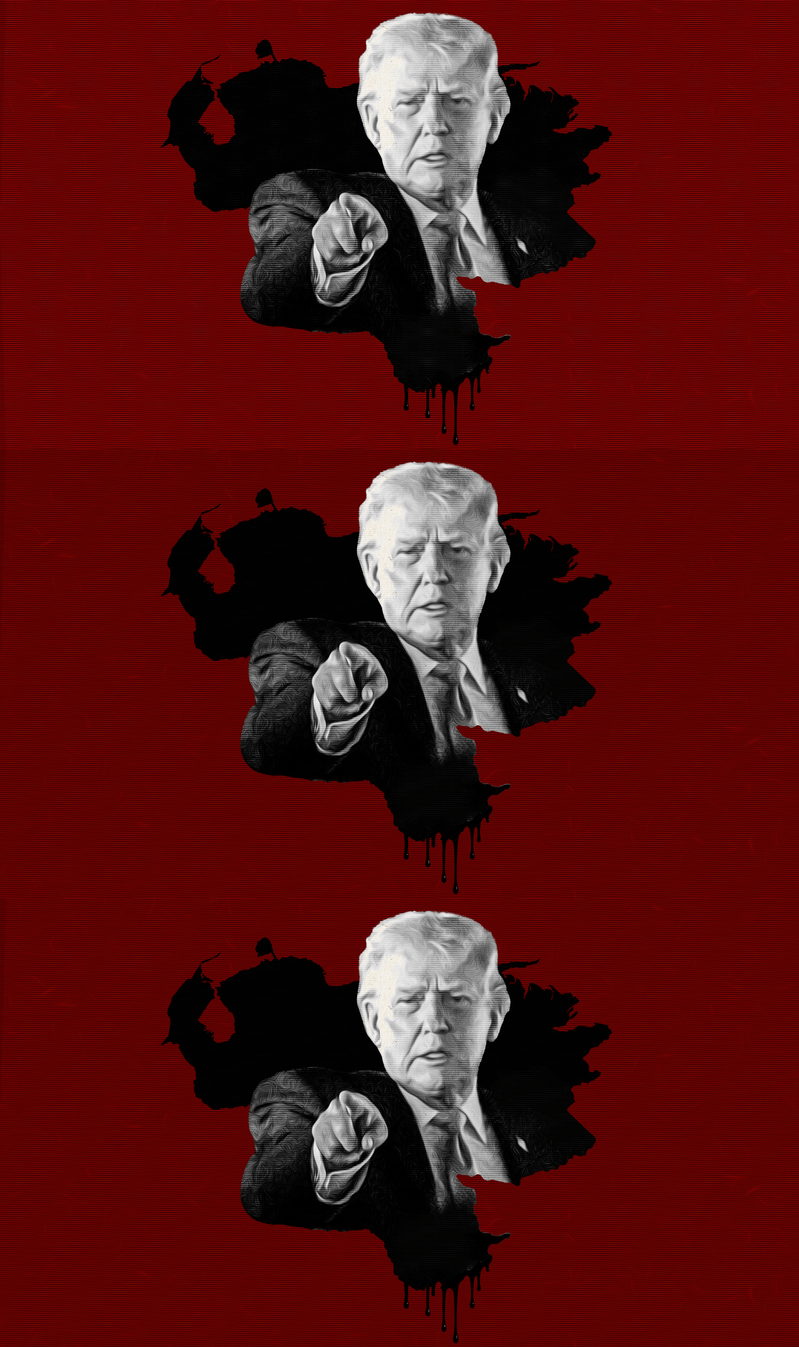
On Friday morning, motorists who spoke with this masthead said much the same thing – they don’t like paying more for fuel, and they don’t understand why Donald Trump is dropping bombs on Iran.
“Every morning I’m afraid of what I might see in the paper. I’m totally opposed to it,” says Sheena Morrison, 60, who has driven from Baltimore to visit her mother.
“There’s not much we can do since this administration has taken it upon itself to wage war on a country that has not been a threat to us.”
Stolba, 83, blames Trump’s ego. “I don’t believe anything he says. It’s all about him,” she says. “Whatever we’re doing – saving money or making money, or not saving money or not making money – it’s because that man wants everything for himself.
“If he could, he would buy every country in the world.”
Marvin, who won’t say his last name because he’s a federal government employee, is also dubious. “If the goal is American interests, then the focus should be in America,” he says. He can handle the higher costs but worries about those who can’t. “For people who live within this community, any jump in gas is pretty significant.”
As the US and Israeli campaign in Iran enters its third week, and the price of oil hits $US100 a barrel, people like Janet, Sheena and Marvin reflect a large proportion – though not necessarily an outright majority – of American public opinion.
Polls have consistently shown Americans are sceptical about the country’s largest military undertaking in two decades, despite the threat the Iranian regime has long posed. When the University of Maryland asked voters in early February whether they would support the US initiating an attack on Iran, 21 per cent said yes, 49 per cent opposed it and 30 per cent were unsure.
A Quinnipiac University poll of 1000 voters taken a week after the strikes started found 53 per cent opposed the military action, while 40 per cent backed it. “Voters are unenthusiastic about the air attack on Iran and there is overwhelming opposition to putting American troops on Iranian soil to fight a ground war,” the university’s polling analyst, Tim Malloy, said.
The US is much less reliant on oil imports than it used to be, which offers some protection from price shocks, and pump prices remain much lower than their peak in 2022. But in a country where cost of living is still the dominant issue for voters, petrol prices can be a barometer of political sentiment.
The Trump administration is working with allies to put more oil on the market by releasing emergency stocks, and it’s providing insurance for tankers to navigate the Strait of Hormuz (Trump says they should “show some guts”). The US has also temporarily lifted sanctions on Russian oil that is already at sea.
“But none of those steps will stop prices for surging higher as long as transit remains blocked and oil production in the Gulf continues to be a target of Iranian drones,” says Josh Lipsky, chair of international economics at the Atlantic Council.
There are some signs Americans’ scepticism about the war has abated as the US military pummels Iran’s navy, missile stocks and weapons industry with overwhelming force. A Washington Post survey found the proportion of people who opposed the strikes fell from 52 per cent to 40 per cent in a week, although it asked a slightly different question the second time, which omitted Trump’s name.
Meanwhile, Reuters/Ipsos polls found public opinion was unchanged, with 43 per cent against, 29 per cent in support and about a quarter of voters uncertain – essentially the same as the week before.
Dan Shapiro, a former US ambassador to Israel under Barack Obama, says this partly reflects Trump’s “strategic incoherence” and his “total failure to describe the campaign [and] the necessity of going to war to the American people”.
Public opinion is also one of the few tools the decimated Iranian regime has left. The country’s foreign minister, Abbas Araghchi, constantly highlights rising oil prices in his social media missives, and accuses Trump of being “Israel First” rather than America First.
“They want Americans to look at their television sets and say: what’s going on here?” said Karim Sadjadpour, a senior fellow at the Carnegie Endowment for International Peace, on Washington Week with The Atlantic. “They’re hoping American public opinion is going to restrain these ambitions that Trump has.”
The president is dismissive of domestic scepticism about the war, even from parts of his base – he is fond of saying that he determines what “America First” means, not anyone else. But he has acknowledged a level of disagreement even within the highest ranks of his administration.
Vice President JD Vance, who was mostly silent when combat operations began, was “philosophically a little bit different than me”, Trump said. “I think he was maybe less enthusiastic about going [into Iran], but he was quite enthusiastic.” Vance, asked about his views on Friday, said he wasn’t going to canvass publicly what he advised the president in classified settings.
And Trump has given mixed signals about his ambitions in Iran. When he announced the campaign in an eight-minute recorded video, he gave the impression it would be a long and arduous fight. He spoke of a “massive and ongoing operation” to end 47 years of menacing by the regime.
He told the Iranian people that when it was over, it would be easy for them to overthrow the government: “It will be yours to take.”
But now, he says regime change may not happen, noting it is difficult for Iranians to protest without weapons and in the face of brutal suppression from the Islamic Revolutionary Guard Corps.
‘I don’t believe Israel would be able to continue the kind of campaign they’re conducting in Iran without US participation.’
Dan Shapiro, a former US ambassador to Israel.
Trump doesn’t want the new supreme leader, Mojtaba Khamenei, in charge, but is open to some other regime insider taking control. He says he will know when it’s time to end the war on instinct – “when I feel it in my bones”.
Shapiro says it’s time for Trump to end it now.
“If the objectives are what his military leaders are telling us – degrade the missile capability, the navy, nuclear sites – that degradation of [Iran’s] power projecting capabilities is significantly accomplished. You can always do more, but they’ve been significantly weakened,” he says.
“The risk is getting pulled into an extended conflict where you’re running out of essentially targets that you’re going to hit with aerial munitions but in the meantime, you’re suffering what pain Iran can impose through the closure of the Strait of Hormuz and all the economic dislocation that causes.”
If Trump simply declares victory sometime this week or next, it does not mean Iran will agree. It could continue to fire what missiles it has left and continue to close the strait. “But that’s going to leave us in a better position than if we get piled into something much more extended,” says Shapiro.
Israel has made clear it has more maximalist goals. Prime Minister Benjamin Netanyahu explicitly said he was adding regime change to his list of goals while acknowledging it may not happen. But that is something most analysts say is difficult to impossible through airpower alone.
“They want more time,” Shapiro says. “This would be a diverging of interest in terms of war aims. However, it ends when President Trump says it ends. I don’t believe Israel would be able to continue the kind of campaign they’re conducting in Iran without US participation.”
That leaves Iran in a precarious position, with a regime that survives but has been weakened – and, as Shapiro points out, has new motivation to keep enriching its uranium.
The existential threat that Trump talked about eliminating “once and for all” would continue to exist – albeit less potent, for now. “Wars end messy,” Shapiro says. “You rarely get everything you want.”
Get a note directly from our foreign correspondents on what’s making headlines around the world. Sign up for our weekly What in the World newsletter.
 Michael Koziol is the North America correspondent for The Age and Sydney Morning Herald. He is a former Sydney editor, Sun-Herald deputy editor and a federal political reporter in Canberra.Connect via X or email.