


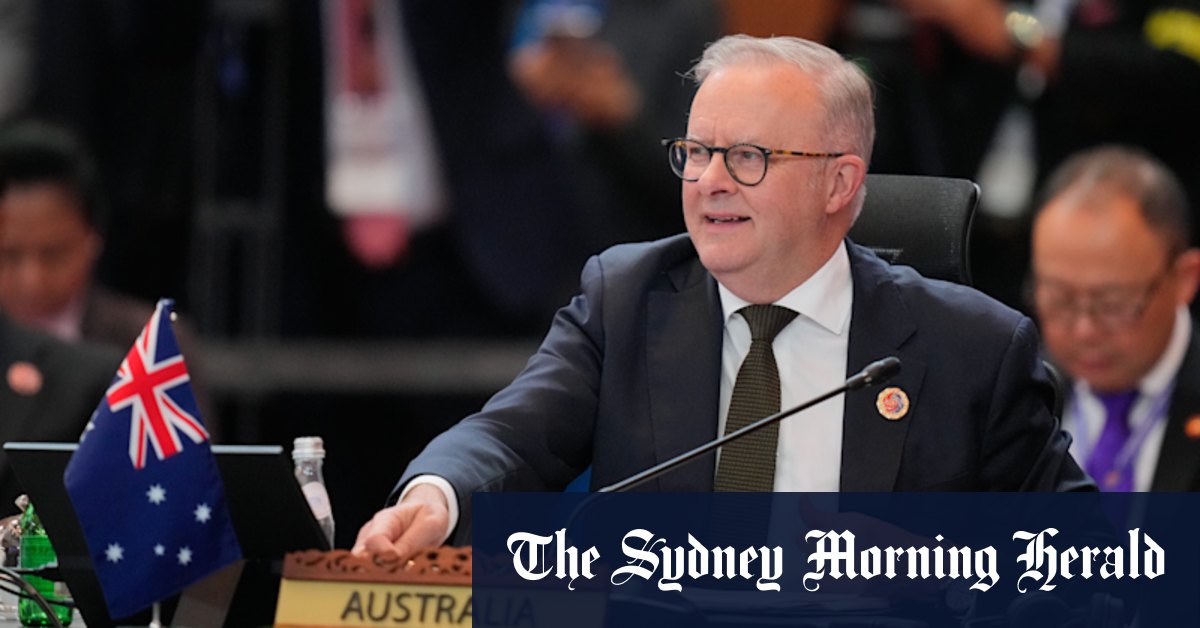

Despite the flare-ups over military encounters and Australia’s concerted efforts to counter China’s influence among Pacific nations, the Albanese government has sought to stabilise diplomatic relations and restore trade ties with Beijing. That has meant taking a lower-volume approach to criticism of Beijing than in the Morrison government era.
In remarks before the pair’s closed-door meeting, Li said the China-Australia relationship had deepened following Albanese’s meeting with Chinese President Xi Jinping in July in Beijing.
“Indeed, we are seeing an upward momentum in our relationship, and we welcome it, and we are happy to see it,” Li said.
Albanese, in turn, said he welcomed the tempo of the relationship, adding “whenever there are differences, we navigate those wisely”.
Albanese met with Takaichi on Sunday, where the pair reaffirmed their commitment to the Quad grouping, which comprises Australia, Japan, India and the US, and their strategic co-operation in the region.
“I also hope that our two countries can spearhead efforts so that we can push a free and open Indo-Pacific,” Takaichi told Albanese on the sidelines of the summit.
“Japan and Australia both have the will and capacity to realise these aspirations.”
Trump will meet Takaichi in Japan on Tuesday before heading to the Asia-Pacific Economic Co-operation meeting in Gyeongju, South Korea, where his expected to meet with Xi for the first time during the American president’s second term on Thursday. Albanese is also heading to South Korea later in the week for APEC.
Loading
China’s latest sweeping export controls on rare earths and magnets are expected to be a key topic of discussion at the Trump-Xi meeting, along with tariffs, fentanyl trafficking co-operation, other export controls and Taiwan.
Earlier this month, a fragile trade truce between the US and China blew up again after the US moved to cut off technology exports to Chinese-owned subsidiaries of blacklisted companies. Beijing hit back with its far-reaching rare earths crackdown, leading Trump to threaten to impose an additional 100 per cent tariff on Chinese goods.
The two countries’ top trade negotiators appeared to broker a pathway for de-escalation on Sunday after two days of talks on the ASEAN sidelines, paving the way for Trump and Xi to sign a deal when they meet in South Korea on Thursday.
In a series of interviews with American TV networks following the talks, US Treasury Secretary Scott Bessent said he believed China would delay its rare earths restrictions “for a year while they re-examine it”, while the US would drop its latest tariff threat.
“I would expect that the threat of the 100 per cent [tariff] has gone away, as has the threat of the immediate imposition of the Chinese initiating a worldwide export control regime,” Bessent said.
Get a note directly from our foreign correspondents on what’s making headlines around the world. Sign up for our weekly What in the World newsletter.
