


Rule No.1 in politics is that leaders should always project capability and certainty, even in the most uncertain times. When COVID-19 reached our shores, public anxiety about lockdowns and supply chains resulted in consumers stockpiling toilet paper, pasta, meat, baby formula and paracetamol.
The pandemic was a global event, its causes and effects ranging far beyond the capabilities of any single nation’s leadership to control. At that point, the power of federal and state governments to reassure became particularly important.
The decision of the United States and Israel to wage war on Iran, and Iran’s decision to restrict tanker traffic through the Strait of Hormuz in retaliation, have already hit our economy hard, despite Australia having had no input into either one (though perhaps Prime Minister Anthony Albanese might have hoped for some sort of warning from our closest security ally of its intentions).
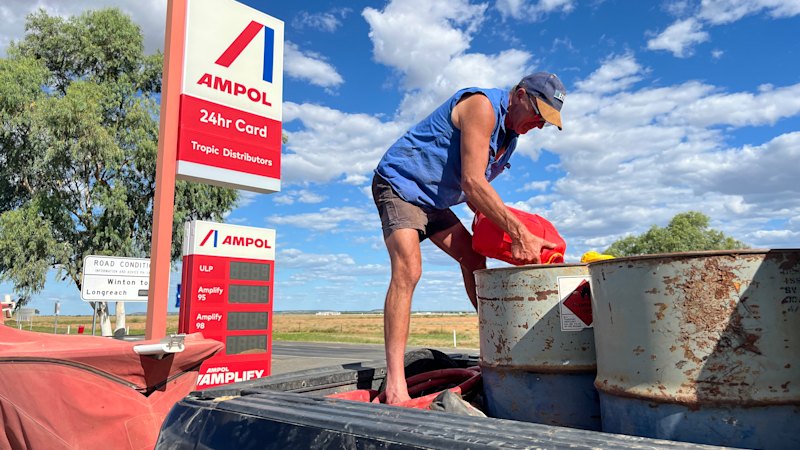
The main source of anxiety this time around is fuel. As Energy Minister Chris Bowen stands up in parliament to deliver daily tallies of petrol stations running dry, and the opposition responds by reading out stories of personal hardship caused by surging prices at the bowser, both sides know they can’t solve the problem. It then becomes a question of whether things that can reasonably be done to mitigate it are being done.
When Albanese was asked last Saturday about the possibility of fuel rationing, he replied that it was “a decision for state and territory government, so it’s not a question for me”. It sounded too much like “I don’t hold a petrol hose, mate” for comfort.
The days since have seen him sing a more proactive tune. “We don’t come in here and say there aren’t issues. What we do is come in here and put forward practical plans to make a difference,” he told parliament on Thursday.
As our chief political commentator James Massola points out, Monday’s emergency meeting of the national cabinet, first revealed by our reporters, is when the federal government needs to get on the front foot, not only with measures but with messaging. Albanese was defensive about his messaging so far in his Friday press conference, pointing out the government had answered dozens of questions in parliament on the topic.
So far, Albanese and Bowen have relied on supply-side steps such as relaxing quality standards on petrol and diesel and going out into the global market to secure replacements for six cancelled ships of fuel.
Monday’s meeting looks likely to call on the public to address the demand side of the equation by working from home, using public transport and even rethinking holiday plans.
Since another Iran-related oil shock in 1979, Australia has been a signatory to the Agreement on an International Energy Program treaty, which requires us to hold oil stocks equivalent to at least 90 days of our previous year’s daily net imports in case of global emergencies.
Yet, the stockpile from which Bowen drew 760 million litres of petrol and diesel – six days of supply – on March 13 sits nowhere near the 90-day mark. Explaining to the ABC why successive Labor and Coalition governments have failed to comply with that obligation, he cited the cost of maintaining such a stockpile on our shores as “$20 billion over four years … That’s $20 billion we’re not spending on schools, hospitals or anything like that.”
There should be renewed scrutiny of that argument. But The Age welcomes the news that this first release is bound for the regions, where people have greater distances to travel in meeting daily needs and fuel – diesel in particular – is a vital component in food production and distribution.
On Thursday, One Nation’s Barnaby Joyce envisioned city dwellers running out of eggs and urged rationing of fuel, adding that “a plan is better than panic, and panic is where we’re going”. Liberal Party leader Angus Taylor has called for a temporary cut to fuel excise.
As our senior economics correspondent Shane Wright has warned, measures that may seem to offer relief can end up compounding our inflation woes or helping the wrong people.
But the question is: what will the framework of our response be, and how will it escalate if necessary? Does it resemble the plan drawn up by the Department of Environment and Energy in 2019, from carpooling to fuel caps, or will it be different? Will we draw from the experience of our Asian neighbours, many of whom are also dependent on imported fuel and have already begun to shorten the working week or restrict which cars can fill up on a given day?
The message has to be transmitted uniformly by Canberra, the states and territories and fuel tsar Anthea Harris to alleviate short-term concern. But in the longer term, as environment editor Nick O’Malley has written, we surely have to look again at how we generate energy with a view to insulating ourselves from fossil fuel-based shocks in the future.
When the prime minister points out that this crisis “involves things we can’t control, but what we can control is our response, which is orderly”, he needs to take Australians into his confidence, in both senses of that word.
Get a weekly wrap of views that will challenge, champion and inform your own. Sign up for our Opinion newsletter.
 The Age’s View – Since The Age was first published in 1854, the editorial team has believed it important to express a considered view on the issues of the day for readers, always putting the public interest first.