










Prime Minister Anthony Albanese is poised to strike a long-delayed $110 billion free trade deal with Europe as both sides aim to fortify relations with like-minded nations at a time of global economic uncertainty.
The deal has been in sight several times previously and fallen over due to disputes about the quantity of meat Australians could sell into European markets, particularly France and Ireland, whose farmers are reluctant to compete with Australian products.
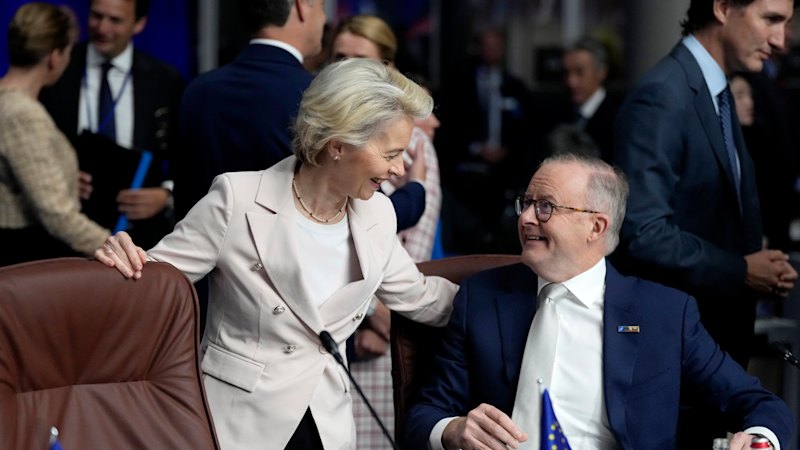
Australia has raised its hopes that a deal will finally be reached early next week when European Commission President Ursula von der Leyen is expected to travel to Canberra, months after her trip to Australia was first floated. The pair must still settle long-running tension over beef exports.
Trade Minister Don Farrell said he had a phone call with EU trade bosses on Monday night and told this masthead on Tuesday that he was “confident we can do a deal”.
Bloomberg reported overnight that von der Leyen had told EU leaders in a letter that talks with Australia were in the final stretch.
“This will mark yet another milestone in diversifying Europe’s international partnerships,” she said.
The Australian pact would fit into a string of trade deals Europe has struck since United States President Donald Trump’s tariff campaign, building on agreements with India and South American countries. Australia signed a trade deal with the United Arab Emirates last year and has softened its posture towards China in a bid to raise trade volumes.
Von der Leyen’s visit to Australia, likely to be confirmed in coming days, will represent another moment of symbolism between middle powers projecting stability and a commitment to open trade.
Farrell said he anticipated the deal in its current form would deliver $10 billion in additional trade for Australia during its first year, and more in subsequent years.
“We need to be able to demonstrate to the rest of the world that there are countries that still believe in free and fair trade, and that we can reduce trade barriers, not increase them,” Farrell told Sky News on Tuesday afternoon.
“The way Australia has produced its prosperity is by being outward, outwardly looking, by delivering goods.
“The troubles in the Middle East are a wake-up call, I think, to everybody that we need to diversify our trade relationship. Europe really is the last key to all of that.”
Canadian Prime Minister Mark Carney addressed the Australian parliament a fortnight ago to build on his argument for liberal democracies to work more closely as China and the US increasingly flex their muscles with little regard for smaller nations.
European nations, including the UK, have been drawn into the US-Israel war with Iran much like Australia, as they seek to support the US to curtail the economic carnage caused by the closure of shipping routes. The UK and France expressed more tempered support for the initial strikes than Australia.
The trade deal between Australia and the EU is likely to be framed in strategic terms. Officials are also scrambling to finalise a defence partnership; it will not act as an alliance like NATO or ANZUS, but will focus on working together on exercises and procurement.
Talks have largely overcome differences over the naming rights for European products such as prosecco and feta cheese. The likely gains for Australian households include lower prices for European exports such as cars and trucks, wiping away tariffs that add 5 per cent to every vehicle.
Under the long-awaited trade agreement, Australia will cut the price of European cars and open the door to more foreign investment. It will also lower barriers for farm exporters in the hope of boosting trade worth $110 billion a year.
In a sign of growing worry about the industries and people who lose out from free trade, Nationals leader Matt Canavan on Tuesday made an argument for placing tariffs on cheap Chinese steel undercutting the Australian industry.
“I don’t quite agree with Donald Trump that the word ‘tariff’ is the most beautiful word in the English language. But it’s not a dirty word either,” Canavan said on Tuesday. “A tariff is just a tax. It’s just a type of tax.”
“There’s taxes on everything in this country … but [Labor] don’t want to put any taxes on the surge of foreign goods into this country.”
Cut through the noise of federal politics with news, views and expert analysis. Subscribers can sign up to our weekly Inside Politics newsletter.


