


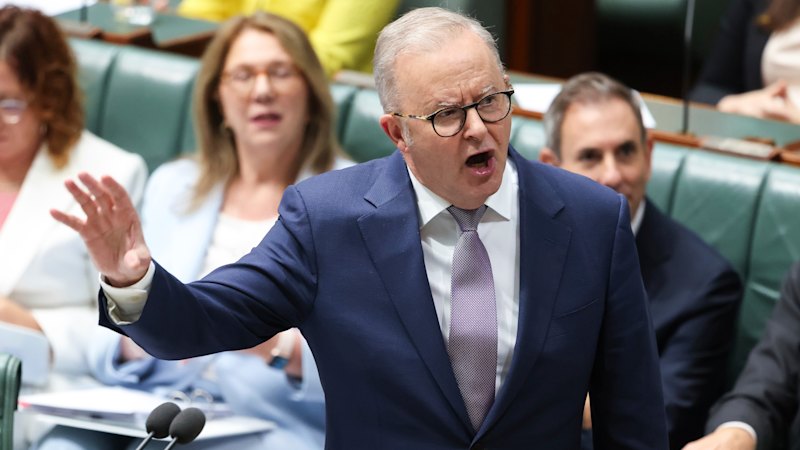
Prime Minister Anthony Albanese will convene a meeting of national cabinet on Monday as his government contemplates a national plan on fuel conservation to offset the risk of a supply shortage late next month due to the war in Iran.
Talks are underway inside the federal government about bringing the states together to create a consistent message on light-touch ways to save fuel. They could include encouraging working from home for white-collar workers, using more public transport and other voluntary measures like those introduced by South Korea under its emergency plans on Tuesday.
Senior sources in the government, who requested anonymity to talk about contingency plans, said there was a growing sense that measures might be needed to reduce demand on fuel supplies, and it was not tenable to leave states to come up with individual plans as they did during the COVID-19 pandemic in 2020-21.
They cautioned that the situation was unpredictable, with the prospect that US President Donald Trump may wrap up the war, while the government hopes guarantees of oil supply from Asian neighbours will help Australia avoid worst-case scenarios.
And so while it was becoming more likely, but not guaranteed, that governments will resolve in coming weeks to nudge people to conserve fuel, the government said it was nowhere near taking drastic measures such as capping the amount of fuel people could buy.
This masthead reported on Tuesday that the states wanted Albanese to step in and lead a national conversation about emergency policies, after he declared such actions were up to states and “not a question for me”.
Since then, the prime minister has met with national fuel coordinator Anthea Harris, who is working with state officials to get data on choke points so that fuel can be sent to the right spots.
The federal-state framework around supply chains could be used to manage prospective measures around demand, a source said.
In the second shift in language this week indicating a move towards emergency policies, Energy Minister Chris Bowen said there were many contingency measures “that we shouldn’t deny aren’t there and governments do have at their disposal”.
“There’s also voluntary measures that government can encourage,” he told reporters on Wednesday. “We’re not there yet. These are all prudent contingency measures”.
Albanese, Bowen and Foreign Minister Penny Wong have been calling officials in Singapore, Malaysia, Japan, Korea to shore up oil supply and use Australia’s massive exports of coal and gas as leverage.
This masthead understands that the regional partners confirmed they would keep prioritising Australian customers. However, it is unclear if these assurances will hold later into April if those nations struggle to supply their own populations.
Japan’s ambassador to Australia, Kazuhiro Suzuki, cautioned that any windfall tax on LNG exports, a prospect the government has entertained in the past week, would be seen as a “bad surprise” that would kill off investment. Cabinet ministers are privately downplaying the chances of Labor pushing ahead with the tax.
“If there’s a retrospective taxing or something, I think that would be really bad news,” Suzuki said at a Minerals Week conference in Canberra on Wednesday.
Japan gets about 40 per cent of its gas from Australia. Suzuki said Japan may be open to swapping petrol for gas, but played down the prospect.
Bowen, whose renewable energy agenda has made him a prime target for conservatives, faced sharp criticism from the opposition again on Wednesday. The Coalition says he had not been transparent in his response to the oil crisis.
Bowen dismissed the attacks, telling parliament the opposition were “not serious people” and had offered no policy solutions while Labor had temporarily dropped fuel standards to allow greater supply and released fuel from the nation’s reserves, which he said would be sent to the regions, which are suffering the worst shortages.
In a positive development, he also announced extra shipments of oil already on the way from Europe and the US.
Additional shipments secured in the past week equate to six days worth of average national diesel consumption and five days of petrol.
Earlier this month, fuel suppliers cancelled six of the 81 shipments bound to reach Australia by mid-May.
A total of 474 service stations around Australia were without at least one grade of fuel as of Wednesday afternoon.
Panic buying has driven a doubling of demand from motorists, farmers and other fuel users alarmed at closure of the Strait of Hormuz, which supplies about 25 per cent of the world’s oil supply.
However, Asian refineries that supply about 80 per cent of Australia’s fuel may exhaust their stocks of crude oil within a month and it remains unclear how these potential shortfalls could be filled.
Posing a challenge to Labor’s oil diplomacy, the gas industry insists it has no extra supply that could be traded for fuel supplies.
Australia’s biggest gas company Woodside said this week that it had very limited supply, above what it is currently exporting.
“In the immediate term, there’s not a lot of trades you can redirect … but we continue to look at what’s not contracted,” said Woodside chief executive Liz Westcott.
Rick Wilkinson, chief executive of consultancy EnergyQuest, said Australian gas export projects are already operating at near full tilt.
“There is limited capacity for Australia to increase Liquified Natural gas cargoes,” Wilkinson said.
Cut through the noise of federal politics with news, views and expert analysis. Subscribers can sign up to our weekly Inside Politics newsletter.
 Paul Sakkal is Chief Political Correspondent. He previously covered Victorian politics and won a Walkley award and the 2025 Press Gallery Journalist of the Year. Contact him securely on Signal @paulsakkal.14.Connect via X or email.
 Mike Foley is the climate and energy correspondent for The Age and The Sydney Morning Herald.Connect via email.