





In early 2014, Anna Wakelin was flying a Tiger Airways domestic route as part of her certification process to become a captain.
When she smelled something like dirty socks she assumed it was the captain playing a practical joke on her. He wasn’t.


”I started to feel a bit tired … I guess my thinking was a bit foggy,” Wakelin says. “At the end of the day I felt like I was almost drunk.”
Wakelin had experienced a “fume event” in which she was exposed to oil fumes and their additives, most likely through the plane’s ventilation system.
For Wakelin, the consequences were substantial. Today, she has no doubt she suffered “aerotoxic syndrome”.
But across the industry there is scant comprehensive data about the long-term health effects of these fume events on crew. That has left airlines and workers at a stalemate.
One side argues there isn’t a medical definition for “aerotoxic syndrome”. The other fears that they are at the tip of another endemic workplace illness that takes decades to gain recognition, such as asbestosis or silicosis.
The vast majority of commercial liners today are designed to “bleed” air from the engines, where temperatures hit 2000 degrees C, for use in the interior cabin. When oil gets that hot, it can break down into its constituent chemicals.

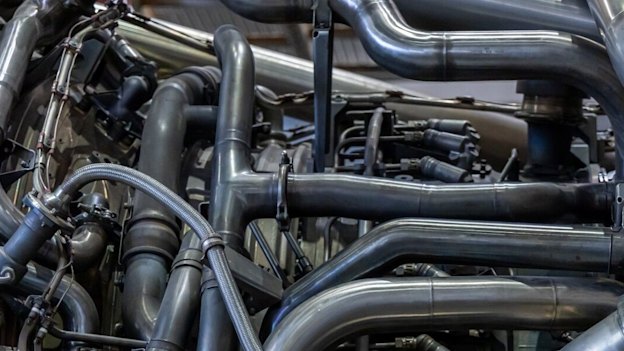
And while advanced jet engines are intended to keep cabin air and engine fluids separate, occasionally things go wrong. When that happens, the chemicals can get into the plane’s ventilation systems, resulting in anything from mist or smoke in the cabin to a barely detectable scent. These are classified as “fume events” – a term largely accepted by the industry.
Debilitating fumes
That these events can be debilitating is certainly no secret. The Australian Transport Safety Bureau released a report on a June 2023 Sydney-Hobart flight of a Boeing 717 in which flight and cabin crew noticed a “transient chlorine odour”.
The cabin crew initially noticed “dizziness”, with a “feeling of pressure in the head” and a “metallic taste”, the report said.
At one point, “the captain noticed quickly developing adverse effects on vision, mental capacity, and movement, and self-assessed as unable to safely fly the aircraft”.
He handed control to the first officer.
As the plane approached Hobart airport, the first officer, himself feeling “hazy”, noticed his own reactions slowing as the plane lined up with the runway.
After landing, he experienced a dull headache for two days, the ATSB said.
The safety bureau reported “similar occurrences” including ones in Britain, France, and Sweden.
But how debilitating these events are, and what symptoms they share, is unclear. The incidence documented by the ATSB resembles Wakelin’s. But Wakelin reported feeling more fatigued and run down in the days after her exposure.
“Days after [the fume event] I was getting more and more fatigued … I hadn’t cottoned on to the fact that it could have been the aircraft that was making me feel like that.”
A week later, strapped into the harness in a flight simulator, Wakelin said she couldn’t say which way was up. Her inner ear sense of balance just wasn’t working any more, she said. “I felt like I was just floating through space. It was a bizarre feeling.”
By April 2014, Wakelin lost her medical certificate for flying, ran through her sick leave and was on Victorian WorkCover. She then received regular payments from the Australian Federation of Air Pilot’s (AFAP) loss-of-licence cover – the pilot-run mutual benefit fund – for six months.
Eventually, she was diagnosed with vestibular migraines, which affect balance, ears, and vision.
Fume events and ‘aerotoxic syndrome’
The International Air Transport Association, which represents the airlines, says aerotoxic syndrome – the catch-all term for serious illnesses from fume events – “is not a medically or scientifically recognised diagnosis, and there are no scientifically valid tests or treatments”.
Former airline captain and head of technical standards for the International Federation of Air Line Pilots’ Associations Richard Woodward said: “There is some evidence crew around the world have had neurotoxic poisoning because of pyrolysed oil.” Oil is pyrolysed when its component ingredients are separated by heat. In that process, compounds called organophosphates, used as additives in oil, get released. They are known to cause neurological damage.
Woodward says this issue is a “known problem” but it is typically worse with older planes equipped with older engines.


In one example, an Australian cabin crew member reported a fume event on an international flight in the mid-2000s.
A member of the Flight Attendant’s Association of Australia told this masthead: “Crew in multiple galleys detected a strong petrochemical odour and some reported headaches.” It was later blamed on lubricant residue on aircraft equipment after maintenance, the crew member said in a statement.
“It was a very strong petrochemical smell … a smell none of us had ever encountered before on an aircraft,” the crew member said.
Afterwards, the crew member said, “there was definitely pressure” from the airline about how the event was described as either fumes or smell. “We were drawn towards saying it was a smell event to ensure the flight could continue.”
Incidents like that have led unions representing flight crews in Australia to see a pattern of topic avoidance by airlines.
Yet, they say, as with tobacco and asbestos establishing a cause-and-effect link is not easy.
Occupational and environmental physician Dr Warren Harrex, a specialist in aerospace medicine, said: “A definitive link has not been established between exposure and long-term health problems.”
“With respect to workers compensation claims, we need to show that an exposure is ‘more likely than not’ to have caused a health problem,” said Harrex, a retired senior RAAF medical officer.
“So this legal threshold for ‘more likely than not’ is unable to be reached for these exposures, because of the absence of good data.”
One well-informed source in the Australian aviation safety sector estimates there would be one to two fume events a month across the entire Australian fleet. The most problematic planes would be the smaller jets used for fly-in, fly-out mining work, primarily in WA.
The source also believes people should worry about both “fume events” and the cumulative effects from the chemicals, which are unknown.
Industry pushback
The airlines instead point to established safety guidelines and definitions. Qantas Group Chief Health Officer Ian Hosegood said: “Fume or unusual smell events on aircraft are rare.”
When they do occur Qantas crew follow all Australian and international safety guidelines, he said. “We take every report seriously and always act out of an abundance of caution to ensure the health and safety of our crew and customers.” Rex Airlines did not respond to questions on the topic.
Virgin said the safety and wellbeing of passengers and crew was “our top priority” and that crew were “trained to respond swiftly if a suspected air quality event occurs”.
While “aerotoxic syndrome” is not an official medical term and is not recognised by medical bodies, it is something that has been accepted at various times by governments, unions and courts. A court in France ruled in December that a “direct and essential link” between the neurological illness and the plaintiff’s profession “as an airline pilot was established”.
There is an anecdotal regularity at least. Pilots know when fume events are most likely to occur – when the plane’s engine power is in flux, during take-off or at the start of a descent for landing.
That’s when pressure changes within the engine can result in heated oil being sucked into the air bleed line.
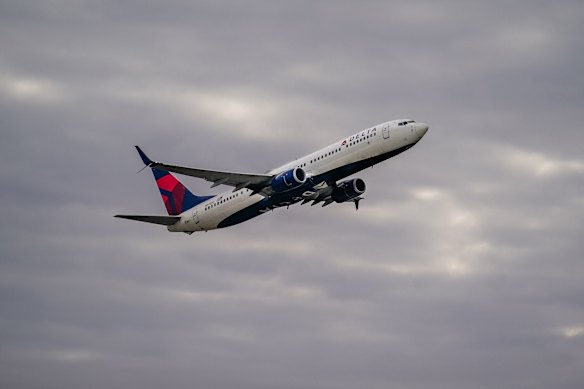
There are signs airlines are aware of the issue. Delta Airlines replaced the auxiliary power units on over 300 Airbus 320s because of air quality issues. (The small engine units provide pneumatic air for onboard air conditioning when the plane is on the ground.)
The Civil Aviation Safety Authority in February republished 2018 information on handling fume events.
Airlines are encouraged to develop procedures guiding in-flight communications, the use of oxygen-masks, and systematic training for crew on the topic.
The science of bleed air
The Flight Attendants’ Association of Australia, in conjunction with AFAP, wants more extensive and systematic testing and reporting into air quality in aircraft – the kind that can capture data on fume events and the health impact on crew.
Yet consistent, truly comprehensive data showing the frequency and severity of fume events is scarce.
Dr Harrex believes what’s needed is a comprehensive registry, so that anyone who reports exposure can have their case added to it. However, registries cost money to maintain, especially when events are infrequent. So it’s probably beyond the capability of any one airline, he said.
Yet one of the thorniest aspects of the issue of tainted air stems from the design of most commercial aircraft, which use “bleed air”.
“Bleed air” is used not just to help keep the plane pressurised and with enough oxygen but also to keep the cabin at the right temperature, UNSW senior lecturer in aerospace design Sonya Brown said. At about 36,000 feet, the outside temperature is -56.5 degrees.
“If we removed bleed air, we can’t actually get to the temperature requirements easily without using a lot more energy,” she said.
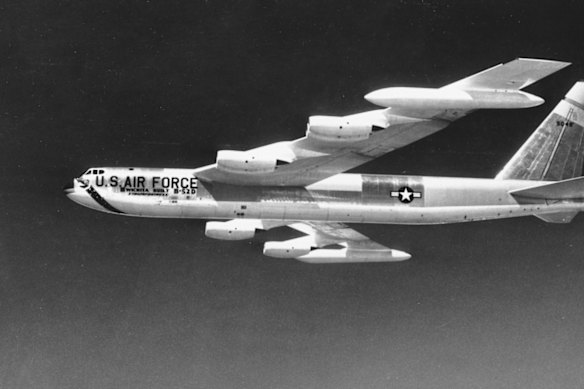
Modern “bleed air” systems are based on the 1950s B-52 bomber design. The bomber’s design formed the template for the shape of commercial aircraft for decades to come.
A spokesperson for Boeing said the company had a long history of supporting industry efforts to assess air quality but the world’s leading aerospace medical associations “have rejected a connection between cabin air and significant health effects, and no aviation regulator has determined that additional safety regulations are required”.
Boeing nevertheless “continues to work with scientists to improve our understanding of cabin environmental factors”, the spokesperson said.
Boeing rival Airbus said its planes were designed and manufactured according to all airworthiness requirements and the company worked with operators and regulators to ensure the best possible cabin environment for passengers and crew.
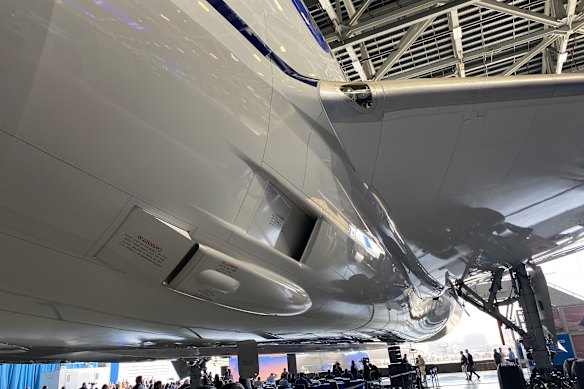
AFAP wants to see “bleed air” systems avoided in future aircraft design. And yet, with its efficiencies, “bleed air” is the default design for most commercial aircraft.
Perhaps it’s for this reason that AFAP’s Safety & Technical Manager Captain Marcus Diamond said that discussions with the ATSB on the issue historically don’t go very far.
“Imagine them saying that all the current modern fleet of airliners have got a design fault in their bleed system. They just won’t do it.”
It’s Boeing, actually, that carries the distinction as the only aircraft maker to create a major plane that doesn’t have the bleed-air system on engines.
The 787 Dreamliner instead uses pumps on the fuselage to bring air in and then to circulate it from there. This involves extra weight and power requirements for the plane.
The approach of the airlines and plane-makers continues to raise suspicions of affected employees.
Wakelin, the former Tiger Airways pilot, said that what was disturbing was her employer’s response to the case. The airline told her essentially that “I was making it up and that I should keep quiet and not talk about it”.
A spokesperson for Virgin, which was in the process of acquiring Tiger Airways Australia from Singapore-based Tiger Airways Holdings in 2014, addressed the incident saying: “The safety and wellbeing of our guests and crew is our top priority.”
”Extensive research shows the air inside commercial aircraft is of high-quality and meets relevant international air quality standards.”
After Wakelin was told by her doctor that she would likely never go back to flying, she began studying for a new career in law. But she actively tried to regain her medical qualification to fly.
After two years, she began to see an improvement with treatment. “I was very lucky.” Wakelin eventually got her medical qualification back and returned to flying with a different airline.
While Woodward, the former captain, acknowledges the issue of sickening fume events, he believes flying is “safe for regular passengers” and suspects “the amount of contamination regular passengers would see would be minimal”.
Dr Harrex, the occupational safety expert, agrees, saying passengers don’t likely face long-term problems from the risk. “For people who are employed as cabin crew who might be getting more exposures, there is a possibility it may lead to long-term consequences.”
“Just because we can’t prove that a health problem may be caused by exposure, or deny that it may be related to the exposure, workers still need to be treated,” said Dr Harrex.
“Their symptoms and illnesses are real and they need to be managed regardless of the causation.”
The Business Briefing newsletter delivers major stories, exclusive coverage and expert opinion. Sign up to get it every weekday morning.