


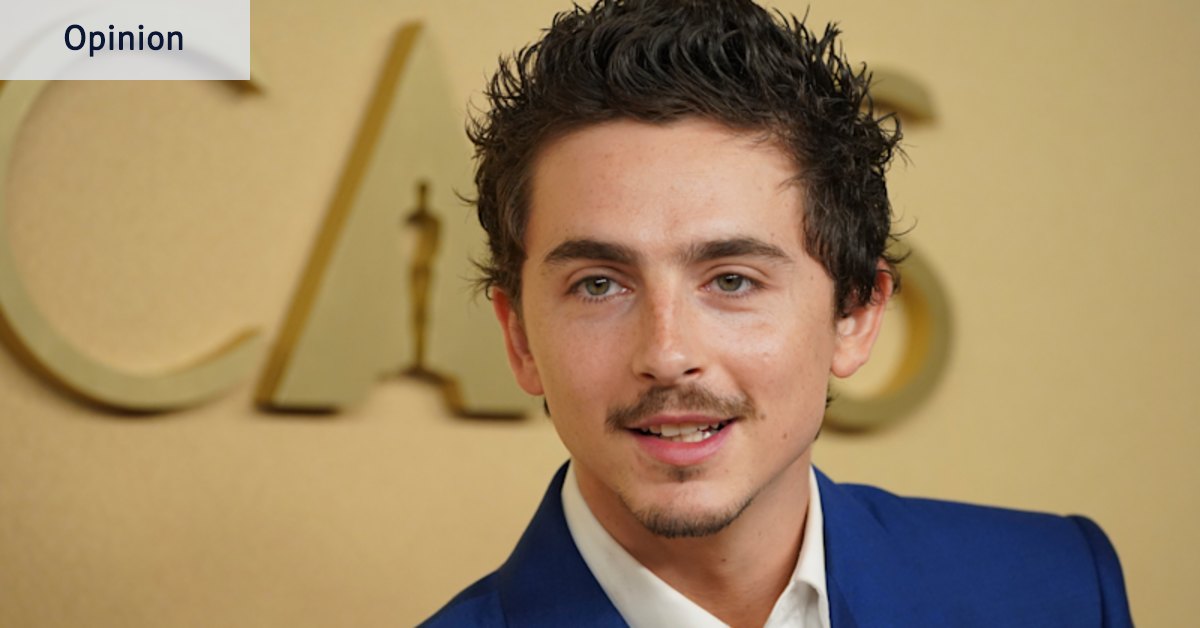
Actor Timothee Chalamet, the puckish young leading-man du jour, has lately discovered the downside to a form of fame powered by a thousand internet posts and lit by a million memes.
For about a decade now, the 30-year-old actor has been one of what is known as the internet’s boyfriends – an arty, non-threatening, emo-ish, quirky young talent, who is just socially awkward enough to feel relatable, even when he’s accepting awards for his acting, flicking his fringe from his eyes as he does so.
He’s handsome in a sweet-faced way that allowed him to be cast as Laurie Laurence in Greta Gerwig’s Little Women, and also as the young gay teenager discovering his sexuality in Luca Guadagnino’s Call Me By Your Name. It helped that he was not the product of a Los Angeles-based fame-system, whereby stars come up through the Disney child-star machine, or perhaps as the offspring of a big Hollywood director.
Chalamet is from an artistic New York family – his mother and sister studied at the School of American Ballet, his sister is also an actor, and he grew up in Manhattan Plaza, a famous New York building which provides affordable housing for performing artists. He even attended the high school that served as the model for the high school in the TV show Fame.
In interviews, he has stressed that he comes “from a theatre background” and talks frequently about his “art”. When he accepted a Screen Actors Guild Award last year he said, “I’m really in pursuit of greatness. I know people don’t usually talk like that, but I want to be one of the greats”.
He has compared himself to Daniel Day Lewis and Marlon Brando, and as part of the press tour for his new movie Marty Supreme, which earned him a best actor Oscar nomination, he said that “it’s been like seven, eight years that I feel like I’ve been handing in really, really committed, top-of-the-line performances”.
“I don’t want people to take it for granted,” he added.
More recently, Chalamet earned himself a huge internet backlash when he made dismissive remarks about ballet and opera, during a YouTube-broadcast fireside chat with fellow actor Matthew McConaughey, so earnest you would think they were discussing something genuinely important, not a movie about a spaceman and another about a ping-pong player.
Chalamet told his interlocutor that “I don’t want to be working in ballet or opera, or, you know, things where it’s like, ‘Hey, keep this thing alive’.”
He added, quickly: “All respect to the ballet and opera people out there,” and said that he “took shots for no reason”. He joked that he would lose “14 cents in viewership” from making the comments.
The internet cancellation was swift, and migrated quickly to the mainstream. He was criticised on the popular US breakfast show The View, and at the Oscars ceremony, host Conan O’Brien made him the butt of jokes.
The problem with riding to fame, popularity and wealth via internet-fuelled celebrity is that the internet always eats its own. This is not a problem that plagues opera and ballet stars, for all their puny viewership.
Even Chalamet superfan Simone Cromer, who has powered his online fame – she runs a popular social media account called Club Chalamet – announced she needed “a break” from “covering the Chalamet/Oscar quests”. According to The New York Times, she is turning her attention to a different star – Connor Storrie of Heated Rivalry.
A young, celebrated actor has an ego? This is not top-of-the-line news, although Chalamet’s naked self-admiration does break the unspoken pact of contemporary celebrity interviews, where they pretend to be fun, approachable and normal.
Movie studios and the Hollywood publicity machine have always manufactured adulation of their stars, but once it was through cover shoots for celebrity magazines, where the star granted a guarded interview and got done up for glamorous photographs. In the social media era, the star on the make must do much more. Magazine covers and talk-show appearances are fine, but he or she must also feed the algorithm.
Social media is now flooded with short-cut videos which can be chopped up for Instagram and TikTok – of co-stars in a film giving each other quizzes on how well they know each other, or female actors talking through their skincare regimes (never mentioning the copious cosmetic surgery help they surely get), or of actors having jokey chats with YouTube personalities over burgers.
This content-creation ramps up massively during the pre-Oscars season, when studios are sending out their stars for publicity to win awards. Add to that the amount of curated content many stars push out themselves on their Instagram accounts, and it becomes overwhelming.
For example, I know what supermodel Cindy Crawford’s morning regime is (it involves a lot of lymphatic drainage skin-brushing). I just don’t know why she needs me to know it.
The result is a celebrity culture so ubiquitous that it is now impossible to go to a movie and not see that you are watching actors, no matter how great, act the shit out of parts.
We know so much about these actors and their personal lives that it becomes difficult to believe in the characters they are playing; to suspend reality and feel we are watching, say, Cathy Earnshaw, rather than Margot Robbie playing her.
It must be even more exhausting for the stars themselves, required to churn out so much casual content to sell their films (after all, cinema-going is also suffering a popularity crisis). No wonder they make missteps like Chalamet did.
Richard Tognetti, the artistic director of the Australian Chamber Orchestra, found the Chalamet fracas mildly amusing, particularly the response of some opera and ballet companies, who used it as publicity.
“It was a clumsy comment which turned into a moral crisis,” Tognetti told me. “But the comments wouldn’t have hurt if they didn’t hit.”
Chalamet was correct – audiences for ballet and opera are shrinking (just as they are for traditional media like newspapers), but there is relevance, in terms of popular clout, and there is resonance, Tognetti says.
If they must justify themselves, the “higher” art forms are part of an ecology that feeds the popular art forms. Films still need scores, generally performed by orchestras. Ballet is a rarefied mini-industry which produces costume and set designers, choreographers and dancers which cross-pollinate the other arts. But surely, the whole point of art is its essential resistance to strictures of productivity or viability.
Artists keep doing art anyway, hoping for large audiences but rarely expecting them. And the upside to having only boutique, offline popularity is that you are unlikely to get cancelled by the same algorithm that hyped you up.
Opera, full of rape and misogyny, has ridden out its lack of political correctness, and ballet remains the foundation of many forms of dance.
I’m sure you could watch a cut of Nessun Dorma on TikTok, perhaps sped up to cater to the contemporary attention span.
But it has considerably more power when you see it in the Sydney Opera House – so named for a good reason.
