


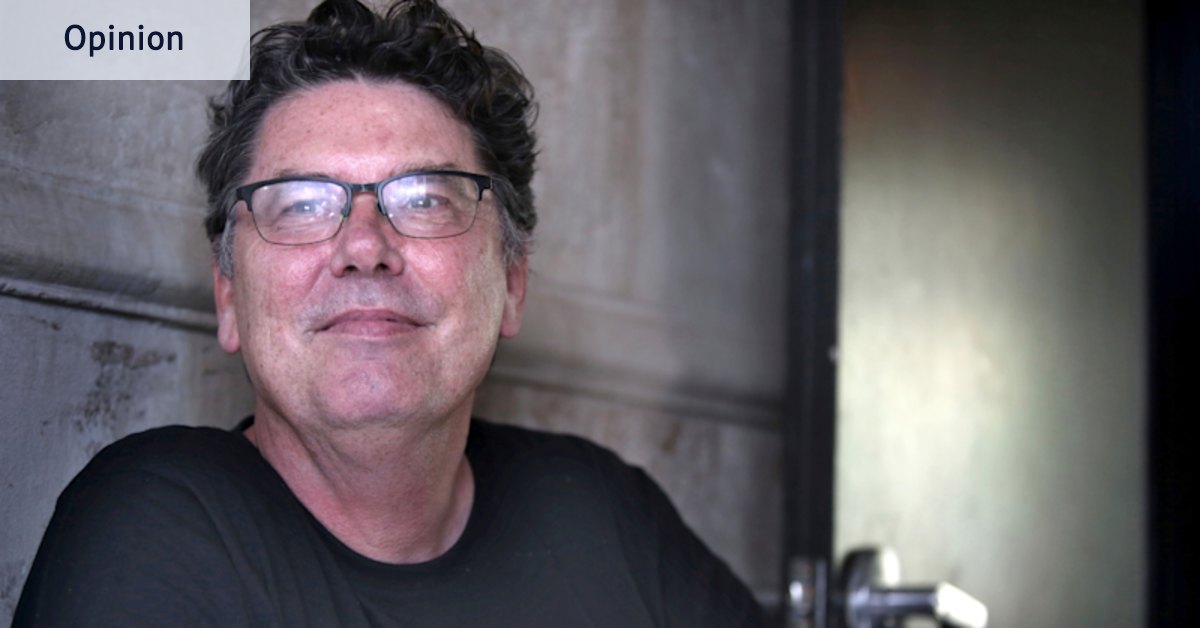
Everyone loves James Valentine. From his days as a saxophonist with 80s pop quintet The Models to his singularly long career with ABC Radio Sydney, James has accumulated legions of fans and admirers. On February 6, he announced that he would not be returning to the airwaves due to a serious battle with cancer.
Fitz: James, first-time caller, long-time listener … How are you feeling after hanging up your microphone?
JV: Still warmed. It was actually a really lovely time. The response from the audience, from listeners, was just so overwhelmingly wonderful. When you’re on radio, you really feel the audience all around you. But this was like ending the show, and walking offstage, as they tipped their hat. I feel really nourished in a lot of ways by the response. I loved that people got the show. They understood the thing that I put out for the last 25 years was an odd creation, and people got it and said, “Thanks very much”. So I actually feel great.
Fitz: You will know the lovely bloke downstairs at the ABC who’s on the front desk, Jock Hobbs, a man of Fijian heritage, named for a former All Black captain. Did there come a time at the end of your final show where he put out his hand and said: “Security pass, please.” “Badge, please.” “Hand over your pistols.” And then you walked out the door and you no longer had the right to be in the ABC, after three decades?
JV: Yes, but it was effectively four decades, as I started doing kids TV in the ’80s. So it was 40 years on and off, and it really did finish incredibly abruptly. As it happened, I did try to get back into the building, but all my rights had been cut off and they wouldn’t let me in.
Fitz: You’ll probably be aware of the Lebanese philosopher/poet Kahlil Gibran who, in his book The Prophet, has a line, “Like the mountain climber, who can see the mountain more clearly from the plain …” Now that your ABC Radio career is truly over, the true highlight moments must stand out better than ever and truly warm the cockles of your soul?
JV: Absolutely. I had my fair share of famous interview subjects, and I loved, for example, talking for an hour to the great author Douglas Adams, from The Hitchhiker’s Guide to the Galaxy. But what thrilled me even more was just talking to the listeners themselves. I loved it most when I could give them an outlandish proposition – let’s pretend that you can call in from 20 years in the future and describe Sydney from that point – and see this whole fascinating conversation take place, this exchange of ideas and stories.
Fitz: To which you always gave space. In my own first days on talkback – 2GB in 2000, seeing as you ask – I was drilled on the edict, “Greet ’em, gut ’em, get rid of ’em.” But your approach was different.
JV: Yeah, well, I was the opposite of that ethos. My principle was much more: “Let’s dig a little further. There’s probably more gold to come.”
Fitz: And there certainly was. On your final day, you ran the audio of what you said was your most memorable call ever, from Eric, the bloke who matter-of-factly described skiing at Perisher with his wife, who was a new mother, and they’d left their child with grandma down below.
JV: I’ll never forget it!
Fitz: “And so we’re up there, on the slopes,” Ecka the Wrecker says to you, “having a wonderful time. And she’s gone from a B cup to like a double D. And she says, ‘Eric, Eric, I can’t take it, I’m in agony!’ And I did the gentlemanly thing, and we found this quiet spot somewhere and just sat down and drank all the milk, and we went back to ski. Again, she filled up like a couple of balloons, and I did the same thing again, so I never had to even stop for lunch.”
JV: [Laughing uproariously] Now, in 40 years, that was a rare moment of me pretty much being speechless. Was what he was saying even legal? On the one hand, my producer and I were both rolling around the floor laughing. But I was also wary. There are certain topics that are inherently tricky, and breastfeeding is one of those. There’s lots of people who are for it, there’s lots of people who are against it. There’s lots of people who think if you do anything else to what they think, it’s just flat-out wrong. It’s a really touchy issue. And so this was one where I don’t even know what to do. Is this dangerous? Is this fun? Am I about to stomp into this territory that I’m not quite understanding, and suddenly I’m going to be pilloried forever after? I couldn’t say anything. Yeah, I just, I couldn’t figure out quite where he was going, and then he said all that. And it’s the great thrill of live radio. You’re always just three words away from ending your career.
Fitz: In your case, however, sadly, it was just two words that ultimately ended it: “Oesophageal cancer”. Tell me the story.
JV: Well, I was first diagnosed with it in December 2024. I had tumours. And then there was this period where I was going to get full surgery and an oesophagectomy, where they remove the whole oesophagus. And because I broadcast it and talked about it, interviewed the surgeon and told everybody exactly what was happening with me on air, I heard from another group of gastroenterologists at Westmead Hospital who said, “We have an alternative. We’ll just remove the tumour itself.” And I decided to do that and …
Fitz: If I may just interrupt there, your friend and mine, Andrew Denton, often quotes the line from Graham Greene about how, even at his own mother’s funeral, he was observing how people were reacting, thinking: “There’s some great material here for me”. Greene maintained that in the heart of every good writer there is a “splinter of ice”. So, too, you? You’re getting a diagnosis of serious cancer and your first instinct is, “Geez, I can make some good radio out of this”?
JV: [Thoughtfully] Yeah. I must admit, not long after the diagnosis, I started considering in what medium shall I explore this? Do I write something every day? Do I write a diary? Do I, you know, write the memoir of how I went through this? Is it a book? Is it a podcast? Is it live radio?
Fitz: And what did your wife, Joanne [Corrigan], say when you discussed these matters?
JV: Well, she was reasonably used to this sort of thing. The only thing she vetoed was when I once considered doing my vasectomy live. But she was OK with this, whereby I was just frank with the audience from the beginning, telling them exactly what was happening, how I was feeling, including when I revealed that the original oesophageal cancer had metastasised through my gut and as I was facing such a heavy period of chemo, which was going to wipe me out physically, I wouldn’t have the energy to be on air any more.
Fitz: In such public pronouncements, you’ve been, allow me to say, very dignified and very calm. You’ve been gracious and courageous and accepting that suddenly, out of a clear blue sky, you’ve heard thunder and suddenly been hit by a bolt of lightning. But when you’re home with Joanne, or staring at the cracks in the ceiling at 3am, do you give in to despair?
JV: I’ve had every emotion, and therefore, yes, moments of despair, particularly when I think about my children and Joanne and that sort of thing. But, in general, I’ve also tried to approach this with an acceptance, with a sort of sense of “at least live the life you’ve got now”. And so live those good days when you’re feeling well and you’re feeling OK. Enjoy that day. You know, when someone’s come around to visit, you enjoy their visit. And when you can get out to the restaurant, have a good night.
Fitz: When you look at your bucket list, have you crossed out nine out of 10 things? Is there one to come?
JV: Not really. I do tend to look at my life and go, “I did OK, you know”. The fact that I managed to pull off a career out of nothing bar some musical tricks and a bit of verbal ability was great. I have two children I love dearly, who love me back. I’ve got the love of a great wife, and we’re still in love and still happily together. They’re the headline items. Like, if you can pull that off, what else are you talking about, really? There’s not much more on my bucket list. I just need to see my son and my daughter. I need to see Joanne. They’re the only things I really need.
Fitz: You and I were together at Dame Marie Bashir’s state funeral last week. For a man with the diagnosis and prognosis you’ve got, you could be forgiven for idly thinking, “Yeah, well, for my funeral, I’d like …” Did your mind turn that way?
JV: Yes. There’s a bit of wanting to be memorialised in particular ways.
Fitz: Well, this is the best time to say it. Let’s have it on the public record.
JV: I want a joyful funeral. I want to be marched out by every saxophone player in Sydney. I want everybody singing great pop songs we love. I want to lift the roof. I want us all to look into the great unknown, and I want us not to fear that.
Fitz: And what about your ashes or your body?
JV: [Laughs] I’m an ashes man. Somewhere along the coast, you know? I came to Sydney in my teens and moved here in my early 20s, and it’s that coastline and that beautiful blue sky that drew me here, so something like that.
Fitz: All right. As a serious point, I reckon I speak on behalf of everyone when I say that we wish you well. We admire your courage and wish you all strength in difficult times to come. Good luck, mate.
JV: Thank you. Thanks so much. I’m honoured.
Fitz: A pleasure. But listen, James. If these do happen to be your last words to Sydney in the public domain, what are they?
JV: [Thoughtfully, quietly] Thanks for letting me get away with it for all those years …
The Opinion newsletter is a weekly wrap of views that will challenge, champion and inform. Sign up here.
 Peter FitzSimons is a journalist and columnist with The Sydney Morning Herald.Connect via X.