



Examine, a free weekly newsletter covering science with a sceptical, evidence-based eye, is sent every Tuesday. You’re reading an excerpt – sign up to get the whole newsletter in your inbox.
In the cold and airless void on the far side of the moon, cut off from contact with Earth and further from home than any human had ever been, the commander of humanity’s most epic quest gazed into the darkness and thought of his wife.
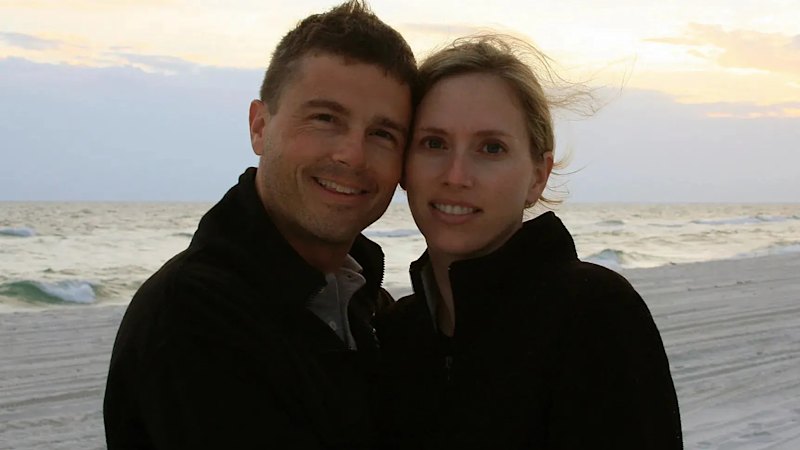
Carroll Taylor Wiseman spent her life caring for sick children and babies. She worked in a newborn intensive care unit and her last job was as a school nurse in Friendswood, Texas, near her husband’s office at NASA.
She passed away in 2020 after a five-year battle with breast cancer.
On Tuesday morning, the husband who still grieves her, Artemis II commander Reid Wiseman, became one the first humans to observe the far side of the moon. He and his three crew spied a lunar crater shining as if dusted with fresh snow.
“There’s a feature in a really neat place on the moon, and it is on the near-side, far-side boundary,” astronaut Jeremy Hansen radioed to mission control on Earth once the Orion spacecraft came back into view and restored comms.
“At certain times of the moon’s transit around Earth, we will be able to see this from Earth. It’s a bright spot on the moon,” he said, before tears almost stopped him from talking and Reid pulled him into a floating hug.
“And we would like to call it Carroll.”
How better to illustrate space travel as a deeply human endeavour? How better to remind us, even as we pursue life beyond our planet, how much we have to learn about the bodies we were born in?
But the Artemis II lunar flyby is not a separate pursuit to advancing medical knowledge and the effort to stop the disease that took Carroll Wiseman.
In fact, on USB-sized sticks secreted within a silver nook on the Orion spacecraft, the furthest-flung biology experiment ever attempted is taking place.
Why astronauts are carrying their own stem cells
Before the four astronauts geared up for their lunar flyby, each donated stem cells from their bone marrow.
The cells were grafted onto USB-sized sticks known as “organ on a chip” devices.
The devices allow scientists to grow human cells in tiny 3D channels, and the chips act as proxies for blood vessels, brains and lungs that scientists can experiment on instead of lab rats or less complex cells in a dish.
Each Artemis II astronaut has a unique chip grafted with their own cells on board the Orion spacecraft.
Once they return, NASA’s scientists will be able to study each astronaut’s individual cellular response to the stressors of space travel, microgravity and cosmic radiation.
Bone marrow cells, which make blood, were chosen because they are among the most sensitive cells to radiation, and act as a bellwether for how other organs are faring.
The investigation is called AVATAR (A Virtual Astronaut Tissue Analog Response).
The ultimate aim is to be able to create custom medicine packs tailored for future space travellers based on their biology and genetics.
Such technology may be crucial for a trip as far as Mars. The research goes to show that, despite the advanced spacecrafts, fuel blasters and laser beams, the most crucial vessel for space travel will always be the human body.
Earthly researchers hope the experiment will advance our understanding of how radiation and chemotherapy can affect blood cell formation within cancer patients.
It also marks a leap forward for personalised or “precision” medicine, where cancer treatments are custom-crafted for patients based on their genetic make-up and the unique properties of their cancer.
Which brings us to the Australian cancer cells about to blast skywards.
Australia blasts cancer into space
In an Australian first, Dr Nirmal Robinson of Adelaide University will later this year send cancer cells to the Swedish Space Corporation, which will blast them into space.
In a dish on Earth, gravity makes cancer cells grow flat. In space, the cells float and form 3D clusters closer to real cancer growths in human tissue. “It gives us a clearer window into how these cells behave,” Robinson says.
The harsh space environment, lashed by cosmic radiation, also serves as a kind of proxy for a human body undergoing cancer treatment – there’s radiation, low oxygen and a lack of nutrients. It’s hard for a tumour to survive.
But a cancerous tumour warps in response to these stresses. The cancer cells that remain after a chemotherapy treatment, for example, are often worse.
“When cancer cells undergo stress and are able to circumvent the stresses, they become really hostile or aggressive,” Robinson says.
When the cancer cells return to Earth, they’ll be snap-frozen and returned to Robinson’s lab to see how space rewired their metabolism, gene expression and proteins.
What happens to your body in space?
Muscles and bones: Weight-bearing bones lose over 1 per cent of their mineral density per month during spaceflight, and muscle mass also declines faster in microgravity without exercise.
Balance: Motion sickness can arise when the sensors in our inner ear responsible for balance can’t feel the familiar pull of gravity. The vestibular system gets used to this, but becomes deconditioned over time, which can cause further problems with motion sickness upon returning to gravity.
Blood pressure: The body’s ability to regulate blood pressure deteriorates the longer a person spends in space, which can result in lightheadedness and fainting once they return to gravity.
Vision: The fluids in the body shift upwards into the head in microgravity, which can put pressure on the eyes and cause problems with eyesight. These issues usually correct themselves on returning to Earth, but can take longer for some people.
Radiation: Outside the Earth’s magnetic field, astronauts are exposed to varied and increased levels of radiation. As we aim towards long-duration spaceflight to Mars and beyond, scientists will need to come up with ways to shield astronauts from long-term exposure to harmful rays.
“What we are really looking forward to is: can we identify some new signatures or new proteins or new genes which we wouldn’t have normally been able to see under gravitational forces? Can those be targeted as a vulnerability in these cancer cells?”
The data could one day help identify ways to kill the most stubborn cancers.
There’s another curious thing that happens in microgravity: cells age faster. While that’s bad for astronauts, Robinson wants to use it to advantage to study cancer in ageing cells.
“Cancer is an age-related disease; many of the cancers develop in aged individuals above 60 or 65.” But it’s hard to study the effect of age on Earth because you have to wait for an animal, cell or human model to, well, age.
“But if you think about cells ageing rapidly under microgravity, then we might be able to understand things better and earlier, which shortens the research time.”
Working alongside companies Cambrian Defence & Space and Blue Dwarf Space, the project aims to create a pipeline for future medical research in space, Robinson says.
“It is going to be useful for people on Earth, and those who will be travelling away from it.”
The Examine newsletter explains and analyses science with a rigorous focus on the evidence. Sign up to get it each week.
 Angus Dalton is the science reporter for The Sydney Morning Herald.Connect via X or email.