


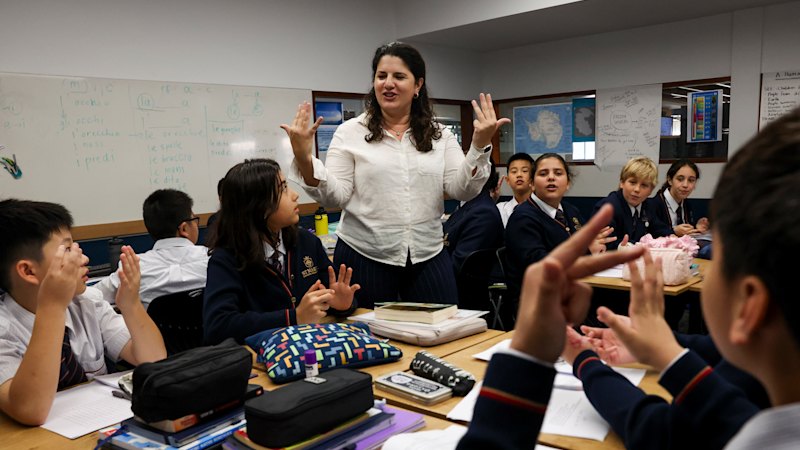

When Emilia Crino took her child to a new high school, teachers pounced when they found out she taught Italian for a living.
“And they said, ‘Do you want a job?’”
The offer, which she declined, came as little surprise to the St Mary’s Cathedral College language teacher due to the chronic shortage in the profession across the state.
While research consistently points to broader cognitive benefits of learning a foreign language, enrolments are declining. The number of public school students studying beginner Japanese halved to 259 compared with a decade ago, while French, Italian and German have seen similar steep declines.
“The literature on learning another language is there and it’s been shoved down our throats and we’re ignoring it,” Crino says.
“It’s good for their maths skills, it’s good for their pattern building, it’s good for so many things. It’s actually great for their English literacy.”
On top of difficulty finding staff, Crino says schools often face difficulties offering languages to just a handful of students in a class.
Newtown High School of the Performing Arts earlier this year advertised for a French teacher. It only found one after offering a $20,000 recruitment bonus.
“You need continuity and you need a critical mass,” says University of Sydney languages professor Ken Cruickshank.
Both of those are lacking in NSW. Last year just 6 per cent of students studying the HSC learnt another language, according to NSW Education Standards Authority data. In 2004 that figure stood at 12 per cent.
In public primary schools, students learning a second language fell from 80,000 students in 2016 to 70,000 students in 2024, the latest year for which data is available.
By comparison, 89 per cent of students in Europe learnt English as a second language while half learnt two foreign languages in the upper years of high school, according to 2024 European Commission data.
In 2012 the Gillard government proposed making all students learn an Asian language in schools, while the landmark review of the NSW Curriculum recommended every student learn a language. The former state government never adopted the recommendation.
Dr Anna Formosa, head of languages at Strathfield girls’ school Santa Sabina College, recently completed her PhD in linguistics. Language study is supported at her school but after conducting research interviews with other language teachers she discovered it was not the case everywhere.
“There’s great frustration. Language teachers, generally in NSW, do not feel supported by this school. They don’t feel supported by their principals,” she said.
Formosa said they faced pressure to “dumb down” their subject.
“They have to make Italian all about ice-cream. There’s a frustration because then when the students pick it in year 9 because it’s fun, then they don’t pick it in year 11 and 12 because it’s not considered serious.”
She said students aspiring to get into top university courses requiring high ATARs could also be put off because of scaling.
In NSW the curriculum stipulates students complete 100 hours of a foreign language over the course of one year between years 7 and 10. In Victoria, learning a language in primary school is compulsory.
St Mary’s Cathedral College and Santa Sabina both start languages in year 5, which Formosa said was helpful.
At Sydney Secondary College Senior Campus in Glebe, French teacher Stella Holmes makes a kind of pact with students before they enrol in the beginners’ course.
“I say to them, look, you’ll get a really basic foundation of French, the 18 months of work requires you to be self-disciplined and committed,” she says.
In last year’s HSC it was the school’s best subject.
There are two French beginner classes, as well as Italian, but they do not offer the continuers’ course for students who completed the year 9 and 10 elective course due to staffing.
“I think our breed is dying,” Holmes says.
Year 11 student Charley Dawson, 16, said: “I think the hardest thing is keeping up with work because Ms Holmes, she expects quite a lot from us.”
Classmate Arielle Bor, 16, studied French when she was in year 8 but said she’s actually learnt a lot more since enrolling in French beginners at Sydney Secondary College’s senior campus this year.
“It’s actually moved pretty quickly, we’ve already started looking at past tense and I touched on, like, future and, like, when I did language in year 8,” she said.
A NSW Department of Education spokesman said there were more than 30 languages available for year 11 and 12 students to study.
“The updated kindergarten-to-year-10 language syllabuses gives schools the opportunity to teach a wide range of languages, encouraging further studies in year 11 and 12,” he said.
Start the day with a summary of the day’s most important and interesting stories, analysis and insights. Sign up for our Morning Edition newsletter.
