


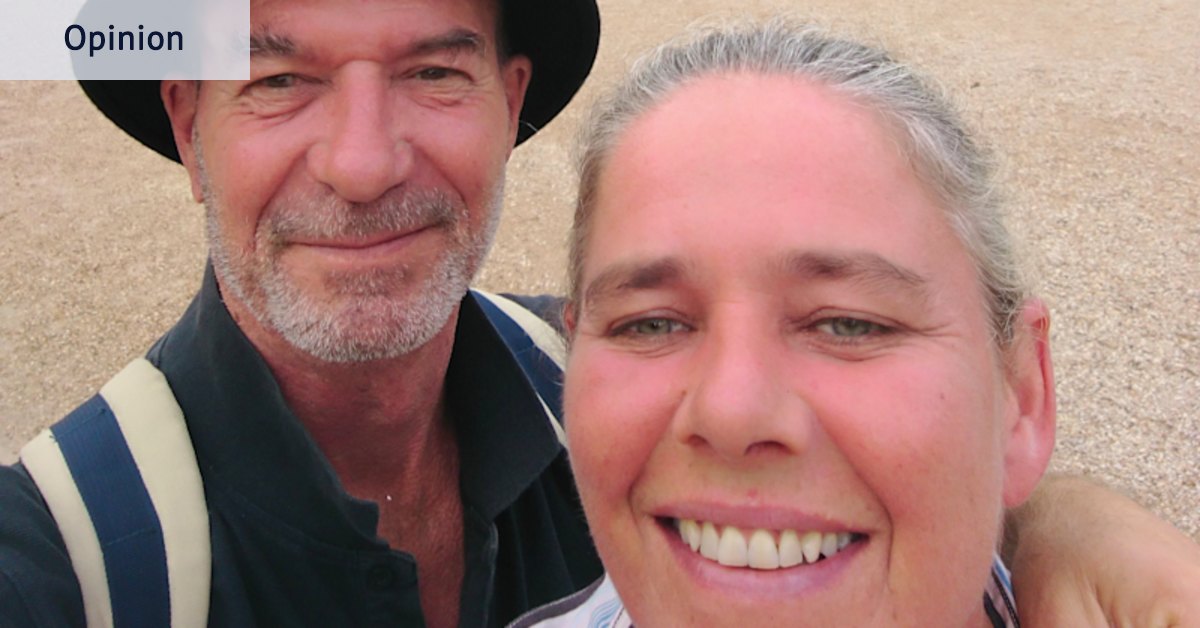
For the past decade, John and Jane Rose have spent half the year in France on their riverboat, living their dream for a remarkably low cost. I caught up with them just before their departure this year.
Fitz: John, mon ami, let’s get to the backstory first. When did you two meet?
JR: In 1993, Jane was at university studying, and I was working in another university as an administrator, and it was love at first sight.
Fitz: So in the early 2000s, you’re living in Sydney when you two made your first decision to rat on the rat race and leave us, yes?
JR: Yes. We were in Gladesville, struggling with a mortgage. I was working as an executive consultant, going out most nights of the week to functions, earning good money in a high-pressure corporate atmosphere, dealing with the demands of politicians and business people but not enjoying it. Life in Sydney was impossible – super expensive, a permanent construction site and such terrible traffic; it took ages to get anywhere. There was a hangover from the Olympics that just never cleared up. Sydney was not a fun place to be.
Fitz: So you decide to decamp and settle somewhere between Woop Woop and the Black Stump in southern NSW?
JR: Yes, after a couple of ventures elsewhere, we moved down to the tiny town of Adelong in the Snowy Valleys, where we bought an abandoned bakery with a wood-fired oven that was over 150 years old.
Fitz: As you do. So you were still thumbing your nose at the rest of us! You’re basically rejecting the materialistic life, you’re rejecting mortgages, you’re rejecting the way the rest of us live, aren’t you? You decided you were sooooo much better than us!
JR: Well, I had realised that the best person to work for, and maybe the only person left standing who would employ me, was me. I’d done a course on how to bake bread in the traditional way and felt it might work in a country town. So Jane and I spent six months renovating the bakery and one great day we opened the door with freshly baked loaves.
Fitz: Did they sell?
JR: Like … hot cakes. The bakery was greeted like the second coming. The little town had everything else bar an old-style bakery and it sort of completed things for everyone.
Fitz: But still that wasn’t good enough for you? You decided to turn your back on that too, for at least six months a year. Will your treason never end? Where did the idea to go to France come from?
JR: For years, my father built a boat and was going to sail the world but never made it out of the harbour. So I thought, “Well, I’ll complete his dream”. Trouble is, Jane doesn’t like it when boats tip over, doesn’t like sailing. So I thought, “Oh well, the next best thing is I will spend the rest of my life exploring the world’s great rivers.” So I started looking at waterways in Europe, and I came across all these people who had made a life of travelling along the waterways on old boats, so I started researching that.
Fitz: Isn’t that extraordinary, by the way? I’m sure a lot of people don’t realise that beyond its highways and byways, its autoroutes and autobahns, Europe is actually crisscrossed by endless canals that come off big rivers and often go to other rivers.
JR: Exactly. There’s 40,000 kilometres of navigable inland waterways in Europe, including going from Amsterdam Harbour to Berlin and further east; from Berlin to Bordeaux to all through the south of France, and so on. Some of the canals date back to the 17th century. So, in May 2016, I went over to Europe looking for the kind of boat we wanted. It had to be old – no plastic fantastic for us, nor expensive modern boats – with at least a couple of cabins and a good kitchen, decent outdoor space, with good electrics and a reliable motor. Not so big that two people couldn’t handle her, but big enough for two people not to be tripping over each other.
Fitz: And …?
JR: And I found one for sale on a canal that comes off Antwerp Harbour in Belgium. An old steel-hulled one, called Eben Haezer, that was built in 1917 and had a very low draft – which we could buy for a song.
Fitz: How did it feel when Jane flew over, you were handed the keys, kicked her in the guts, the engine started and ol’ Eben Haezer was moving?
JR: Effing terrifying. I’ve done plenty of sailing and so on, and in fact we spent our honeymoon on a Halvorsen cruiser on the Hawkesbury River, but we had never handled a boat of that size.
Fitz: And so begins the rest of your life, one of pretty much perpetual summer …
JR: Yes! And even though we could cruise all over Europe, we’ve pretty much stayed with France. There are 5000 kilometres of canals in France alone, and so much to explore we can’t get enough of it. So when we’re in France in a normal year of five or six months, we might go about 1000 kilometres in 150 days, but only cruise for about 60 to 70 days.
Fitz: What does it cost you?
JR: Amazingly little. We shop around for return air-tickets, and they can be got for about $1700. For food, it’s about $500 a head for food every month – which we prepare on board in our own kitchen. About the same for eating out and wine, and then about $1000 a month for fuel for the motor and mooring fees and things like that.
Fitz: So – dot three, carry one, subtract two – that’s about $9k spent over six months, for each of you – cheaper than you’d live in Australia. And when you pull into a little village, let’s say that little-known French village Le Woop Woop – right by that Napoleonic canal in Le Midi – do you come into a marina and have to pay an overnight fee?
JR: Sometimes yes, sometimes no. But even when you have to pay a mooring fee to connect to their electricity and water, it’s usually no more than €10 a night. They’re glad to have us there, to explore their village and region.
Fitz: And your daily life?
JR: Slow. Wonderful. Wake up in our cabin to the sound of the church bells. Wander into the village to get our morning baguette and café au lait, then go off exploring, meeting people, buying three cheeses a week, buying wine from the cellar door, buying great, cheap food and preparing it …
Fitz: Making love at midday …
JR: Making love at midday! Picking walnuts off the grass, picking berries from bushes as you glide along the canal, yeah. And then you moor once more, find a nearby crêperie, and sometimes get invited by the lady owner to stay back so she can teach us how to make Breton galettes. Or get invited by a village boulanger who will take us into his bakehouse to talk about how to make his kind of bread. Or go to a restaurant where, when they find out it’s my birthday, they fetch a cake, dim the lights and get the whole place to sing Joyeux Anniversaire.
Fitz: So everywhere you go, the locals are always happy to see you?
JR: Always. As we glide along, we are right by the tow paths, where people are now walking their dogs, waving at us, greeting us, and sometimes throwing to us some of whatever they’ve collected in their baskets, the berries, walnuts and so forth.
Fitz: What are “tow paths”?
JR: The barges on these canals, filled with produce from the farms, used to be towed along by horses, or if they didn’t have one, a donkey – and if they didn’t have either, women. And now people use them to go from village to village. They’re absolutely flat, and therefore also great for cycling. We now have two e-bikes on board, so once we moor we often venture as far as 40 kilometres away, exploring chateaus, vineyards, ruins and so forth.
Fitz: This is not hard to like!
JR: Yes, but it’s not just about France, and the people in the villages. There is also the life on the canal, meeting other boaters, from UK, Sweden, Denmark and so forth, looking after each other when things go slightly wrong. Jane and I travel very much as a self-contained couple, but we have never felt alone or isolated at any time. It’s all about getting out of ourselves and experiencing life daily with other people from outside our normal circle. It feeds the soul in 1000 little ways, quite different from visiting museums and galleries and cathedrals, although you can also do that as well.
Fitz: Of all your explorations over the past decade, what is the most exquisite part of France that you’ve been in?
JR: Canal de Bourgogne, the “missing link” which connects the English Channel to the rivers that can take you all the way to the Mediterranean. It’s just a few days’ cruising from Paris and takes you right across country to Dijon. But cruising the Seine River is also wonderful, as is mooring in Paris, and going from there along the Marne River through the whole Champagne region.
Fitz: Mooring in Paris …?
JR: It cost €50 a day to moor on the Seine right in the centre of Paris, near the Bastille and a quick walk to the Louvre.
Fitz: Is Jane thrilled with the whole thing, and does she call you “Skipper” or “mon Capitan”?
JR: She loves it, and calls me all kinds of things, but neither of those. And she’s crucial to the operation. The Canal de Bourgogne, for example, has lots of locks and it can be heaps of work to get Eben Haezer through. I’m behind the wheel, and she has to throw the ropes onto the bollards. It can be very tricky navigating into them sometimes, so we’ve worked out a series of hand signals where she tells me how much space to the side, how much to the front, just how much I’ve got it wrong by this time, and so on. We finally get it done, and then afterwards have a drink and make up.
Fitz: Have you got a message for all of those people in Sydney you left behind 20 years ago? They’ll be reading this now. What’s your message? “See you, suckers!”?
JR: No. It’s: “See you join us!” It can be done … It’s just a bloody good life, and cheap. No winter. Great food and wine. Fabulous friendships made every week. We avoid every responsibility we’re expected to knuckle under to. Every day is different.
Get a weekly wrap of views that will challenge, champion and inform your own. Sign up for our Opinion newsletter.
 Peter FitzSimons is a journalist and columnist with The Sydney Morning Herald.Connect via X.