


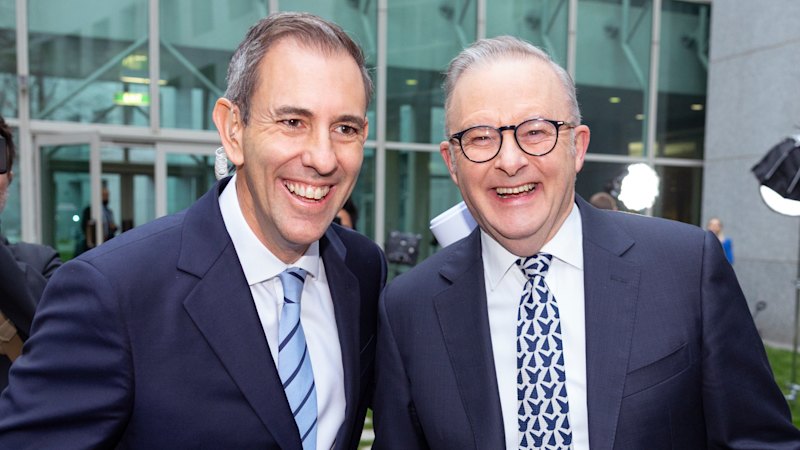

Prime Minister Anthony Albanese is open to changes on a proposal to tax trusts that the Coalition has described as a “death tax”, according to government sources, though Labor will overlook a business outcry and push ahead with its remodelling of the capital gains tax.
The public furore is not persuading Labor to rethink its CGT plans, according to well-placed sources in the government who say that the silent majority of voters, particularly young people without assets, are either pleased or unaware of the changes.
The government is, however, open to a reversal or amendments on its contentious move to include discretionary testamentary trusts in its minimum 30 per cent tax on discretionary trusts, the sources said.
As analysts warn of a major property price drop after Treasurer Jim Chalmers announced sweeping tax changes in the budget, former Labor leader Bill Shorten told this masthead’s Inside Politics podcast that there was lots of “noise” from critics but said the party could win the long-term argument on the merits of its budget.
Shorten, who faced a Coalition “death tax” scare campaign in 2019, warned of the political attacks that could stem from any proposals around taxing testamentary trusts – a surprise inclusion in Labor’s budget last week.
Labor’s decision to replace the flat CGT discount with an inflation-adjusted model used last century has provoked anger from small and medium businesses and entrepreneurs, who say the new model will penalise risk-takers and benefit lower-growth investments at a time of poor productivity.
This masthead reported on Tuesday that Labor insiders were worried about the economic consequences of changing the CGT discount for investments beyond housing, and that Labor’s caucus was growing uneasy about the business backlash.
Chalmers moved on Thursday to counter criticism that the government’s budget was anti-aspirational, telling reporters in Perth that Labor was “not making a judgment on people who’ve done well – we want more people to do well.”
A Labor MP who represents a more affluent seat said on background that the Liberal Party was too heavily swayed by a small segment of tech and crypto investors who were filling Coalition MPs’ social media algorithms, but not reflective of the rest of the broader community.
Separately, Housing Minister Clare O’Neil said on social media: “Does anyone find it weird that a whole bunch of internet finance bros are suddenly concerned about renters?”
Those CGT and negative gearing changes – the latter having received barely any criticism – will be pushed through parliament by July, almost certainly with Greens support in the Senate, though the minor party has previously indicated it wants Labor’s changes to go further. The new rules will take effect this year and expand in 2027.
The government is consulting the tech sector about potential carve-outs for a limited range of firms such as start-ups, as the government acknowledges they may be hard hit by the CGT changes.
The government may allow income averaging or allowances for firms whose employees are effectively paid in stock options. These changes are unlikely to satisfy a growing host of critics, including independent MP Allegra Spender and former Labor adviser Lachlan Harris, who worry the new inflation-measured discount will chill investment and hurt many business people, not just start-up founders.
Unlike the CGT and negative gearing plans, which will be rushed through parliament next month, Labor is planning a months-long consultation on the trusts changes, which are designed to kick in from July 2028.
Trusts are politically contentious because hundreds of thousands of families and businesses use them; these include “bucket companies” used by many small firms and family businesses.
Discretionary testamentary trusts are used by families to protect assets when, for example, parents are worried about the reliability of their child’s partner who may claim half an inheritance, or when parents die before a child is old enough to manage an inheritance.
There are more than one million trusts, of which 840,000 are discretionary. About 10,500 Australians have testamentary trusts, though some are fixed rather than discretionary and therefore won’t be caught up in the tax changes.
Trusts set up for farmers, or on behalf of minors and vulnerable people, are also exempt, although the final detail of how exemptions will work is yet to be settled.
The notion of a death tax has long been contentious in Australian politics. More than 20 countries in the OECD, a club of rich nations, have some type of inheritance or estate tax.
Many mainstream economists support inheritance taxes as a way of balancing the taxation of capital and labour and countering the growing trend of young people only being able to buy property if they have well-off parents.
The Coalition ran a campaign against Bill Shorten in 2019, suggesting his tax agenda, which included a change to franking credits, amounted to a “death tax”, which he was not actually proposing.
On the Inside Politics podcast, Shorten said: “There’s always an issue soon as you’re talking about testamentary arrangements that you are talking about inheritance, which then leads to the possibilities of a scare campaign.”
Earlier this week, Opposition Leader Angus Taylor labelled the changes “a death tax by stealth, there’s no doubt about it”.
Morgan Stanley analysts sent a note on Thursday saying the combination of CGT and negative gearing changes and a rate-hiking cycle could “fundamentally change the asset allocation decision for households”.
“We estimate that housing prices would need to fall 5 per cent to adjust to the tax changes (with a permanent reduction in investor demand share), but taking into account the soft starting point for housing with RBA rate hikes, we see a 5-10 per cent drop in national prices as likely, one of the largest price corrections over the past 40 years,” they said.
On Thursday, in a conversation about football on FM radio in Brisbane, Albanese was confronted by a host about what “feels like a lie” in relation to Labor’s broken pledges on tax concessions.
Albanese responded: “No, look, we changed our position. You’ve got to be upfront about that. And just like, you know, you’ve got to change your position sometimes in a, in a footy game if things aren’t working. And the truth is that the housing system isn’t working for young people.”
Cut through the noise of federal politics with news, views and expert analysis. Subscribers can sign up to our weekly Inside Politics newsletter.
 Paul Sakkal is Chief Political Correspondent. He previously covered Victorian politics and won a Walkley award and the 2025 Press Gallery Journalist of the Year. Contact him securely on Signal @paulsakkal.14.Connect via X or email.