


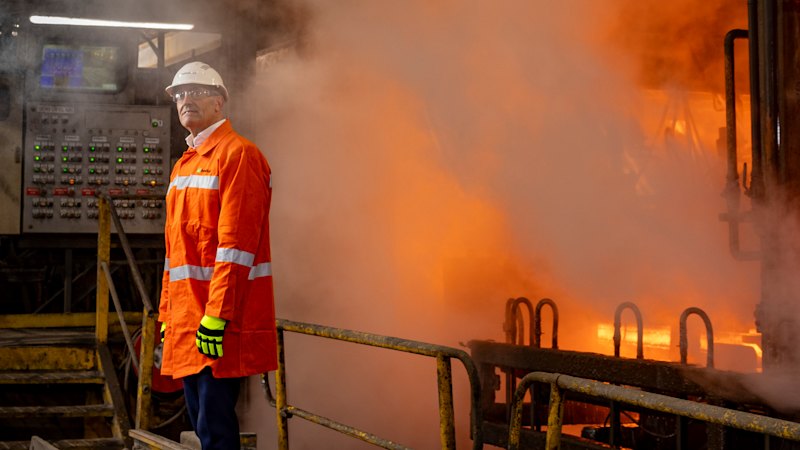

A steel mill on the industrial edge of Melbourne has become the first in Australia to draw more than half of its power from renewable energy sources, marking a step forward in the push to clean up one of the world’s most carbon-intensive industries.
Since activating a new energy supply deal on April 1, InfraBuild’s Laverton steel mill in Melbourne’s west has been contracting enough electricity from a wind farm to cover more than 50 per cent of the power it needs to melt scrap metal into molten steel.
The rest of the power for the mill’s furnace continues to be drawn from the grid, which relies on a fluctuating mix of fossil fuels, renewable energy and storage.
The move reflected growing efforts by companies and governments to decarbonise steelmaking, which accounted for up to 8 per cent of the global output of greenhouse gas emissions, InfraBuild chief executive Francisco Irazusta said.
“This means a significant reduction of carbon dioxide emissions per tonne of steel that we produce,” he said.
“Our objective is to go to 100 per cent renewable. We have a target to reach that by 2030.”
Experts deem steelmaking as an industry where pollution is hard to abate. It is a corner of the economy where phasing out climate-warming emissions is particularly difficult. The main way of making steel today — by heating coal to create coke, then burning it inside massive blast furnaces to melt iron ore — emits vast quantities of carbon dioxide into the atmosphere.
“Those who have claimed over the years that renewables can’t power Australia’s heavy industry must now confront reality.”
Matt Kean, Climate Change Authority chairman
But as efforts accelerate to arrest climate change, steelmakers are increasingly shifting their growth plans from blast furnaces towards electric arc furnaces, which use a high-voltage electric current to melt down scrap metal from products such as old building materials, cars or refrigerators. If powered by renewables, this step of the steelmaking process could achieve major emissions reductions.
Climate Change Authority chairman Matt Kean said the move by a major Australian steel manufacturer to source more than half of its power from renewables was an undeniable demonstration of the “energy transition happening in the real world”.
“Those who have claimed over the years that renewables can’t power Australia’s heavy industry must now confront reality,” Kean said.
“The economics of renewables have moved decisively, and the manufacturers who lock in those advantages first will be the ones who compete globally.”
InfraBuild runs another electric furnace, in Sydney’s Rooty Hill, which sources a quarter of its power from renewables. InfraBuild, with its two steel mills and a network of manufacturing, recycling and distribution sites across Australia, ranks as the second-largest local steel company behind BlueScope
However, it has come under intensifying scrutiny over the state of its finances. The company is part of British billionaire Sanjeev Gupta’s fraying global empire, GFG Alliance, which was thrown into financial turmoil after the collapse of its financier in 2021, leading to the South Australian government pushing its Whyalla steelworks into administration last year due to unpaid royalties and debts.
InfraBuild says it is “ringfenced” from the wider group and has separate financing. Despite the upheaval at GFG, Sydney-based InfraBuild is planning a major expansion in Australia, aiming to increase the Laverton plant’s production volumes from 750,000 tonnes of steel to 1 million tonnes by the end of 2028, and to lift Rooty Hill’s output from 620,000 to 680,000 tonnes.
Irazusta said the company was on track to reach 100 per cent renewable power for its two electric arc furnaces in a “couple of years max”. It would also seek to lock in supplies of biomethane – produced when bacteria break down organic material – as a cleaner replacement for the natural gas currently used in parts of its mills that cannot be readily switched to electricity, such as reheating steel billets to be rolled. “We are already having discussions with different potential suppliers,” he said. “I also think we could have that solved in the next two to three years.”
About 75 per cent of InfraBuild’s steelmaking emissions come from electricity. The rest come from natural gas.
The use of cleaner energy at steel mills would appeal to customers who increasingly wanted to lower the carbon footprint of their end products, said Davina Rooney, chief executive of the Green Building Council of Australia, which administers the “Green Star” sustainability rating system for properties.
“Australia’s property [industry] is entering a new phase of decarbonisation where it’s not just about the emissions from what we use from the grid, but it’s about how the buildings themselves are built,” she said.
Embodied carbon – referring to the emissions caused by the extraction, manufacturing and transport of building materials – was about 16 per cent of Australia’s total “built environment” emissions in 2019, and it was set to make up an even larger share as the grid continued decarbonising, Rooney said. “Without other interventions, it will balloon to 85 per cent in 2050,” she said.
While renewable-powered electric arc furnaces will help decarbonise steel, industry leaders caution that limitations remain, including that there is not enough high-quality scrap metal available in the world to meet growing demand.
The most promising technology to replace blast furnaces to make new steel is what’s called “direct reduced iron” production, which uses green hydrogen, made from renewable energy, instead of coal to reduce iron ore. However, the technology is not yet widely used due to high production costs and the limited availability of green hydrogen.
The Market Recap newsletter is a wrap of the day’s trading. Get it each weekday afternoon.
 Nick Toscano is a business reporter for The Age and Sydney Morning Herald.Connect via X or email.