


This summer, the vast Thwaites Glacier in Antarctica had so much meltwater running down its face, it looked like it was weeping.
Dr Yixi Zheng, a climate scientist at the British Antarctic Survey, describes standing on board the South Korean icebreaker Araon in the Amundsen Sea, looking at the Thwaites ice shelf towering 40 metres above her.
“It’s like a 10-floor building in front of you, and it is melting so fast the water is dripping fast down – between dripping and a waterfall,” Zheng says.


“When you see it, it really just triggers you. You see that they are melting, almost crying in front of you.”
The scientists from a joint British and South Korean mission also noticed a “shimmering” effect at the sea surface and realised it was the meltwater from beneath the ice shelf – the frozen freshwater at the end of a glacier that extends beyond the grounding line into the ocean.
“The ice shelf base is quite deep, maybe 200 to 400 or even 500 metres [underwater], but the momentum of the meltwater can still reach the surface, and we can observe it, we can see the shimmering,” Zheng says. “It is almost like the ice shelf is like shivering.”
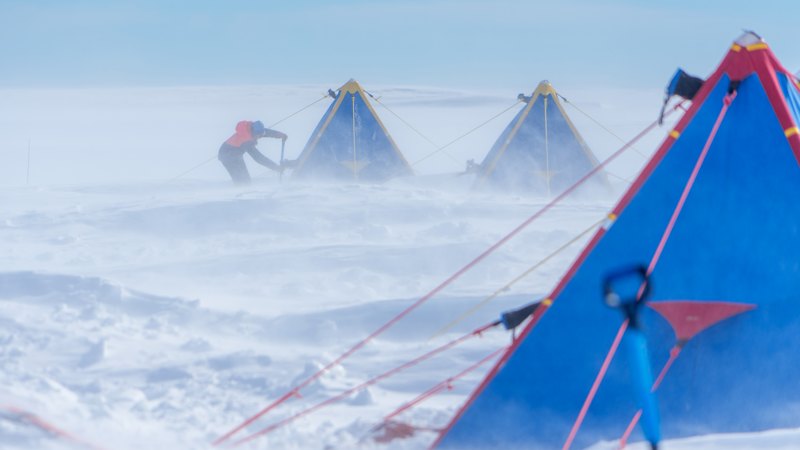
When the scientists left the ship to camp on the ice shelf for 12 days, they could not use their usual fixed-wing plane because the ice was in such poor condition, riddled with heavy crevasses, cracks and cavities. Instead, they used a helicopter, which gave them a close view of the damage.


They were camped 30 kilometres from the open ocean, Zheng says, but even here the temperature of the water under the ice was 1.1 degrees – about 3 degrees above the freezing point of seawater.
Scientists from the Korea Polar Research Institute, on a repeat visit to Thwaites, have used radar to detect that the ice shelf is thinning between 40 and 140 metres a year.
The Antarctic summer provides a window for an annual flurry of scientific endeavour. Polar scientists have now returned to their home countries and started combing through their research.
The news is grim. The frozen continent is rapidly warming, sea ice is disintegrating, glaciers are shrinking, and the resulting meltwater is already disrupting climate systems half a world away.
Often called the “doomsday glacier”, Thwaites contains enough water to raise global sea levels by 60 to 65 centimetres. Some other glaciers actually contain more water – Denman in East Antarctica would raise sea levels by 1.5 metres if it melted fully. Yet Thwaites is unstable and melting rapidly, posing more of an immediate threat though a full collapse is not likely this century.

Dr Edward Doddridge, a physical oceanographer at the Institute for Marine and Antarctic Studies (IMAS) in Tasmania, says Thwaites and other glaciers in West Antarctica collectively contain five metres of sea level rise.
“There’s mounting evidence that we have already reached the point at which they cannot be saved,” Doddridge says. “It’s grim.”
Lowering emissions would mean they melt much more slowly, buying crucial time for humanity to adapt.
The rest of Antarctica has not seen dramatic losses yet, but with an enormous 52 metres of sea level rise locked away in the East Antarctic ice shelf, scientists are scrambling to understand what is in store.
“The massive sea level rise potential in East Antarctica is why we are all so worried about it, even though it hasn’t done anything yet,” Doddridge says.
Most Australian scientists focus on East Antarctica, where the Australian Antarctic Territory is located, and the Southern Ocean. This year the CSIRO’s flagship RV Investigator made an expedition to Cook Glacier to map the sea floor and take sediment core samples that provide a fossilised archive of life dating back millions of years.


Lead scientist on the so-called COOKIES mission, Dr Linda Armbrecht from IMAS, says out of all the hotspots for melting in East Antarctica, the Cook region is thought to be the most vulnerable.
“Our focus was on the history of the area, where we can actually look into the changes of the past so that we can predict where this ecosystem and the ocean in this area is going in the future,” Armbrecht says.
Other research has extracted ice cores that contain an archive of past climate, providing a record of past snowfall and atmospheric gases, and other information.
The melting ice is consequential for another reason – meltwater in Antarctica and the Arctic affects global ocean currents and the climate thousands of kilometres away.


The global conveyor belt
Among a slew of academic papers published in the past month are several on the overturning circulations that together form a global conveyor belt of ocean currents.
The best known of these is the Atlantic Meridional Overturning Circulation (AMOC). The famous Gulf Stream is a surface current that is part of AMOC and also driven by trade winds.
This is the climate driver that keeps the weather in Europe and Scandinavia relatively balmy compared with North America. Fun fact: New York City is at roughly the same latitude as Portugal, and Nova Scotia in Canada is equivalent to northern Spain and southern France.
The Antarctic version of the AMOC – sometimes called the Southern Meridional Overturning Circulation (SMOC), Antarctic Meridional Overturning Circulation (AntMOC) or Antarctic Abyssal Overturning Circulation (AAOC) – is less well known, but just as important.
The Antarctic overturning system plays a significant role in the circulation of nutrients back to the surface. This allows phytoplankton – a building block of the food chain – to thrive and absorb carbon dioxide through photosynthesis. Phytoplankton consume an estimated 40 per cent of all greenhouse emissions, about four times as much as the Amazon rainforest.
A growing number of scientists believe the AMOC could be reaching a tipping point where the system will sharply weaken or collapse this century. Matthew England, scientia professor at the University of NSW and deputy director of the Australian Centre for Excellence in Antarctic Science (ACEAS), says in the past this has meant ice ages in North America and Europe.
“You wouldn’t get a Day After Tomorrow disaster movie ice age scenario under future climate change because the world will be so much hotter,” England said. “But an AMOC collapse would create a major climate disruption, with severe consequences for agriculture and social systems.”
A shutdown of AMOC would mean a more La Nina-like world, England says, with more flooding rains over eastern Australia and worse droughts and bushfire seasons over the south-west United States.
Turning off AMOC would not only make Europe much colder than it is at present, but it would also lead to substantial oceanic carbon release, says a March 2026 article in Communications Earth & Environment. As a global average, this would lead to about 0.2 degrees of additional warming, but regional effects would vary – the Arctic would be 7 degrees cooler and Antarctica would be 6 degrees warmer.
Predictions for AMOC range from a modest decline to full collapse by 2100. The projections used by the Intergovernmental Panel on Climate Change (IPCC) suggest weakening of a further 24 to 39 per cent, depending on the emissions scenario.
An April 2026 study in Science Advances suggests the AMOC is most likely to slow by about 50 per cent by 2100.
A March 2026 paper in Wiley Interdisciplinary Reviews: Climate Change finds that the AMOC has already weakened by about 15 per cent since the mid-20th century, and could be at a tipping point that could see it transition to a substantially weaker or collapsed state.
An eventual AMOC collapse might be already unavoidable, even under moderate climate change, the paper says. England, a co-author of the Wiley paper, says this is a system that has been stable for thousands of years.
How does it work?
Sea ice in the polar regions forms in winter and melts in summer. Multi-year ice survives the summer months, but the overall area grows and contracts.
When the sea ice forms, only the water freezes. The salt is forced out, and the resulting brine falls to the depths of the ocean because of gravity. The water at the bottom of the ocean is extremely dense because it is so cold and salty.
Pushing denser water to the bottom of the ocean displaces the water that is already there, causing upwelling. The strong westerly winds in the Southern Ocean also contribute to upwelling.
Upwelling and downwelling are linked in a continuous loop known as an overturning circulation. This exchanges colder abyssal water with warmer surface water, and brings nutrients from the ocean depths back to the surface.
Downwelling (or sinking) portions of the overturning circulations occur in both polar regions, one near Greenland and the other near Antarctica. They are linked through ocean currents as one giant global conveyor belt, but they also have localised effects.
“Around Antarctica, we’re talking about less than 1 per cent of the total area of the global ocean, yet these isolated polar waters control the circulation and properties of half the world’s ocean by volume,” England said.
The AMOC takes cold water that sinks in both the Greenland and Labrador seas to the tropical east coast of the Americas via deep ocean currents. Completing the loop, currents carry warm tropical surface water from the Gulf of Mexico past the East Coast of the United States to the North Atlantic.
Antarctic bottom water is the densest and fills the bottom two to three kilometres of the world’s oceans. Atlantic deep water is not as dense, and it fills the water column at depths of 1500 to 4000 metres.
How the overturning circulations replenish nutrients in the oceans
Nutrients near the surface of the ocean support life. Inorganic nutrients are consumed by phytoplankton, which absorb carbon dioxide and provide the building blocks of the food chain.
Dissolved organic matter is broken down by microbes, regenerating nutrients. Particles of organic matter such as dead organisms and faecal matter fall to the ocean floor because of gravity, making the deepest waters nutrient rich.
When the upwelling occurs, it spreads the nutrients from the bottom water back through the water column.
Turning off the Antarctic overturning circulation would give warmer water more access to the ice shelves, which would lead to more ice melt. In what is known as a “feedback loop”, the extra meltwater would further slow down the overturning.
The oceans and near surface air are already heating up – up to 3 degrees in the Arctic and between 0.5 and 2 degrees across most of the globe. The notable exception is the so-called “cold blob” south-east of Greenland, which is about 1 degree colder than 100 years ago, and is thought to be a sign of the AMOC slowdown.
Global warming is causing the melting of freshwater locked in ice sheets and glaciers in both Greenland and Antarctica. Since ice sheets (massive stretches of glacial ice at least 50,000 square kilometres in size) and glaciers sit on land, the melting can raise sea levels. Ice shelves float, so they don’t raise sea levels directly.
Meltwater from all three sources disrupts the global ocean overturning systems. The freshwater is less dense and tends to float on the surface rather than sink and contribute to the overturning circulation.
Doddridge says a modelling study a few years ago included future projections of the melt of the Antarctic ice sheets, and predicted a 40 per cent reduction in the strength of the Antarctic overturning in coming decades.
“When you put extra fresh water into the ocean, it becomes less dense,” Doddridge says. “Even if you form sea ice, the salty brine rejected out of the sea ice isn’t as salty as it used to be, and so it’s not as dense as it used to be, and it doesn’t replenish those abyssal waters in the same way.”

The effect is strongest with the AMOC because in Greenland a lot of the meltwater is flowing off the land onto the surface of the ocean. In Antarctica, more of the meltwater is coming from the underbelly of glaciers, so the dilution is occurring at some depth.
Global warming is also causing less sea ice to form each year, which further affects the overturning circulations. Sudden collapse of sea ice in recent years wiped out entire colonies of Emperor penguin chicks, contributing to the iconic seabird being listed as endangered earlier this year.
Scientists who work in Antarctica sometimes say that in such a vast landscape, with glaciers melting over centuries rather than months or years, the effects of climate change are not always apparent to the human eye.
That makes it hit even harder when it is as obvious as what Zheng saw at Thwaites.
“You feel a sort of very strange emotion because you see the urgency, you see it is melting fast, it is breaking up fast, and we need to do something,” she says.
Get to the heart of what’s happening with climate change and the environment. Sign up for our fortnightly Environment newsletter.
