


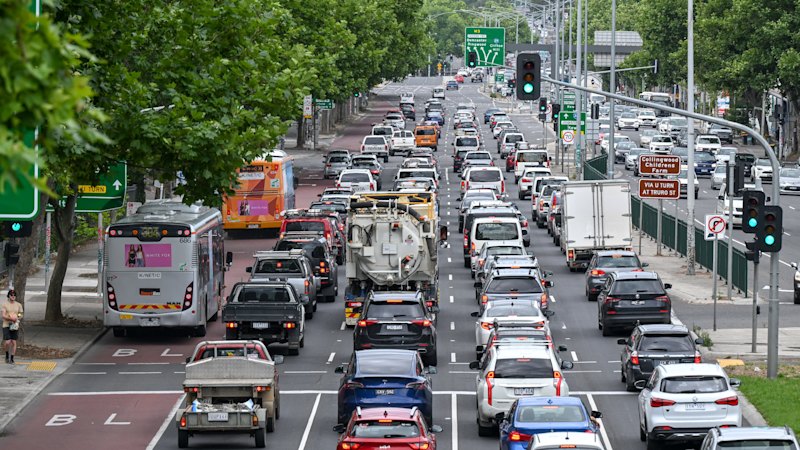

Motorists will be able to claim a rebate on vehicle registration fees from June as the Allan government continues to spend up big in next month’s budget ahead of November’s state election.
Defying warnings from economists and ratings agencies, as Victoria’s debt bill soars above $160 billion, the government will on Sunday unveil another cost-of-living handout, which will cost the budget $750 million in forgone revenue.
It means the government has committed more than $4 billion in recent weeks to new initiatives, including cutting public transport fares, buying new trains, upgrading hospitals, investing in social housing and bolstering emergency services.
Sunday’s announcement of a 20 per cent registration rebate will save eligible vehicle owners $186.
However, Premier Jacinta Allan said the state could afford the one-off cut to the light vehicle registration fee, while maintaining her government would still post a surplus when Treasurer Jaclyn Symes delivers her second budget on May 5.
Light vehicle registration costs up to $930.70 a year for cars, utes and vehicles under 4.5 tonnes. The rebate applies to vehicles driven for personal use, and can be claimed for up to two vehicles per owner, regardless of how many cars in the household.
Motorists will have two months to claim the rebate – for the registration fee they paid in the 2025/26 financial year – through the Services Victoria website when the scheme launches on June 1.
In a pre-budget announcement designed to show voters the government is taking the cost of living seriously amid high fuel prices arising from the war in the Middle East, Allan said the move would have an immediate impact on motorists’ hip pockets.
“It’s one-off cost-of-living help right now, while we are delivering a surplus,” Allan said.
“I’m determined to use government to help Victorians who are under pressure.”
The policy comes on top of the government’s $432 million plan for free or discounted public transport. Free travel on trains, trams and buses runs for two months until the end of May, and then full-price fares will be cut in half from June 1 until the end of the year – a month after the election.
While the measures may benefit household budgets, economists have sounded a warning over the effect the election-year spending will have on inflation and the state’s credit rating.
Victoria’s net debt is forecast to swell from $165.8 billion this financial year to $192.6 billion by 2029, according to the mid-year budget update. At the same time, interest expenses are forecast to reach $10.47 billion by 2028-29.
Independent economist Saul Eslake has argued that if the fuel shock caused by the war in the Middle East continued, it would result in higher long-term interest rates, which would hit Victoria hard because of the state’s high debt.
S&P Global Ratings analyst Rebecca Hrvatin told this masthead last month that while Victoria’s AA credit rating remained stable, it was not immune to changes outside the economic assumptions that informed the state’s budget forecasting.
“If high oil prices, rising inflation and supply chain disruptions persist, Victoria’s operating balances would likely weaken,” she said.
Speaking after the government extended its public transport fare discounts, fellow S&P analyst Martin Foo told the Australian Financial Review that Victoria’s credit rating hinged on the state government “delivering sustained operating surpluses, credible cost control and fiscal restraint as election-related spending pressures build”.
“Any policy that substantially undermines these assumptions could weigh on the ratings,” he said. “We are not surprised to see free/discounted public transport extended, given the political popularity of this policy, but it is another example of how spending that was initially meant to be temporary can prove hard to unwind.”
Both Allan and Symes have maintained the state remains in a strong financial position. But Opposition Leader Jess Wilson has accused the government of putting Victoria at risk of a credit rating downgrade that would bring “higher taxes, higher debt and poorer services”.
In a series of pre-budget announcements, the government has also allocated $673.6 million for 25 new X’Trapolis 2.0 trains and $77.5 million to provide 3500 additional train services.
Other new spending includes $459.4 million for skills and training, $860 million for 7000 social housing properties, $100 million for Country Fire Authority trucks, $217 million to upgrade the state’s forest firefighting fleet, $305 million to redevelop Dandenong Hospital, and $249 million to extend maternity services in the western suburbs.
The burgeoning public sector wages bill is also weighing heavily on the state’s finances, and additional pressure has come from the Australian Education Union as it negotiates a new agreement for teachers.
The union rejected the government’s offer of an 18 per cent pay rise over four years and is instead pushing for a 35 per cent wage increase over three years. The protracted negotiations prompted about 35,000 educators to walk out of classrooms last month, and rolling half-day strikes are set to begin next month.
Start the day with a summary of the day’s most important and interesting stories, analysis and insights. Sign up for our Morning Edition newsletter.
 Bridie Smith is an education reporter at The Age. A former desk editor, she has also reported on science and consumer affairs.Connect via X, Facebook or email.