


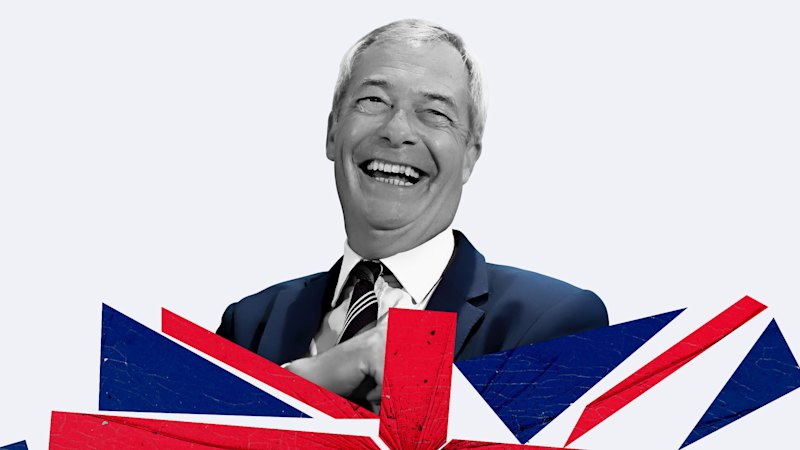
London: Nigel Farage had good reason to sound confident on Thursday when asked about an election next month that could reshape British politics.
The Reform UK leader knows he is gaining ground with voters with his calls to crack down on crime and turn away asylum seekers.
“I want us to win, and we aim to win,” he told reporters as he campaigned in the Welsh town of Merthyr Tydfil, north of Cardiff. “I’m not going to predict we are, but we’re aiming to win, absolutely.”

The polls put Farage and his party on course to seize ground from the country’s two main political parties at elections on May 7 that will decide who controls parliaments in Wales and Scotland as well as 136 local governments across the country.
Labour is exposed to an angry backlash from voters who feel let down by Prime Minister Keir Starmer almost two years after he won power with a handsome majority. The Conservatives and their leader, Kemi Badenoch, are still blamed for squandering their time in office with four prime ministers over 14 years.
While Farage campaigned in Wales, the government lurched into another crisis. The Guardian revealed on Thursday that Peter Mandelson, the disgraced former cabinet minister and friend of sex offender Jeffrey Epstein, failed an official security check before Starmer appointed him as British ambassador to the UK in December 2024.
It was another black mark against Starmer. The prime minister denied knowing the details of the security check, but he had previously told parliament that Mandelson had cleared the “full due process” before starting the job. Debate raged over whether he had misled parliament. By the end of the day, a top Foreign Office official had quit – in effect, taking the fall for not telling the prime minister.
Scrambling to save the prime minister, the government released an email chain on Friday afternoon that appeared to show he had been misled. Parliament is expected to turn a blowtorch on Starmer in the week ahead.
Farage runs rings around his opponents with his sharp complaints about both Starmer and Badenoch, his easy-going chatter with voters in the street and his talk about turning the country around. He knows how to put the snap, crackle and pop into populism.
‘Britain is broken’
But what gives his campaign real power is the agonising national debate about the future of the United Kingdom when so many of its citizens feel the country is in a doom loop. Costs are high and wages are barely keeping up with inflation. The daily headlines are about knife crime and shoplifting. The number of asylum seekers has surged since the pandemic.
There is a pervasive sense that Britain is changing too fast for many of its own people – and they are not listening to Starmer and Badenoch when they offer smooth assurances about their solutions.

Farage has a strategic advantage. He sneers at the Conservatives for failing to fix the problems under prime ministers such as Boris Johnson. And he dismisses Starmer for doing too little since the general election of July 2024.
Most of all, he uses simple language to say something many already feel in their bones. “Britain is broken,” he declares.
A more polished politician would be wary of sounding so grim, but Farage heightens the sense of crisis. The trouble with Britain, he says, is that nothing works any more. This is one of his repeated phrases.
Farage is probably best known in Australia for being a friend of US President Donald Trump and a key agitator for the Brexit vote that took Britain out of the European Union.
But he is known in his home country for much more than this because of the way he taps into discontent about migration, social change, crime and the cost of living. “Britain is broken – and violent crime is everywhere,” he says.

When he takes on Labour, he accuses it of abandoning the working class. “The Labour Party that once represented working men and women has now gone,” he tells voters. “They care more about welfare, migrants and human rights lawyers than hardworking British people.”
When he goes after the Conservatives, he blames Johnson for a “Boriswave” of migration that increased under the previous government. And what makes him so deadly is that both major parties are so vulnerable on their performance in office.
Migration rose quickly in the UK after the pandemic, just as it did in Australia, and the Conservatives were responsible for the rules. In the year to June 2019, net migration into the UK was 206,000, according to the Migration Observatory at the University of Oxford. In the year to June 2023, it was 924,000.
Asylum seekers, meanwhile, are still being intercepted in the English Channel. Hardly any people used this route before 2018. Last Monday alone, there were 201 on three boats.
The official figures show that 41,000 asylum seekers arrived by boat last calendar year. When arrivals at airports are included, 106,000 individuals applied for asylum.
In a sunny economy, voters might be inclined to accept social change. In an overcast economy now lashed by war, voters may be more likely to turn on their leaders.

Even before the Iran war, inflation was running at 3.2 per cent in Britain – and workers were struggling to keep up. In real terms, annual pay growth was just 0.5 per cent last year, according to the Office of National Statistics.
There is a strata of English society where the wealthy can be insulated from this hard reality, perhaps at a country estate or a townhouse in Chelsea. For others, however, it is easy to feel they are running on the spot.
The anxiety is pervasive, even when the facts seem to counter the sense of crisis. Crimes against individuals and households have actually fallen over the past decade, according to the Office of National Statistics. There are fewer homicides. Knife crime fell in the year to September.
At the same time, the mobile phone theft in London is real and makes global news. There are horrendous knife attacks among young men and teenagers. Families know that shoplifting is a bigger problem, not just because they see the headlines, but because they see the heightened security at their supermarkets. If it is not reported, it never shows up in the official data.
‘Vote Reform. Get Starmer out’
Farage appears to be coasting to victory. The polls suggest Reform UK will replace Labour and Conservative councillors across the country, seizing control of more local governments.
This will give Farage a new cohort of politicians to fight the next general election, due in 2029. Although these are only local elections, a big swing to Reform will heighten the sense that Farage can be the next prime minister.
The elections in Wales and Scotland are more complex. In a shock for Labour, it appears to be on track to losing its majority in the Welsh parliament. If this happens, the big winner is likely to be local party Plaid Cymru.
In Scotland, the polls suggest a big swing against Labour and a gain for the Scottish National Party, which already holds power with the biggest bloc in the parliament.

But Farage does not have to gain control in Wales and Scotland to claim success. His campaign slogan is simple: “Vote Reform. Get Starmer out.” He offers voters a way to channel their anger, rather than giving them much of a solution.
If Labour suffers humiliating defeats in these contests, Starmer will face a leadership spill over the summer. And Farage will claim the scalp.
Many in the British media seem to assume Farage will triumph, and the polls certainly suggest Reform UK will make big gains. But he has not cleared all the hurdles in this race.
Farage was confident that Reform UK would win a byelection in Greater Manchester just a few months ago, only to be beaten by the Greens. This was a reminder that voters have more than one option for a protest vote against Labour and the Conservatives. Polls suggest the Greens are likely to do well on May 7.
Farage is also bedevilled by dud candidates. In a spectacular case this week, one candidate for the right-wing party turned out to have a history on the hard left and chanted against Israel at public protests. Another was exposed for posting Islamophobic remarks on social media. Another spread conspiracy theories about COVID.
And then there is the friendship with Trump. Being too close to the US president can come at a cost, as former Hungarian leader has Viktor Orbán discovered.
Farage has had to shift his stance on the war with Iran to avoid this sort of political blowback. At first, he wanted the UK to do more to help the US offensive. More recently, he has backed the US alliance while being wary of going to war.
Starmer seeks to convey strength compared to the prevarications from his opponents. (Badenoch, also, has shifted on the war.) Without being too personal about Trump, he basically suggests he is standing up to a bully.

“It is not our war, a lot of pressure has been applied to me to take a different course,” Starmer told the House of Commons on Wednesday. “I’m not going to change my mind, I’m not going to yield, it is not in our national interest to join this war, and we will not do so. I know where I stand.”
There are fewer than three weeks to go before the votes are cast. Will the Iran war change the outcome? Starmer needs Labour to hold its nerve, look tough against Trump and hope that voters grow weary of Reform.
There are three years go to before the next general election. Farage needs to last the distance if he is to win the ultimate prize and become prime minister. For now, he is thriving as Britain’s prophet of doom.
Get a note directly from our foreign correspondents on what’s making headlines around the world. Sign up for our weekly What in the World newsletter.
