



A Chinese ute with 1000km of driving range and more power than Ford’s Ranger Raptor is set to shake up the Australian car market this year.
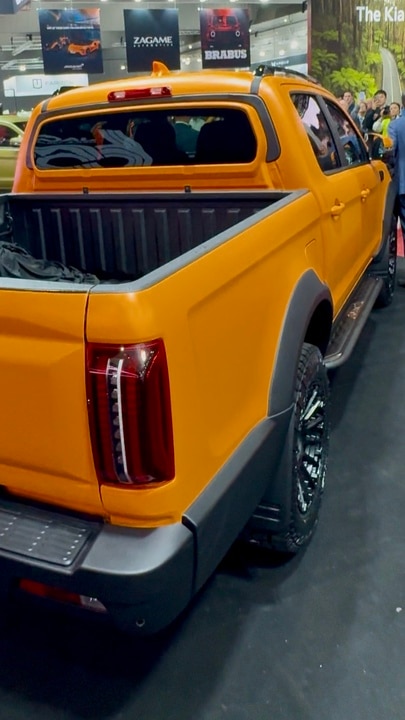
The JAC Hunter follows BYD’s Shark to showrooms as a tough-looking pick-up that combines a turbocharged petrol engine with a powerful battery.
Ahmed Mahmoud, Australian Managing Director of JAC, says the shift to electric vehicles is irreversible, as rising fuel costs and changing consumer habits accelerate demand for electric cars.
“Changing consumer behaviour and the acceptance of electrification, I think is here to stay,” Ahmed Mahmoud said.
“It was hovering around a few per cent of sales, I have no doubt that it’ll be 50 per cent plus in the near future.”
MORE: EVs conquer the Melbourne motor show
That shift has been driven by global instability and a sharp increase in fuel prices.
“I don’t think anybody would’ve predicted, maybe even two months ago, they would be in a situation where diesel is over $3 per litre,” Mahmoud said.
“Whilst I think petrol prices will stabilise, consumer behaviour has already changed.”

His comments come as JAC Motors unveiled its new plug-in hybrid dual cab ute, the Hunter. While pricing is yet to be confirmed, the model is expected to compete aggressively in the growing electrified ute segment.
MORE: BYD to flood market with EVs following fuel crisis
The Hunter pairs a petrol engine with a battery system, delivering a claimed combined driving range of 1005km with fuel consumption of 1.6L/100km. It can also travel up to 100km on electric power alone.
“The hybrid is a stepping stone to full EV,” Mahmoud said.
“The brutal answer is we don’t have as many charging stations as we see in other countries. We also have longer distances to travel.”
MORE: Billionaire’s bold plan to conquer Aus
“When you look at other countries around the world, whether it’s China, Singapore, a lot of major cities, every second corner has got a charging station.” he said.
“We’ve got a long way to go.”
Despite infrastructure problems, Mahmoud said demand for electrified vehicles is rising rapidly.
“Consumer behaviour has already changed. I have no doubt,” he said.
“I do believe there’s a genuine shift … towards more electrified fuel efficient cars.”
Mahmoud acknowledged, however, that traditional powertrains will likely remain part of the Australian motoring world well into the future.
“There will always be a segment that requires diesel,” he said. This will particularly be the case in regional areas and heavy-duty industries.
“ We’re committed to fleets, and we’re committed to tradies that require that. We’ll continue to forward forecast the market. But we’ve got no necessity just to have diesels or hybrids or electric vehicles. We’re afforded the opportunity to create the optimal mix for Australia.”
As for what that optimal mix is now? Mahmoud says it’s changed drastically in a short period of time.
“ If you asked me that eight weeks ago, it’s a very different question.”
“I would say at least for the second half of this year … 60 per cent of the inquiry and the sales will be around that electrified area.”
