


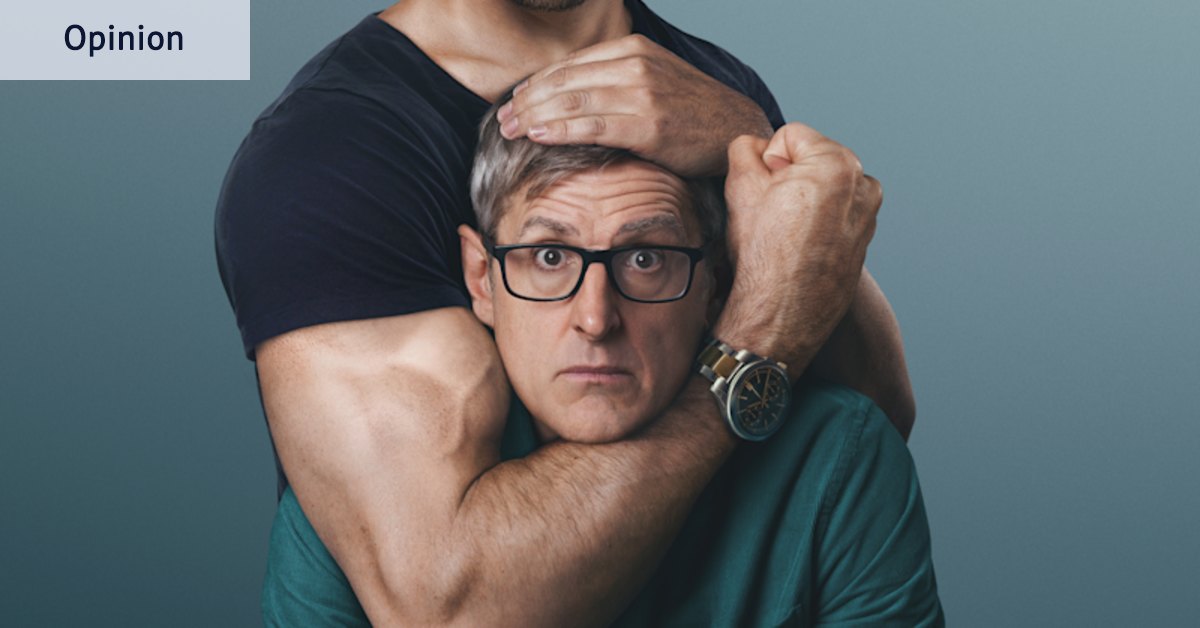
There’s a character missing from Louis Theroux’s Inside The Manosphere documentary, and it’s not Andrew Tate.
Much has been written about Theroux’s probe into the world of the content creators who sell manhood to a generation of dislocated boys. Whether these meditations centre on the missing character or glide over him tells you a lot about the author – and even more about their cultural politics.
Because the missing man is the father. The fathers of each of the interviewees. The fathers of their audiences. The absence forces viewers to grapple with the idea of the father as a key contributor to the development of a child.
Theroux’s documentary is a patchy experience. The filmmaker becomes a character to a degree that even celebrity documentarians try to avoid. He is not sure how to be on the sidelines of this world of misogyny, antisemitism and “paedophile hunting”, which turns into a gay bashing.
His subjects, used to controlling the image they put into the world, are not sure how to handle an outside camera usurping their ability to edit and shape it. They joke about the situation uncomfortably. They turn their cameras on him. They vacillate between hamming it up for the documentarian and seemingly genuinely wanting to be understood.
Nonetheless, valuable insights emerge. First, regarding the content creators’ relationships to women. For all the men boast about “one-way monogamy” and exerting control in relationships because “that’s what women really want”, when their wives and mothers are in the room the dynamic shifts.
The OnlyFans models the men invite on their broadcasts might be happy to play the part the manosphere has written for them. But the women they love disrupt the narrative. Insofar as they tolerate the bluster, they do so because they say the public image is not what they experience in private. The men seem to be trying to prove something to themselves as well as the women, which the women aren’t buying.
And then there are the creators’ relationships with men. Theroux tells the viewer towards the end that “it’s striking how many were raised without dads”. The documentary explores the story of influencer HSTikkyTokky, the child of a single mother, born of a brief relationship with a rugby star. The mum comes across as a switched-on woman who is clearly devoted to her son and worked long hours to give him a good education. If anyone is “enough” as a parent, surely it’s her. And HS tells Theroux that “if there is any trauma there … it is subconscious – it’s not something that I’m aware of”. In a clip of an encounter between father and son, HS’ body language betrays a wary yearning. The subconscious will out.
Another creator, Justin Waller, tells of growing up in a Louisiana trailer park, with a mother who would “just come in sometimes and start punching” his father. As a society, we don’t talk much about female violence. But there’s trauma here too. Justin’s father was later prevented from seeing his children and Justin and his siblings were raised by their mother. We never find out how that came to pass.
These are the sad stories of the men trying to teach boys how to be masculine without having had good role models themselves. That’s like me trying to teach someone to conduct an orchestra, having only observed it being done from afar from the wrong angle.
With the benefit of hindsight, the issue of fatherlessness would have been a strong lead for Theroux to start his investigation into the manosphere, instead of the place to end it. The problem isn’t new and nor is scholarly work on it.
In 1965, Daniel Patrick Moynihan, in his capacity as assistant secretary of labor to US president Lyndon Johnson, authored a report on poverty in black communities, which was politically controversial in its time. The report argued that the high rate of black families in which the father was absent – often due to a cycle of crime and imprisonment – was holding the black community back from attaining economic and political equality. It found that that black families which had both father and mother were more likely to become and remain safely middle class. Many white American families are also now fatherless, often with similar results.
Nonetheless, there is ongoing resistance to discussing the issue of fatherlessness in polite society. Partly from the generous instinct not to shame, guilt or stigmatise mothers and children who, for whatever reason, find themselves in that situation. Partly because there are more than a few shining examples of boys who grow up to be wonderful men and fathers despite not having had a father around themselves. Trust me, I know. I am the daughter of one and married to another.
Not everyone is so lucky. Among the many fascinating insights of a recent federal Department of Education research project, which studied outcomes for 274,000 children based on their first five years of life, is the finding that boys are especially vulnerable to adverse conditions. Not every boy who grows up in a less than ideal situation will suffer serious setbacks. But enough will that we should give special thought to what can be done to protect these vulnerable children.
David Maywald, an Australian advocate for “men, boys, healthier relationships and social balance”, says the research shows that fatherlessness is connected to youth crime, mental health struggles and educational disadvantage. It is also, as Theroux’s documentary suggests, connected to a form of misogyny, violence and antisocial behaviour that are sold as masculinity by men – who’ve never experienced the real deal – to boys looking for role models they don’t have in their own families.
The solution to bad men is better men. And a society which stops treating fathers as extraneous.
Parnell Palme McGuinness is an insights and advocacy strategist. She has done work for the Liberal Party and the German Greens and is a senior fellow at the Centre for Independent Studies.
Get a weekly wrap of views that will challenge, champion and inform your own. Sign up for our Opinion newsletter.
 Parnell Palme McGuinness is an insights and advocacy strategist. She has done work for the Liberal Party and the German Greens and is a senior fellow at the Centre for Independent Studies. She is also an advisory board member of Australians For Prosperity, which is part-funded by the coal industry.