


Stan Choe
Updated ,first published
The Australian sharemarket fell slightly on Friday, but the local bourse held on to much of its gains from earlier in the week as investors remained cautiously optimistic about the fragile ceasefire in the Middle East.
The S&P/ASX200 dropped 0.14 per cent to 8960 on Friday, recovering well after early trade saw a more significant drop than futures markets had estimated. Just three of the ASX’s 11 industry sectors ended the day in the green.
Much of the day’s decline was weathered by technology stocks, which continued yesterday’s fall. Wisetech and Xero fell 2.5 and 2.6 per cent respectively, despite the US’ tech-heavy Nasdaq composite index gaining 0.8 per cent overnight, continuing a torrid year which has seen the broader sector fall nearly 30 per cent since January.
Industrials and energy stocks also faltered. Toll road operator Transurban was down 1.9 per cent, and coal producers also fell, with Yancoal down 3 per cent and Whitehaven falling 3.2 per cent.
The Australian dollar was trading at US70.6¢ at 4.55pm.
Overnight, Wall Street finished with a 0.6 per cent gain after Israel’s prime minister authorised direct negotiations with Lebanon. That eased worries that the two-week ceasefire announced this week may already be in trouble because of Israel’s bombardment of Lebanon.
The Dow Jones Industrial Average added 275 points, or 0.6 per cent, recovering from early losses.
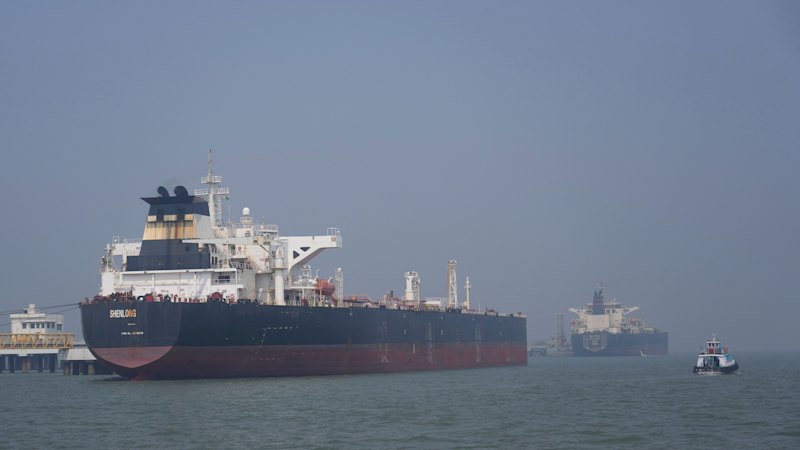
Crude oil prices pared some of their gains, but they nevertheless remained higher for the day on uncertainty about when oil tankers can start fully flowing through the Strait of Hormuz. The narrow waterway has been at the centre of US President Donald Trump’s demands of Iran, and blockages there have kept oil and natural gas stuck in the Persian Gulf and away from customers worldwide.
The price for a barrel of benchmark US crude rose 3.7 per cent to settle at $US97.87 after briefly nearing $US103 in the morning. Brent crude, the international standard, added 1.2 per cent to $US95.92 per barrel.
Given how far apart the US and Iran seem to be in their demands, upward pressure on oil prices may be “here to stay for a while” according to strategists at Macquarie led by Thierry Wizman. Risks remain for renewed fighting, which could cause customers worldwide to hoard whatever oil supplies they do get. That could itself keep oil off the market, much like actual fighting targeting pipelines or oil tankers.
Oil prices have been swinging through sharp and sudden reversals for weeks with hopes rising and falling for the Strait of Hormuz to fully reopen and allow production of oil and natural gas to kick back into gear. Brent oil has gone from roughly $US70 per barrel before the war in late February to more than $US119 at times.
Despite all the swings, the US sharemarket isn’t far from its all-time high. The S&P 500 is just 2.2 per cent below its record set in January.
Constellation Brands climbed 8.5 per cent for one of the index’s biggest gains overnight after reporting stronger results for the latest quarter than analysts expected. The company, which sells Modelo beer and Robert Mondavi wines, said it saw encouraging trends heading into its new fiscal year. But it pulled its financial forecasts for the following fiscal year because of “limited near-term visibility” and other factors.
CoreWeave rose 3.5 per cent after announcing an expanded, $US21 billion deal with Meta Platforms to provide AI cloud capacity until December 2032. Meta climbed 2.6 per cent.
On the losing end of Wall Street was Simply Good Foods, which sank 18.1 per cent after reporting a worse drop in revenue than analysts expected. Chief executive Joe Scalzo called the results unsatisfactory and said the company behind the Quest and Atkins brands was making immediate changes to turn around its performance. It was also a poor day for Australian-founded Atlassian – its shares dropped 7.3 per cent.
All told, the S&P 500 rose 41.85 points to 6824.66. The Dow Jones Industrial Average added 275.88 to 48,185.80, and the Nasdaq composite climbed 187.42 to 22,822.42.
Mixed reports on the US economy also helped keep Wall Street in check. One said an underlying measure of inflation the Federal Reserve considers important was slightly hotter in February than economists expected. It decelerated before the war with Iran began, but not by as much as economists expected.
A separate report said that more US workers applied for unemployment benefits last week than economists expected. The number was not very high compared with history, but it could indicate an acceleration in lay-offs.
Treasury yields swivelled up and down in the bond market following the reports before pulling near where they were the day before.
The yield on the 10-year Treasury edged down to 4.28 per cent from 4.29 per cent late on Wednesday. It’s still well above its 3.97 per cent level from before the war, which has sent rates higher for mortgages and other kinds of loans going to US households and businesses.
AP
The Business Briefing newsletter delivers major stories, exclusive coverage and expert opinion. Sign up to get it every weekday morning.
