


Adrian Black
Updated ,first published
Australia’s share market has edged slightly higher, as a fragile ceasefire between the US and Iran hangs in the balance and a key oil transit route remains restricted.
The S&P/ASX200 rose 21.4 points on Thursday, up 0.2 per cent, to 8973.2, as the broader All Ordinaries edged 3.2 points higher, up 0.03 per cent, to 9168.9.
Oil prices rebounded and growth stocks sold off, as the US and Iran accused each other of shifting the key tenets of a two-week truce, and as Israel escalated its attacks on targets in Lebanon, killing more than 250 people.
“It has been a day of consolidation at the index level, and probably rightly so after yesterday’s rally and with growing questions around the details of the deal, which has been the bedrock of that ceasefire agreement,” IG market analyst Tony Sycamore said.
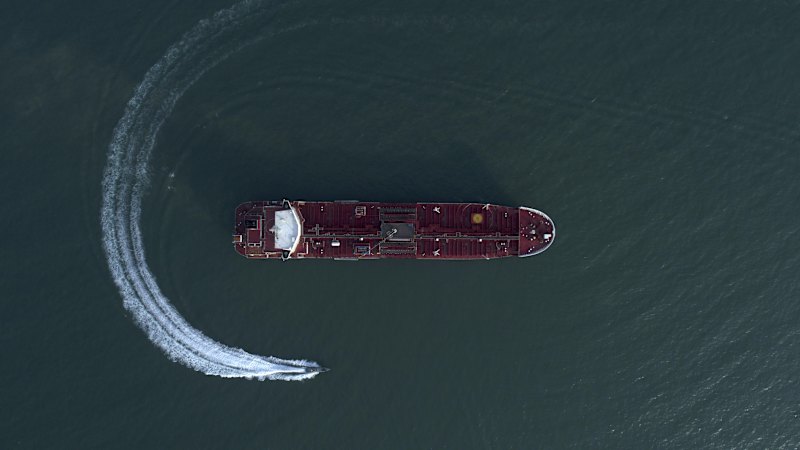
“Markets will probably give the ceasefire the benefit of the doubt and look through some of the differences, as long as we start to see some of these ships get through the Strait of Hormuz.”
Peace talks between Iranian and US officials are set to begin in Pakistan on Friday, which will be Saturday in Australia.
The bourse’s modest improvement came with only four of 11 local sectors trading higher, with energy stocks and financials doing some heavy lifting, while IT, health care and consumer discretionary stocks came under pressure.
Oil and gas giant Woodside jumped almost 4 per cent, while Santos was close behind as the West Texas crude oil benchmark rebounded from as low as $US90.50 a barrel to $US97 by the ASX close.
The benchmark was trading above $US111 ahead of the US-Iran truce on Wednesday.
Mega-miners BHP, Rio Tinto and Fortescue were mixed as iron ore futures dropped sharply to $US105.20, as China reported record stockpiles.
Gold miners were broadly lower, as the precious metal eased to $US4717 ($6706) an ounce.
Local banks were surprisingly strong, and provided a ballast to weakness elsewhere in the bourse, as Bendigo Bank rocketed eight per cent higher on the back of a strong trading update, new tech deals and planned job cuts, while the big four also won some interest.
After soaring nearly 10 per cent the previous session, WiseTech slumped 10.9 per cent. Fellow tech traveller Xero fell 8.6 per cent.
Overnight in the US, the S&P 500 leapt 2.5 per cent after Trump announced a two-week ceasefire with Iran, less than 90 minutes before a deadline he had set for it to open the Strait of Hormuz and allow oil tankers to exit the Persian Gulf.
The Dow Jones Industrial Average rallied 2.8 per cent, and the Nasdaq composite soared 2.8 per cent following even bigger gains in European and Asian stock markets.
To be sure, stock prices are still below where they were before the war. And oil prices are still significantly higher because the threat remains that the war could continue and keep oil produced in the Persian Gulf area blocked in the Middle East.
“There remains a high degree of uncertainty as to how the situation in the Middle East unfolds,” NAB analysts said. “For now, we wait for news from the first round of peace talks which will take place on Saturday in Islamabad.”
So far in the war, Trump has set several deadlines for Iran to open the Strait of Hormuz, a main thoroughfare for oil to reach customers worldwide from the Persian Gulf, and has threatened big repercussions if Iran doesn’t, only to delay them.
“There is a reason to be optimistic, but it is still too early to tell because, as you know, after all, it is Trump,” said Takashi Hiroki, chief strategist at MONEX.
It’s similar to a year ago, when Trump threatened stiff tariffs on imports from other countries on “Liberation Day.” After a couple of delays, his administration eventually negotiated lower tariffs with many countries, though they were still higher than those before his second term. That led some investors to allege Trump “always chickens out” – or “TACO” – if financial markets show enough pain.
When oil prices were screaming higher because of the war, some traders were betting on the possibility that the Fed would have to raise interest rates to keep a lid on inflation. Now, they’re seeing a roughly one in three chance that the Fed could resume its cuts to rates in 2026, according to data from CME Group.
In Asia, where countries are more reliant on oil from the Middle East, South Korea’s Kospi stock index surged 6.9 per cent. Japan’s Nikkei 225 leapt 5.4 per cent, and Hong Kong’s Hang Seng jumped 3.1 per cent. European stock indexes rose nearly as much. Germany’s DAX returned 5.1 per cent, and France’s CAC 40 rallied 4.5 per cent.
