



Australia is facing unprecedented fuel insecurity. Despite the government’s confidence that the nation can avoid a crippling shortage, attention has turned to home-grown solutions.
As the Iran war drags into its sixth week, oil shipments through the Strait of Hormuz are still shut off, disrupting about 20 per cent of global supply.
Last week, the final seaborne shipments from the Middle East that made their way through the straits before Iran closed the channel delivered their fuel to the Asian refineries that supply more than 80 per cent of Australia’s fuel. These refineries have roughly a month’s worth of exports in their inventories, and they are currently attempting to fill the shortfalls with imports from other oil-producing nations, such as the US, Canada, Mexico, and Argentina.
The Albanese government said on Monday it was confident that fuel imports would remain stable beyond late April. It has offered financial support for private companies to boost fuel imports and is seeking agreements with Asian nations to preserve fuel supply contracts.
“We have secured legally binding supply well into May now,” Energy Minister Chris Bowen said on Monday.
The national discussion has thrown up a range of options.
Could Australia drill for more oil?
Ever since car sales took off after World War II, Australia has imported most of its liquid fuel needs.
Currently, Australia uses the equivalent of around 400 million barrels of oil a year. This dwarfs the nation’s annual production of 40 million barrels. But the oil Australia produces, predominantly off the coast of Western Australia, is of a grade that is unsuited for the production of diesel and petrol.
However, there are increasing calls from the public and some politicians to establish a domestic oil industry, after the current supply shock pushed the price of a barrel of oil up 50 per cent since the war began.
Angus Taylor said last week that the government must develop a plan to shield Australia from risks of future energy crises.
“We must dig, and we must drill. We need more Australian oil for Australians. We have the resources beneath our feet to secure our future,” he said.
The main obstacle to Australia becoming self-sufficient in liquid fuels is geology and economics. It is cheaper to buy from countries where oil can be produced more cheaply than in Australia.
The most recent prospects for large-scale oil production wound up from 2016, when Equinor and BP canned their investigations of the Great Australian Bight. Both companies said oil fields there would be commercially uncompetitive.
Were the government to subsidise oil production to boost energy security, it would cost billions of dollars, which could be spent on other fuel security measures, like increasing local refining capacity for petrol and diesel.
What about building more refineries?
There are also mounting calls for Australia to boost its capacity to refine crude oil.
Prime Minister Anthony Albanese said on Thursday the government was investigating that as an option, because the Iran war had shown we can no longer assume “there would always be someone else, somewhere else, who would sell us what we needed cheaper than we could make it ourselves”.
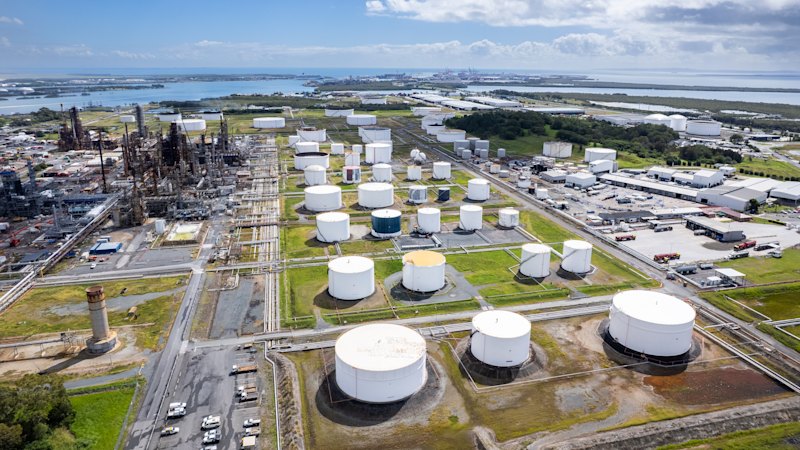
Australia had eight oil refineries in 2000. Since then, six have shut down, and the remaining two are subsidised by taxpayers because it is cheaper to refine oil in Asia and ship fuel to Australia.
However, the advantage of local petrol and diesel production capacity is having the ability to diversify crude oil sources if typical suppliers run short. Having more refineries would also mean more supply lines for importers to hedge against disruptions like the Iran blockade.
Again, it would be expensive – requiring hundreds of millions of dollars – and take years to deliver, which could squeeze Australia’s capacity to invest in what is the cheapest near-term option to increase onshore fuel storage.
Does Australia have enough fuel in reserve?
Australia has 39 days of petrol, 29 days of diesel and 29 days of aviation fuel held in stockpile, Bowen said on Monday. The fuels are stored by refiners and suppliers at private facilities, as well as in the import shipments on their way to Australia.
These stocks do not meet the International Energy Agency requirement for member countries to hold emergency fuel reserves equivalent to 90 days of net imports. Australia is a signatory to the agency.
Japan holds up to 250 days, the UK stores 51 days’ worth of liquid fuel – with greater domestic oil production capacity than Australia – and many European nations maintain a stockpile of more than 90 days, including France, Germany and Italy. The US, which is a net exporter, holds around 400 million barrels of oil in reserve, or enough for over 115 days.
The Albanese government created its minimum stock obligation in 2023, soon after it took office. In the 10 years up to 2020, Australia’s holdings of petrol, diesel and jet fuel ranged between 14 and 25 days’ worth of consumption.
Bowen said this week it could cost $20 billion over four years to build the infrastructure needed to hold enough fuel to comply with the International Energy Agency’s requirement of 90 days’ fuel.
What are the alternative fuel options?
Nationals Leader Matt Canavan has promoted coal-to-liquid technology, an industrial process that can turn the mineral into petrol and diesel, as one of the best technologies to boost Australia’s fuel security.
The only plant in the world using this process is a government-run plant in South Africa, which deployed the technology to counter international oil embargoes during the apartheid era.
The prospect of Australia using this technology is remote. The economics are questionable, heavy government subsidy would be needed to establish a facility, and emissions from the technology are around double that of traditional petroleum fuels.
Hydrogen is also proposed as a solution to fossil-fuel dependence. It is a fuel that burns cleanly, having only water as a byproduct, but is currently only used in some heavy transport applications and industrial processes like fertiliser manufacture. It is considered prohibitively expensive as a replacement for petrol and diesel.
Biofuel, where used cooking oil is turned into diesel, is another option floated on social media. But it is at best a niche option. Australia consumes 55 billion litres of petrol and diesel a year and just 600,000 litres of cooking oil.
What about reducing demand?
There is only one viable way for Australia to survive a fuel crunch in the near future.
A government mandate to cut consumption in non-critical uses like personal cars, would free up supply for freight companies to deliver essential supplies of food and medicine around the country.
In other words: fuel rationing.
But the government’s fuel security plan says this as a last resort, with voluntary measures, like carpooling, to come first.
The need for a more drastic contingency, which would have a severe economic impact, remains to be seen. About 80 per cent of global oil supply has not been disrupted, and as one of the richest fuel-importing nations, Australia is well-placed to outbid other nations competing for the remaining global stocks.
Cut through the noise of federal politics with news, views and expert analysis. Subscribers can sign up to our weekly Inside Politics newsletter.
 Mike Foley is the climate and energy correspondent for The Age and The Sydney Morning Herald.Connect via email.