


Imagine this. You cannot walk your child to the school gate, so you miss those early interactions with other mothers at drop-off and pick-up from which new bonds with other families take root. Your husband, who takes your child to school, sees how sad this makes you. He keeps an eye out for mothers he thinks you might like and returns home waving his iPhone, where he has stored their numbers for you.
You cannot be a “tuckshop mum” as your own mother was. But you hear the teachers need volunteers to read with the children, so you sign up and it’s wonderful. There’s a curious thrill in being seen by the other children as a mother, as though you need the affirmation of random five-year-olds.
You cannot volunteer to marshal at athletics carnivals, nor accompany your child’s class on school excursions. But you see the P&F needs year representatives and, after confirming much of it can be done online, you put up your hand and a kind mother agrees to share the position. This way, she can perform any tasks that require you to be physically present in ways you cannot be. As a bonus, in this role you can push for more thought to be given to making social events physically accessible to everyone. (This follows some disheartening experiences. The class reps who decide to break with counterparts in the other kindergarten classes arranging a get-to-know-you event for the mothers. Instead of a dinner, they organise a bushwalk.)
Try as you do, even when it’s you who organises the event, you can still find yourself, a mother with disability, on the periphery. You cannot easily mingle. You need to sit down, but not on those tall stools – that won’t work for someone whose leg is held on with a metal pin. You end up marooned on a low chair pushed against some wall, unable to move on when the conversation becomes tired. You feel yourself becoming an awkward burden to whomever you are talking to. “Feel free to go and talk to the others,” you say. Now you are alone, nursing your warm white wine. You watch the women in high heels: how carefree they seem. Perhaps one will notice you and pull up a chair.

Disability places you outside the mothering mainstream and because of this, it makes your family, in some ways, outsiders too. It can be exhausting, trying to convince yourself that you have just as much right as anyone to be a mother.
Maybe this is why I was so intent upon the trip to Bologna. Of course, it was about uncovering a long-kept family secret I’d stumbled across. A great-aunt moved into an aged-care facility and, in her papers, I found a birth record from 1898 which revealed my Bolognese great-grandmother – who I’d been told was an orphan – was a foundling. I became obsessed with finding the mother and answering the question of why she relinquished her daughter to a foundling home.
But truth be told, it was also about creating an “experience” for my family. This was my version of motherhood, where I tried to compensate for the fact that – because of my injuries – our son often misses out on things other families get to do.
Take holidays, for example. My childhood school vacations were spent camping by a lake with family friends who had a speedboat and one of those inflatable tubes for towing us kids. Today’s typical middle-class Australian family holidays are more likely to be had in (inaccessible) Airbnbs shared with friends. None of it is practical for a mother with a wheelchair.
And so there we sat, in the Sydney spring of 2018, on an A380, being buffeted by unseasonably hot, gusting winds that were preventing us taking off. Every fibre of my being screamed: why have you brought us here? Muscles, neurons, proteins remembered what happened the last time and demanded an explanation for this insanity. Between my husband and I sat our son, six years old, blond hair snipped into a crew cut, wearing an aquamarine T-shirt with a shark on the front; his favourite animal, he claimed. I ordered myself not to lose it. You are a mother.

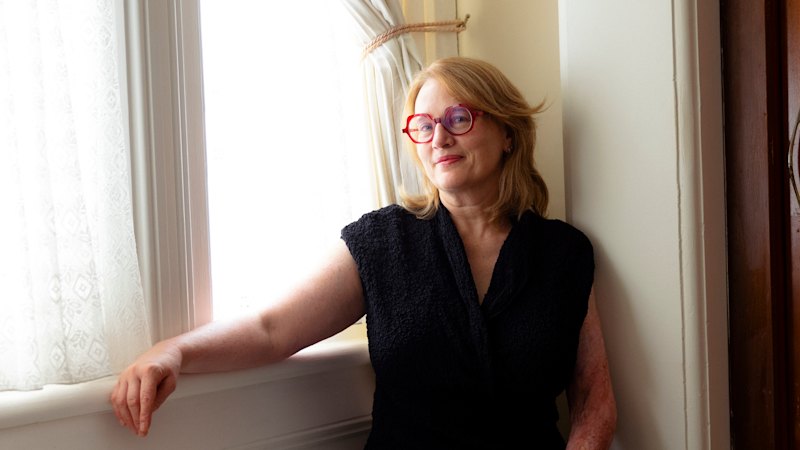
husband Michael in the Italian Renaissance city of Ferrara.Courtesy of Cynthia Banham
I pulled out the still-pristine copy of the Bologna Pocket Guide I’d purchased months ago, turned to the page about children and, to my dismay, found a sad, solitary paragraph that began: “Bologna is not the obvious choice for children.” I regretted not reading the guide before now, but not my decision to uproot our lives and give this a go. There were good reasons for pulling our son out of school for a term. For the three of us taking Italian lessons. And for why we were going to spend the European winter in a medieval city that was, apparently, not fit for children.
Two weeks before departing for Bologna, I had been at my computer when an email arrived. “I think we have found the name of your great-great grandmother.”
Heart and breath halted in that pregnant moment. I could not see her face, but I had a name. A name! I’d never believed it possible. (Experts on Italy’s foundlings told me it was “99.99 per cent” impossible; it remains the law in Italy today that the mother’s name must be kept secret for 100 years from a baby she chooses to relinquish and, in the 19th century, foundling homes did not record the names of these women.)
Volunteers working in the archives of the parish where my great-grandmother was born had located her mother’s name in a clandestine book where the baptisms of all the town’s illegitimate babies were recorded, going back to 1566. The book was titled, in translation from the Latin, The Book of Secret Baptisms. So little did I understand the Catholic Church’s role in shaming unwed mothers. In Italian society up to the 1960s, Bologna archivists told me, a woman pregnant out of wedlock was considered “a marked woman for life”.
Shame was something I knew about. During our son’s infancy, I rarely allowed my husband, Michael, to photograph the two of us. I took photos of our son with his full-bodied father instead. As the memories of that time fade, I find myself a phantom mother in those early years, absent from the photographic record.
I do not feel ashamed of my body with people who know me. I feel it with the delivery guy who comes to the door, the parent I’ve never met who picks up their child after a playdate. The stares that linger on the spaces where my legs used to be.
But the shame wasn’t only over my physical difference; it was also over my inadequacies – as I perceived them – as a mother. Did my great-grandmother’s mother and I share shame in ceding power to others to define us? Is that why uncovering her story felt so urgent to me? Because we were both mothers trying to do the best for our children – in her case, the act of relinquishment was likely an act of protection – within circumstances that limited us.
That first week in Bologna, our little boy had been trailing us around churches, archives, libraries, museums. His legs were tired, could he climb onto the wheelchair? “Please, Mamma?” He’d done it as a baby, then toddler, and I loved that he still wanted to sit with me – if only because he was tired. This was his “normal”. A mother in a self-propelled chair, a mother with removable legs.
In Bologna, every time we encountered a difficult section of road, Michael would take the handles of the wheelchair and push. It was a routine we were used to, and I was grateful to have such a loving husband. Even so, I sometimes felt like an infant in a pram. How did my son see me, that I required looking after in this way?
“I wish I could do magic and make you walk again, Mum,” he said once. “But even without your legs, you are still the best mum in the world.”
When he was little, sitting together on the wheelchair offered consolation. There were many things my mother had done for me that I could not replicate for my son. But this experience was unique to us. When we were nestled this way, my child pressing his back into me, we encountered the world together.
Fast-forward and it was all very congenial travelling this way under Bologna’s endless porticoes (built from the 1100s onwards to increase living spaces). Every time we met with a bumpy cobblestoned laneway, though, I feared the wheelchair was going to crack under our weight.
Our Italian teacher was always thinking of ways to enrich our son’s time in her city. Her pupil might enjoy his time better, she gently told me following one of our lessons, if he had his own set of wheels. “You could get him a scooter.”

Our son’s eyes lit up when he spied the Maxi Micro. The scooter had a bright red deck and grips. Outside the shop, in a darkened medieval laneway, he posed contentedly with his monopattino and matching red helmet for a photo. The little red scooter proved a master stroke. We could now ride Bologna’s porticoes together.
Getting around in a wheelchair makes you see places differently; getting around in a wheelchair with a young child in tow offers yet another perspective. When I think of Bologna now, I don’t remember the lumpy cobblestones. I recall the smooth porticoes with stone walkways the colour of speckled mortadella, which were superb for wheelchairs and zippy red scooters.
I see the three of us in our black puffer jackets, my son and I riding side by side, my husband bringing up the rear. Huge smiles are plastered on our faces as we head through the crisp morning air towards Giardini Margherita, Bologna’s major park. In that moment of joy, I’m not thinking of that despised chair, of the many ways in which it limits my ability to care for my son.
Instead, as I spin those wheels, as my son kicks his scooter along, I am thinking how wonderful it is to be in Bologna riding with my son, how lucky we are to be sharing this as a family.
I am thinking of what the wheelchair gives us, that this is an experience only a child with a mother in one could know.
Cynthia Banham’s memoir, Mother Shadow (Upswell Publishing, $33), is out now.
Get the best of Good Weekend delivered to your inbox every Saturday morning. Sign up for our newsletter.
