


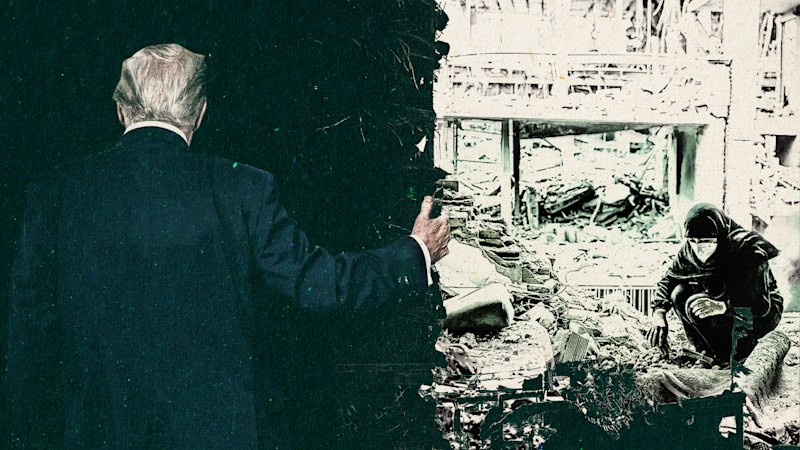
It has been dubbed the Pottery Barn rule: you break it, you own it. That’s what then US secretary of state Colin Powell warned his president, George W. Bush, ahead of the 2003 invasion of Iraq. It has become an aphorism of American foreign policy regarding the Middle East.
Donald Trump’s approach, as many analysts have noted over the past fortnight, has a different flavour: we broke it, you fix it. As he eyes a potential exit from the war in Iran, he is cajoling US allies into resolving the unfinished business – chiefly, reopening the critical Strait of Hormuz.
“That’s not for us,” he said this week. “That’ll be for France, that’ll be for whoever’s using the strait … there’s no reason for us to do it.”
But that is not the only outstanding item. The Iranian regime retains 440 kilograms of highly enriched uranium, believed to be buried underground, that could be the starting point for a reborn nuclear program. Moreover, the regime itself survives – albeit wounded – and with a new appreciation for the havoc it can wreak in the strait.
At the same time as Trump promises to leave Iran “very soon”, and publicly espouses a timeline of two to three weeks, he is amassing an even larger armada in the Middle East, ready to attack. Another aircraft carrier, the USS Tripoli arrived in the area last Friday carrying 2200 Marines, and the USS Boxer, an amphibious assault ship, is on the way.
The build-up hints at a possible ground operation, with most experts suggesting three options: a bid to find the uranium, an invasion of Kharg Island – Iran’s major oil terminal in the Persian Gulf – and/or seizing Qeshm, the large island in the Strait of Hormuz from which Iranian forces can fire at passing ships.
Trump promised the military operation in Iran would be swift, but he has never ruled out putting troops on the ground – even though that would trigger alarm for many members of his America First base who remain deeply sceptical about foreign entanglements, especially in the Middle East.
A product of the 1970s, Trump has long had a geopolitical obsession with Iran and its oil stocks. “Why couldn’t we go in and take over some of their oil?” he asked in a 1987 television interview. The following year, he told The Guardian he would “do a number on Kharg Island” the next time an Iranian bullet hit a US ship. “I’d go in and take it,” he said at the time.
And this week he has repeated similar refrains. “To be honest with you, my favourite thing is to take the oil in Iran,” he told The Financial Times. “But some stupid people back in the US say: ‘Why are you doing that?’ But they’re stupid people.” Now, on the cusp of his 80th birthday, he can try to realise this lifelong goal.

James Acton, co-director of the nuclear policy program at the Carnegie Endowment for International Peace, says any such mission would be a bad idea. Even a ground incursion to seize the highly enriched uranium – most of which is believed to be stored underground at a facility near Isfahan in central Iran – would be “incredibly risky”.
“The tunnels where it is buried are very deep,” Acton says. “The Iranians deliberately covered over the entrances to those tunnels, largely to protect them from bombing. What you can try to do with bombing is collapse the entrances. But that also makes a special operations raid to try to extract the uranium really difficult.
“You have to come in with large number of troops, establish a perimeter, build an airstrip, fly in excavation equipment, start digging out those tunnels – which may very well be booby-trapped – and the Iranians are attacking you the whole time while you’re doing it.”
On the other hand, Acton says, it is an operation with a clear and specific goal – get the uranium, get out. The same can’t be said for an operation to try to reopen the Strait of Hormuz.
The waterway separating Iran from the Gulf states is more than 160 kilometres long, and about 40 kilometres wide at its narrowest point. About a fifth of the world’s oil supply ordinarily passes through it – particularly to Asia – along with other cargo.
The regime in Tehran is maximising its leverage by exercising control over the strait, threatening permanent tolls and firing missiles at tankers around the Gulf. On Wednesday, one such projectile hit the Aqua 1 while it anchored in Qatari waters.
Acton says: “The problem with the Strait of Hormuz operation is you end up having to deploy troops across a very, very wide area of Iran. Very large numbers of troops are needed, and they have to stay there indefinitely.
“If you do the operation, and you manage to reopen the strait – which is not guaranteed – what do you do then? You’re basically in a position of having to occupy a large chunk of Iran indefinitely because as soon as you leave, they just close the strait again. So I think both of those options are very unattractive.”
Acton and others noted that Trump’s live address to the nation on Wednesday night (Washington time), while appealing for the American people to give him two to three more weeks to finish the job, implied that ground operations were not really on the table.
Trump said the US had Iran’s “nuclear dust” – the enriched uranium – under intense satellite surveillance. “If we see them make a move, even a move for it, we’ll hit them with missiles very hard again,” he said. “We have all the cards, and they have none.”
When instructing allies to simply “grab” the oil from the Strait of Hormuz, Trump said the US had already done the hard part. “When this conflict is over, the strait will open up naturally,” he insisted.
Acton said his low-confidence assessment of Trump’s remarks was that a ground operation was not imminent – although the president could be deliberately misleading Iran to gain the element of surprise.
Can Kasapoglu, a senior fellow and military analyst at the Hudson Institute, a conservative Washington think tank, has studied US military options in Kharg Island and the Strait of Hormuz. He agrees any such mission would be risky, but potentially strategically profitable.
About 90 per cent of the regime’s oil exports pass through Kharg, and seizing it would generate significant coercive leverage against Tehran. The island would probably have to be taken by air assault from regional bases, Kasapoglu wrote for the Hudson Institute.
Meanwhile, Qeshm anchors Iran’s ability to menace maritime traffic in the strait using missiles, drones and mines. Seizing it would probably be more difficult, Kasapoglu says, because of its size, terrain and proximity to the mainland. Further, “holding Qeshm would impose a heavy burden for a relatively limited strategic return”.
Kasapoglu is more supportive of a mission to seize Kharg Island. “A US-led effort that dismantles Iran’s control over its Gulf island chain and neutralises Kharg Island would materially alter the strategic balance [of the war],” he tells this masthead.
“Those nodes underpin Tehran’s ability to disrupt maritime traffic and sustain its war effort. These options carry real operational risk, but the strategic upside is significant. The strait is Iran’s coercive lever over global trade; Kharg is its economic centre of gravity.”
Spurred by an oil crisis that has spiked the price of fuel and added to cost-of-living pressures, other countries are now searching for ways to reopen the strait. British Foreign Secretary Yvette Cooper convened a virtual meeting of 35 nations on Thursday (London time) in which Australia participated.
Foreign Minister Penny Wong said the meeting focused on diplomatic and civilian measures, although British Prime Minister Keir Starmer flagged that his country, at least, would also convene its military planners. “I do have to level with people on this,” he said. “This will not be easy.”
Experts agree that any military operation to wrestle the strait open would require US leadership – it is not something a coalition of allies would be willing or able to do alone.
“Iran retains credible anti-access and area-denial and disruptive capabilities in a compressed battle space,” Kasapoglu says. “Reopening the strait is not a one-off act – it requires sustained kinetic operations to secure maritime flow.
“At present, such a coalition [of allies] lacks both the integrated command structure and the political will to execute and sustain that kind of campaign. For this mission set, US military power remains indispensable.”
Acton says he doubts a coalition would be able to force the strait open even with US help. He believes the best option is for the Americans to walk away and leave it for the international community to try to negotiate with the regime in Tehran – even if that seems on the nose.
“Morally, the US should not just wash its hands of a problem it created,” Acton says. “I just think that is the fastest way to reopen the strait. I have so little confidence in the ability of this administration to do the right thing and work out a sensible way of reopening the strait and not escalate the war.”
Even on the enriched uranium – ostensibly the easier operation, and one which would achieve one of Trump’s stated aims of preventing Iran developing a nuclear weapon – the US president has appeared reticent to act.
“That’s so far underground, I don’t care about that,” he told Reuters in one of his brief phone interviews with reporters this week. “We’ll always be watching it by satellite.”
Acton says the uranium issue speaks directly to one of the fundamental problems with the war – you destroy what you know about, and what you can get to, but you have to go back and “do it again and again and again”. That is known in military lingo as “mowing the grass”, which is what Israel does with its many adversaries.
‘Morally, the US should not just wash its hands of a problem it created.’
James Acton, co-director of the nuclear policy program at the Carnegie Endowment for International Peace
“In the short-term, if we seize the uranium, there’s less of a need to strike Iran again in the immediate future,” Acton says. “But over the long run, what I think we’ve done through this war is significantly increased Iran’s incentive to acquire nuclear weapons.”
That problem arises because the Iranian regime has survived, despite Trump’s promise at the outset of the war that once the US was finished, it would be easy for the Iranian people to rise up and take over the government. That ostensibly remains one of Israel’s goals, but it is explicitly not Trump’s.
The US president says regime change has already been achieved because the supreme leader, Ali Khamenei, was killed and his replacement – his son – is nowhere to be seen. Few experts share that view.

“It’s a change of personnel,” former CIA director William Burns said on the Foreign Affairs magazine’s podcast on Thursday. “It’s certainly a much weaker regime, but it’s also one that’s even nastier and more radical and less open to even the kind of compromises that may have been possible before the war.”
As well as running the American spy agency, Burns was also a highly respected diplomat who served as the US ambassador to Russia and Jordan, deputy secretary of state and other senior roles. He noted perfect outcomes were “rarely on the menu” in the Middle East.
“We’re in a pretty deep hole right now, and all the options for getting out of that hole are difficult,” he said on the Foreign Affairs podcast. “They still have no shortage of drones, they still have an ability to inflict economic and political pain, and I think that was all pretty predictable.”
Burns says the Iranian regime is, over time, on a one-way street to eventual collapse. But surviving a war against its existential enemies, the US and Israel, would be a triumph. “I worry that in this war, what we’ve done, rather than accelerate that moment of collapse, is slow it down a little bit.”
Get a note directly from our foreign correspondents on what’s making headlines around the world. Sign up for our weekly What in the World newsletter.
