


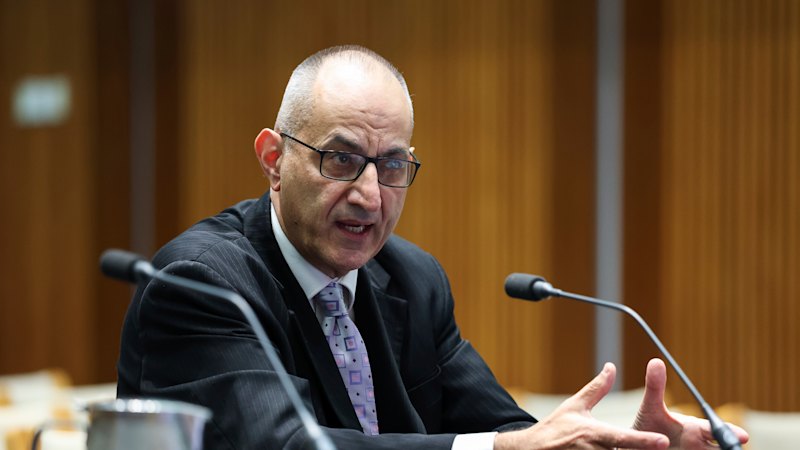

The official who headed Australia’s Home Affairs department acted so recklessly and improperly, particularly in his secret dealings with a lobbyist and Liberal Party powerbroker, that it would be very difficult for him to ever work in the public service again.
That is among a series of damaging findings contained in a confidential report that led to the sacking of Michael Pezzullo as Home Affairs secretary in late 2023 but which the government declined to release at the time.
It can now be revealed the inquiry found that Pezzullo’s dealings with Liberal insider Scott Briggs were so “ill-advised, reckless and a step too far in terms of the boundaries of normal public service practice” that it was “hard to imagine that he might be trusted now and into the future by governments of either political persuasion or by his colleagues”.
The airing of the inquiry report into Pezzullo came in response to an 18-month Freedom of Information Act fight by former federal independent Rex Patrick, and as Pezzullo has reinvented himself as a media commentator on national security issues.
The report not only casts fresh light on Pezzullo’s extraordinary fall from power, but it also highlights the flaws in Australia’s integrity regime, which experts say is still overly secretive and often slow to resolve issues of major public interest.
It was authored by former senior public servant Lynelle Briggs (no relation to Scott) on behalf of the Australian Public Service Commission, who ordered an inquiry after a cache of Pezzullo’s encrypted messages were exposed by this masthead and 60 Minutes in September 2023.
The encrypted messages between Pezzullo and Scott Briggs (no relation to Lynelle) revealed the then-Home Affairs boss’s secret efforts to gain and exert political influence during the terms of the Turnbull and Morrison governments.
Lynelle Briggs’ report determined Pezzullo had breached the Australian Public Service code of conduct, which includes a requirement to remain apolitical in their work, at least 14 times. A brief summary of her findings was revealed after Pezzullo’s termination, but her full report remained confidential until now.
The released version of Briggs’ 66-page November 2023 report, while still partially redacted, contains a litany of criticism of Pezzullo’s activities, such as his push to have certain ministers appointed.
“It is well beyond the political dividing line for a public servant at any level to insert their views and intervene in ministerial appointments, which are rightly the purview of the prime minister and politicians more generally,” the report says.
It describes how Pezzullo’s private dealings with Scott Morrison confidant, Scott Briggs, occurred “over many years, enabling Mr Pezzullo to systematically advance his views and interests and providing him with an avenue to power and influence beyond the usual ministerial systems of the Westminster system”.
“Such is the extent of his engagement with Mr Briggs that it cannot be seen as a one-off or temporary lapse of judgement. Through this engagement, he sought to influence ministerial appointments and machinery of government arrangements to his advantage and denigrated ministers and fellow secretaries.”
The inquiry report details some of Pezzullo’s most controversial WhatsApp messages including a November 2017 missive where he spoke of the need “to build a meritocracy by stealth and run government from the bureaucracy, working to 4-5 powerful and capable ministers”.
“He had earlier in July 2017 joked about him possibly being given Defence and Home Affairs departments at the same time. In 2018, he argues for fewer, bigger departments. Even though Mr Pezzullo evidently understands the concept of ministerial accountability, I doubt that any reasonable person would consider that to ‘run government from the bureaucracy’ is appropriate for a secretary to argue in our system of democratic government.”
The Briggs inquiry was also scathing of Pezzullo’s private savaging of senior public servants and his denigration of certain politicians and ministers in his messages to Scott Briggs at a time the lobbyist claimed to be briefing prime ministers Turnbull and Morrison.
“Mr Pezzullo ought to have been aware of a clear risk that his views would be passed on to the prime minister of the day, and for his views to inform any actions taken by the prime minister about the management of those individuals” whom Pezzullo was disparaging.
“The remaining question is whether or not that detriment was intended, or sought by Mr Pezzullo. In my view, the answer to that question must be yes.
“By sending the relevant messages to Mr Briggs, not only did Mr Pezzullo regularly communicate with Mr Briggs on sensitive government-related matters, but he also breached ministerial confidentiality on a number of occasions.
“Mr Pezzullo’s conduct was made worse by the fact that Mr Briggs did not hold the security clearances that may otherwise have provided some protection.”
The inquiry report is also highly critical of Pezzullo’s decision to direct a $79,500 government contract in 2021 involving Australia’s quarantine system to Scott Briggs’ lobbying firm employer, DPG Advisory, without declaring that he was his friend and confidant.
“After discussing my concerns with Mr Pezzullo, he accepted that he had not taken sufficient steps to make a conflict-of-interest declaration in respect of the procurement,” the report says.
“It was highly inappropriate for Mr Pezzullo to have any involvement in the procurement of DPG Advisory whatsoever. His failure to recognise this ‘in the moment’, and to make sure his conflict of interest was clearly stated on the record, were both significant lapses of judgment.”
Corruption expert Clancy Moore, of Transparency International, said the Briggs inquiry should have been released when it was completed and that preference for secrecy of all of Australia’s key integrity bodies needed to change.
“With trust in government at a breaking point, transparency must be the norm,” said Moore.
“Whilst there are provisions in the Public Service Act to withhold information from inquiries, the keeping of the report secret for more than two years adds to the perception of the Albanese government prioritising secrecy over transparency.
“Given the inquiry examined allegations of conflict of interest, mis-conduct and abuses of power by one of Australia’s most senior and powerful public servants, it’s clearly in the public interest for the report to be in the public domain.”
Lynelle Briggs ultimately found Pezzullo should be sacked because he had used “his duty, power, status or authority to seek to gain a benefit or advantage for himself” and failed to “maintain confidentiality of sensitive government information”.
Pezzullo also allegedly “failed to act apolitically in his employment”, “engaged in gossip and disrespectful critique of ministers and public servants” and “failed to disclose a conflict of interest”.
Pezzullo, who declined to comment when contacted on Friday, was one of the most powerful departmental secretaries in Canberra. He served successive Labor and Coalition governments in senior roles for decades, including as former Labor leader Kim Beazley’s deputy chief of staff and as deputy secretary in the Defence Department during the Howard years.
The leaked encrypted messages show Pezzullo repeatedly pushing Scott Briggs to use his backroom political influence to ensure Peter Dutton retained his post as Home Affairs minister.
He separately sought to get Briggs to undermine ministers whom Pezzullo believed were opposed to him or his policy agenda, including former attorney-general George Brandis.
The Morning Edition newsletter is our guide to the day’s most important and interesting stories, analysis and insights. Sign up here.
 Nick McKenzie is an Age investigative journalist who has three times been named the Graham Perkin Australian Journalist of the Year. A winner of 20 Walkley Awards, including the Gold Walkley, he investigates politics, business, foreign affairs and criminal justice.Connect via email.