


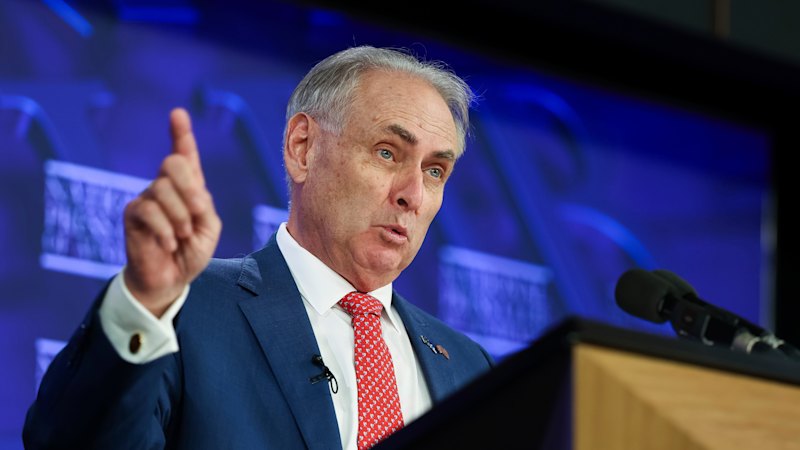
Trade Minister Don Farrell has vowed to fight the 100 per cent tariffs slapped on Australian-made pharmaceuticals by the Trump administration, as Health Minister Mark Butler promised to protect the Pharmaceutical Benefits Scheme from attacks by US lawmakers.
In an interview with this masthead, Farrell said he would meet US trade tsar Jamieson Greer at the OECD in Paris in June and make the case to remove US tariffs on pharmaceuticals, as well as on other exports to the US, in line with the free trade deal between the countries.
“Of course we think it should be zero tariffs on Australian goods and services. We will get our people at the embassy [in Washington] to examine the executive order and we will make our decisions from there,” he said.
“I will continue to engage with my counterpart Jamieson Greer about the impact of any further decisions on trade that might be coming out of the United States.
“The current provisions for 10 per cent tariffs that are the consequence of the US Supreme Court decision will be coming to an end in a month or two, and we need to have a serious conversation with the Americans about what happens next.”
Farrell last spoke to Greer a month ago and was in the United States in February to make the case against what he described as unjustified tariffs placed on Australian exports.
The latest executive order from US President Donald Trump, signed on Thursday night Australian time, slaps a 100 per cent tariff on imports of patented drugs, even though the European Union, Japan, South Korea and Switzerland all secured rates of just 15 per cent.
Trump previously put 100 per cent tariffs on pharmaceuticals in October last year unless manufacturers had started building plants in the US, and months earlier threatened 200 per cent tariffs.
The impact on Australian pharmaceutical giant CSL, which exports significant volumes of plasma to the United States, is expected to be at least partially ameliorated by US government carve-outs for plasma-derived therapies.
ASX-listed biotech giant CSL – which has plants in the US, Australia and Europe – last year also announced a $US1.5 billion ($2.17 billion) expansion of its American operations. Workers broke ground last month at the company’s manufacturing facility in Illinois.
A CSL spokesman said the company was pleased the Trump administration had carved out plasma-derived therapies, which constituted the vast majority of its trade into the US.
“We’re reviewing the materials released today and will continue working with the administration to ensure access to plasma therapies,” he said.
Australia exported about $2 billion worth of pharmaceutical products to the US last year, and the US maintains a trade surplus with Australia.
The latest tariff increase comes against the backdrop of the US pharmaceutical sector ramping up complaints to the Trump administration about Australia’s PBS, which subsidises the cost of medicines and which US drugmakers believe “undervalues American innovation through unfair drug pricing practices”.
The US government has also flagged concerns after Labor moved last year to require major streaming services to invest at least 10 per cent of their total Australian expenditure, or 7.5 per cent of Australian revenue, on local drama, documentary, children’s or arts content.
On Friday, Butler said Australia’s PBS was protected by Australian legislation and that “will not change because of any decision taken by the US administration”.
“There have been several announcements about potential tariffs on pharmaceuticals since President Trump was inaugurated. This is just the latest one. We take it seriously, but we’ll engage with the administration, engage with Australian companies,” he said.
“This has been, to say the least, a moveable feast, trade policy over the past 12 months. Our trade minister, our trade officials, our embassy in Washington, have done a terrific job pushing the case for a continuation of free and fair trade between the two countries.”
Butler said the US’s decision to lift prices on health products imported from countries including Australia was self-defeating and pointed out the US and Australia had had a free trade deal in place for more than 20 years.
Earlier, Opposition Leader Angus Taylor said the opposition wanted to see free trade between the countries, adding that the government must “assert themselves to get exemptions to this for Australian exporters”.
“This is obviously not welcome news. We don’t want to see it. We’ll work with the government to do anything we have to get it overturned,” he said on Sunrise.
UTS professor and trade economist Tim Harcourt said the imposition of fresh tariffs was a bargaining tactic.
“It’s a way of encouraging more investment in US manufacturing, it’s part of that agenda. Most smart exporters will already be thinking about having some operations in the US, and I suspect they have been for a while. Because even when Trump goes, it’s likely this sort of protectionism will continue,” he said.
“I think there is always room for negotiation, even Bush junior put tariffs on, I believe it was steel, but we got a carve-out. So this has happened before.”
Cut through the noise of federal politics with news, views and expert analysis. Subscribers can sign up to our weekly Inside Politics newsletter.
 James Massola is chief political commentator. He was previously national affairs editor and South-East Asia correspondent. He has won Quill and Kennedy awards and been a Walkley finalist. Connect securely on Signal @jamesmassola.01Connect via X or email.
 Michael Koziol is the North America correspondent for The Age and Sydney Morning Herald. He is a former Sydney editor, Sun-Herald deputy editor and a federal political reporter in Canberra.Connect via X or email.