


Opinion

It’s hilarious to think that, in the lead-up to Easter in 2019, then-prime minister Scott Morrison was warning about Labor leader Bill Shorten’s plan to “end the weekend” with an electric vehicle (EV) push that would force our gas-guzzlers off the road.
“Bill Shorten wants to end the weekend when it comes to his policy on electric vehicles, where you’ve got Australians who love being out there in their four-wheel drives,” Morrison told Sydney radio station 2GB.
“It’s not going to tow your trailer. It’s not going to tow your boat. It’s not going to get you out to your favourite camping spot with your family.”
It sounds like a cruel joke now. Prime Minister Anthony Albanese was forced to address the nation ahead of this Easter break, urging Aussies to conserve fuel for those who really need it – and prepare for “uncertain times.”
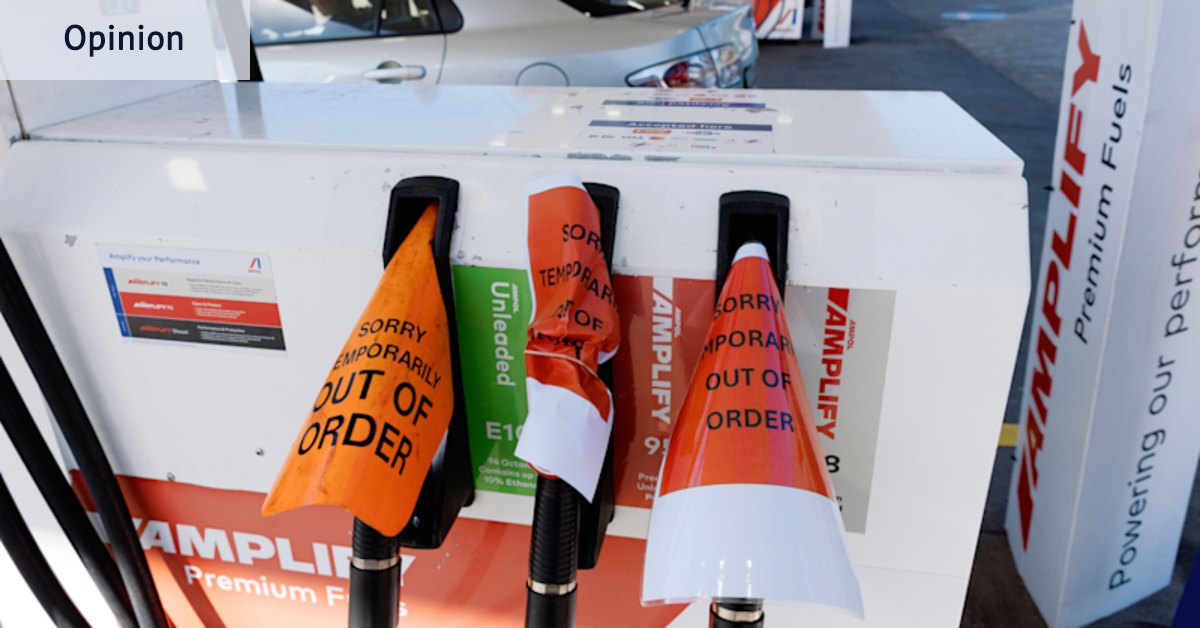
Albanese is holding his breath that a Trump retreat – and his calm words – will ease concerns over fuel rationing, and service stations running dry, despite the largest supply disruption in the history of the global oil market.
The nightmare scenario is burnt into the Aussie psyche by our cult classic movie Mad Max, which was inspired by the catastrophic 1973 OPEC oil embargo: a Middle East conflict triggers an energy crisis and societal collapse in oil-dependent Australia.
We may not be facing that level of calamity, but research for your Easter road trip will now have to prioritise how to avoid ending up by the roadside with an empty tank over the best pie stop for your journey.
Speaking of pies, we also face what Carlyle Group’s Jeff Currie described as the “cascade of consequences” of this crisis, which also has the potential to affect food. “Shut off the gas and the ammonia plant closes; without ammonia there is no urea; without urea fertiliser falls. One molecule at the top of the chain can eventually reach the dinner table at the bottom,” he said.
This fallout is still coming.
But Australia’s sparsely populated continent does not need to look beyond fuel to see how this crisis on the other side of the world posed such a threat to our dinner table.
We remain reliant on these fragile global supply lines for our oil, petrol refining, jet fuel, plastics and fertilisers, but none of that comes close to Australia’s world-beating addiction to diesel. Consumption per head is nearly double the US and far ahead of China.
“Our whole economy depends on it,” Macquarie University finance lecturer Lurion De Mello wrote in a column for The Conversation this month.
“Trucks that move our goods and food around, machinery used in farming and mining, and even back-up generators all rely on diesel.”
But the idea that Australia has to be reliant on fossil fuels for our transport and vital industries does not hold up under any scrutiny.
This week, an electric truck made the 300-kilometre Sydney to Canberra trip on a single charge.
It’s no novelty. China’s road freight sector will soon be dominated by battery-powered e-trucks, with British research firm BMI forecasting they will account for 60 per cent of new sales next year.
As for our miners, Fortescue founder Andrew Forrest is not just on the right side of history with this renewable energy fervour. He is weaning the miner’s massive operations off diesel with a solar-power plan that is expected to cut around $1 billion in costs annually.
Even market analysts are having to recognise that, in a diesel-constrained world, Forrest’s green crusade no longer looks like an indulgent folly.
“Fortescue is potentially the big winner in this world, with its more advanced approach to diesel substitution (nee decarbonisation),” Macquarie’s mining team said.
Fortescue will not remain an outlier.
As is the case with previous energy crises, the push for renewable energy will have added urgency, as Fatih Birol, executive director of the International Energy Agency, told the National Press Club in Canberra last week.
“I expect one of the responses to this crisis will be [an] acceleration of renewables. Not only because they are helping to reduce the emissions but also, they are [a] homegrown domestic energy source,” he said.
The demand for grid-level batteries is sending the demand for lithium soaring, and it is matched by consumer demand for EVs, with China’s giant, BYD, exporting 1 million vehicles last year.
In January, it was targeting 1.3 million overseas sales for 2026. In a briefing this week it upped its target to 1.5 million thanks to the Iranian crisis.
Even Australia was giving up on the petrol bowser before this crisis.
In February, China overtook Japan as Australia’s largest source of new cars with three of its marques– led by BYD – in the top 10 for car sales here.
Second-hand EV dealers like easyauto123 also noted the “hockey stick” growth that they have recorded over the past six months.
Energy research group Wood Mackenzie sees a tipping point being reached: “Elevated oil prices, energy security objectives, the growth in renewable capacity and rapid advancements in battery charging technology support our base case outlook for around 80 million new EVs for the global passenger segment from 2026 to 2030.”
Trump’s folly has laid bare the myopic focus on EV costs and charging stations, and exposed the fragile supply chains and other costs of our fossil fuel dependency, including the unavoidable geopolitical safety implications.
Iran, the global sponsor of terrorism, is likely to be extracting a toll on any shipping through the Strait of Hormuz to fill its revolutionary coffers, and also use it as leverage against anyone it chooses.
If your country is dependent on fossil fuels, Iran has you over a barrel. It is just the latest argument as to why we all need to kick the fossil fuel habit.
The Business Briefing newsletter delivers major stories, exclusive coverage and expert opinion. Sign up to get it every weekday morning.
 Colin Kruger is a senior business reporter for the Sydney Morning Herald and The Age.Connect via email.