


Updated ,first published
Prime Minister Anthony Albanese has warned Australians the economic shocks of war in the Middle East will be felt for months to come, urging people not to take more fuel than they need for Easter road trips and to consider taking public transport in coming weeks.
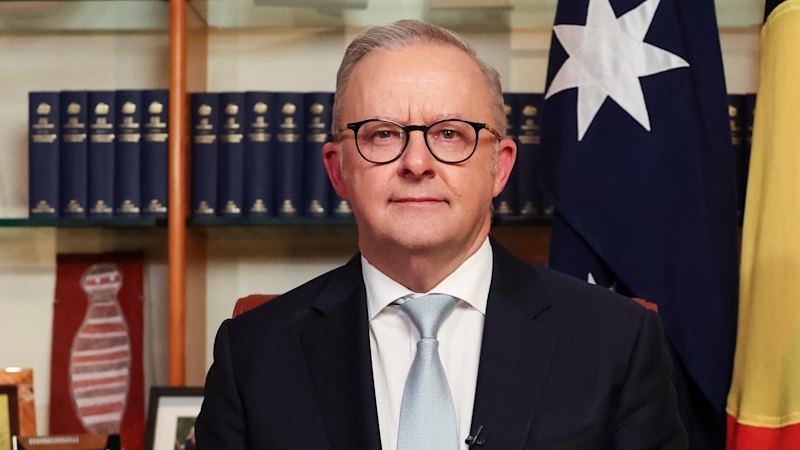
In a rare address to the nation broadcast across TV and radio stations at 7pm, hours before US President Donald Trump is due to deliver his own address to Americans on Thursday morning (AEDT), Albanese reassured Australians they could go about their business as normal and enjoy the Easter break.
But his three-and-a-half minute address from his office in Parliament House in Canberra made plain that the government expects months of economic pain, potential shortages and supply chain disruptions as the global oil crisis enters its second month, even as the Trump administration suggests that its war with Iran could be coming to an end.
“If you’re hitting the road, don’t take more fuel than you need – just fill up like you normally would,” Albanese said.
“Think of others in your community, in the bush and in critical industries. And over coming weeks, if you can switch to catching the train or bus or tram to work, do so. That builds our reserves and it saves fuel for people who have no choice but to drive,” he said.
“Farmers and miners and tradies who need diesel every single day. And all those shift workers and nurses who do so much for our country.”
The prime minister listed the measures the government had taken, including a 26¢ cut to the fuel excise for motorists and suspending the heavy vehicle road user charge, convening the national cabinet and adopting a national fuel security plan, and urged Australians to do their bit.
“No government can promise to eliminate the pressures that this war is causing. I can promise we will do everything we can to protect Australia from the worst of it,” he said.
“These are uncertain times. But I am absolutely certain of this: we will deal with these global challenges, the Australian way. Working together – and looking after each other.”
Albanese’s address is the clearest signal yet that while the government is publicly optimistic about Australia’s ability to handle the shortfalls and supply pinches affecting the availability of petrol, diesel and fertiliser around the world, privately there is mounting concern within government about shortages beyond April.
Ahead of the prime minister’s address on Wednesday night, several Labor MPs, who asked not to be named, flagged the potential for fuel rationing in the future or even the parliament reverting to remote parliament arrangements.
Albanese has emphasised several times that COVID-style emergency measures and lockdowns were not being considered.
Then-prime minister Kevin Rudd gave an address to the nation in 2008 about the global financial crisis and Scott Morrison used an address on March 12, 2020, to say the nation was “well-prepared and well-equipped” to handle the coronavirus threat – just days before his government closed the borders and the first national lockdowns began.
UK Prime Minister Keir Starmer will also brief his nation overnight, Australian time.
The Commonwealth and state premiers agreed on Monday to a national fuel security plan that may include rationing if tankers stopped arriving, but such measures are not yet in play because supply remains steady. There is a greater chance of shortages from May. Currently, fuel outages are exacerbated by excess demand and panic buying, while big firms such as miners have also increased bulk orders.
If Australia were to move to the next stage of the phased plan, level three, that could include restrictions on how much fuel people can purchase to ensure vital industries keep running. Working from home would be more strongly encouraged for people who are able to do so too.
Treasurer Jim Chalmers said on Wednesday: “This is a significant economic shock, a bit like the others, including COVID-19, but it’s not the same, and we go to great lengths to make sure that people understand that we are doing our best to avoid COVID-style interventions.”
Earlier, US Secretary of State Marco Rubio said the US could see “the finish line” in the conflict in Iran.
“It’s not today, it’s not tomorrow, but it is coming,” Rubio said on Fox News.
The United Arab Emirates is willing to use force to help the United States open the Strait of Hormuz, The Wall Street Journal has reported.
According to the report, which cites Arab officials, the UAE is lobbying the United Nations Security Council to authorise the action. A UAE official told the Journal the country was reviewing how it could play a military role in securing the crucial oil choke point, including helping clear it of mines.
The UAE has been subjected to drone strikes from Iran. Australian troops are stationed at a military base in the country, and the Australian government has deployed troops and weapons to the Gulf state to provide protection.
Cut through the noise of federal politics with news, views and expert analysis. Subscribers can sign up to our weekly Inside Politics newsletter.
 James Massola is chief political commentator. He was previously national affairs editor and South-East Asia correspondent. He has won Quill and Kennedy awards and been a Walkley finalist. Connect securely on Signal @jamesmassola.01Connect via X or email.
 Paul Sakkal is Chief Political Correspondent. He previously covered Victorian politics and won a Walkley award and the 2025 Press Gallery Journalist of the Year. Contact him securely on Signal @paulsakkal.14.Connect via X or email.