


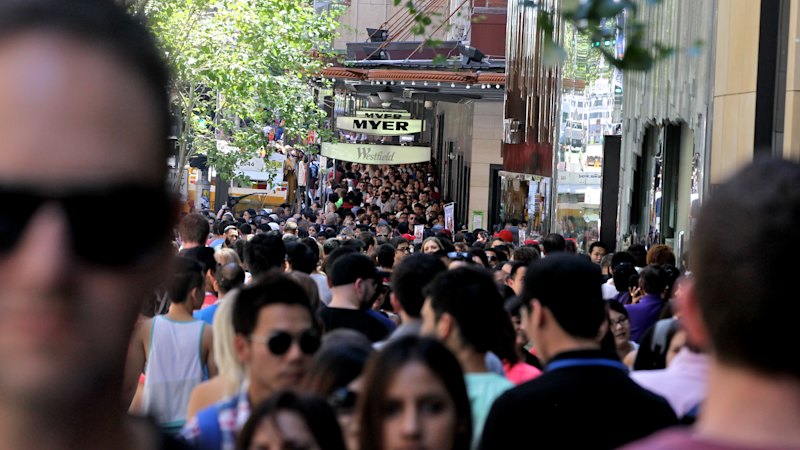

Sydney and Melbourne house values have fallen for a second consecutive month as high prices and inflation drive potential buyers out of the market and as population growth in the nation’s two largest cities slows to its lowest rate since the depths of the pandemic.
Figures released on Wednesday by Cotality show house values in Sydney fell by 0.3 per cent in March. In Melbourne they dropped by 0.6 per cent. Since the start of the year, house values have fallen by 0.6 per cent in Sydney and by 0.9 per cent in Melbourne.
Annual price growth in the nation’s two largest property markets has eased to 5.3 per cent in Sydney and 4 per cent in Melbourne.
Cotality research director Tim Lawless said a combination of factors was at play in the two cities, including the run-up in prices over recent months, which had made homes unaffordable for a growing number of potential buyers.
“The softer trend in values coincides with falling auction clearance rates and a pick-up in advertised supply, providing buyers with more choice and less urgency at the negotiation table,” he said.
It’s a different story in the nation’s other capitals. House values soared by 2.5 per cent in Perth last month to be 24.1 per cent up over the past 12 months. The median house value in the WA capital is now $1.06 million.
Brisbane house values jumped another 1.7 per cent to be 18.5 per cent higher than a year ago, while Adelaide’s median value lifted by 1.2 per cent to sit just under $1 million.
Lawless said there were signs that demand for properties was easing. Sales over the past three months were down on the same period last year and 5.6 per cent lower than the five-year average.
He said that, given the prospect of higher inflation due to the war against Iran and a lift in interest rates, demand by potential buyers was likely to ease further, which would slow down housing value growth.
Part of that slowdown may be due to a drop in population growth in the nation’s largest cities.
Data from the Australian Bureau of Statistics show Melbourne added 105,030 residents in 2024-25, a 37,607 drop on 2023-24 and down more than a third on the record 167,500 that occurred in 2022-23.
Melbourne’s growth, the largest of any city, was driven by overseas migration (81,000) while natural population growth added another 32,416. More than 8550 people left Melbourne for other parts of the country.
Outside of the pandemic, it was the smallest increase in Melbourne’s population in almost 15 years.
Sydney added 75,230 residents last financial year, a 32,000 drop on 2023-24 and almost half what was recorded in 2022-23.
Since the turn of the decade, Melbourne has added 366,000 residents, the most of any capital. But in percentage terms, the biggest increase has been in Perth, which has grown by 335,000 people to more than 2.4 million.
Perth has added more people over the past five years than either Brisbane (279,000) or Sydney (326,000). In the past 12 months, it added 58,000 people, almost the same as Brisbane, which is now home to 2.8 million.
The fastest-growing area in the country was the Port Melbourne area, where the population soared by 22.6 per cent, or more than 3400 residents. Outer Melbourne suburbs such as Plumpton (19.7 per cent) and north Tarneit (18.5 per cent) are also growing rapidly.
Sydney’s fastest-growing area is the Box Hill-Nelson region, adding 26,348 people over the past year.
The figures confirmed that most Australians want to live in our major cities. Regional Australia added 94,700 residents through the year to reach 8.9 million, an increase of 1.1 per cent.
The nation’s capital cities were home to 18.8 million, an increase of 324,700 or 1.8 per cent. Sixty-eight per cent of Australians now live in eight capital cities.
Regional population growth, which soared during the first year of the pandemic, has now slowed every year since 2021.
More than 70 council areas lost residents over the past year. In NSW, the population of 27 councils went backwards. Almost all of them were in regional areas including Broken Hill, Bourke, Parkes and Cootamundra.
Only one council area in Sydney, Hunters Hill, lost residents. Its population fell by 64 people to 13,983. Hunters Hill has lost almost 760 people over the past decade, more than 5 per cent of its population.
The biggest fall in population occurred in the small West Australian wheat-sheep belt council of Trayning. Its population fell by 1.6 per cent, taking the council down to 304. Trayning’s population has collapsed by 25 per cent over the past 20 years.
Cut through the noise of federal politics with news, views and expert analysis. Subscribers can sign up to our weekly Inside Politics newsletter.
 Shane Wright is a senior economics correspondent for The Age and The Sydney Morning Herald.Connect via X or email.