



Updated ,first published
Business groups are warning that cafes, bars, restaurants and shops will raise their prices to pass on added costs they will face from a looming ban on credit and debit card surcharges, after the Reserve Bank announced sweeping payment reforms.
The RBA on Tuesday said that from October, surcharges on credit card and debit card payments will be banned, a move it says will save consumers $1.6 billion a year. However, the changes have been fiercely opposed by small business groups who warn their members will raise prices, while it is also likely the changes will cut the generosity of card reward schemes.
The RBA said that despite fierce opposition to changes that it first floated last year, it believed merchants should no longer be able to apply surcharges on customers’ card transactions. It claimed the fees were no longer working as intended because the majority of payments were now by card, and it was difficult for consumers to avoid surcharges.
To avoid merchants baking in the cost of card payment processing into the price of goods, the RBA will also apply pressure on card issuers – largely banks – and other businesses that provide payment terminals.
Under the RBA’s changes, fees paid by the payment terminal provider to the institution that issues the card being used will be capped at a lower level.
Reserve Bank governor Michele Bullock said the changes would “make card payments simpler for consumers and help businesses get better value from their payment services”.
“Surcharging no longer works as intended,” she said. “Consumers and businesses find the rules complex and confusing, surcharges are often not well disclosed, and most consumers want surcharging to stop,” Bullock said.
Treasurer Jim Chalmers backed the decision, and praised the RBA’s multi-pronged plan. However, he acknowledged some small businesses may ultimately decide to increase their prices.
“We all know that Australians absolutely hate this idea that there’s a sneaky charge when you tap and go, when you get a coffee or get a beer,” he said.
“By getting some of the interchange fees down that will be a benefit to some of these small businesses that we hope that they will pass on to customers as well,” he said. “So there are swings and roundabouts here, but fundamentally this is about Australians knowing what they’re paying,” Chalmers said.
How will a surcharging ban affect small businesses?
However, small business groups warned that if merchants were unable to add a surcharge for accepting debit or credit card payments, they would have to raise their prices.
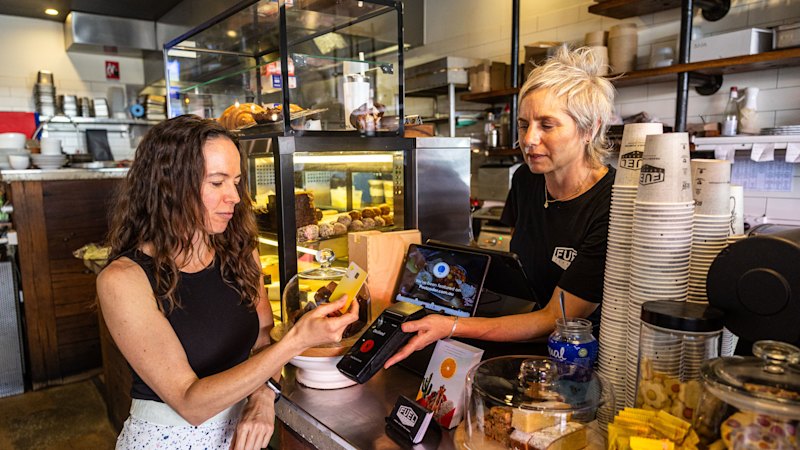
At Fuel Espresso cafe in Brookvale on Sydney’s northern beaches, surcharges on card payments – of about 1.6 per cent – are generally noticed, but accepted, by customers, said owner Jessica Kotzen. “They understand it’s part of the process,” she said.
Kotzen believes she will have no choice but to increase prices when a surcharge ban takes effect. While customers don’t generally react well to menu price increases, a flurry of increased charges from suppliers and delivery companies who are encountering higher costs due to the fuel shortage crisis had left the small business struggling to absorb prices as is.
“We’re absorbing increased costs for now, but we will need to start passing it on to the customer,” she said.
The business has tried shopping around payment processing providers in the past, but Kotzen doesn’t have much faith that the RBA’s measures designed to boost transparency and reduce the fees card issuers charge will ultimately offset the loss of surcharge revenue.
“I’m deeply concerned that it’s just going to mostly hit small businesses. There’s only so much you can charge for a cup of coffee,” Kotzen said.
On Tuesday, long-time customer Amber Boardman was buying lunch at Fuel. While she notices how surcharges quickly add up across many of life’s receipts, she is concerned if it harms her local favourites such as Fuel.
“If it leaves them worse off and having to absorb the cost, it’s not cool,” Boardman said.
The sentiment at Fuel was echoed by several business groups, which insisted the decision harmed small businesses and would lead to them baking their costs to process card payments into all prices.
Council of Small Business Organisations Australia (COSBOA) chair Matthew Addison said, “If you ban surcharging without guaranteeing lower fees, small businesses have no choice but to absorb the cost and that will ultimately be reflected in prices.”
Wes Lambert, CEO of the Australian Restaurant and Cafe Association, called Tuesday’s announcement “the biggest early April Fool’s joke the RBA could have handed the hospitality industry”.
“Ultimately, the consumer will pay for this,” Lambert said.
The RBA cracks down on surcharging
How much do Australians pay in surcharges?
The Reserve Bank estimates Australians pay between $1.6 billion and $1.8 billion in surcharges. While many retailers add surcharges, the central bank says that overall, only 16 per cent of business charge a surcharge.
What is the average cost of a surcharge?
The size of a surcharge will vary depending on the type of card used, and the cost to the merchant of accepting that payment. Eftpos surcharges are typically less than 0.5 per cent, Canstar says, Visa and Mastercard debit surcharges are between 0.5 per cent and 1 per cent, and Visa and Mastercard credit surcharges are between 1 and 1.5 per cent.
Does this change cover all cards, including AMEX?
The changes announced by the RBA do not apply to American Express, which is regulated differently. American Express does not have interchange fees because the merchant’s payment service provider and the cardholder’s issuer are the same institution.
Banks – which make up most issuers, a group set to lose $660 million in annual revenue under the changes – slammed the move, suggesting it could undermine the nation’s “sovereign capabilities.”
“The RBA’s decision will see foreign multinationals extract an increasing share of revenue from the payments system to the long-term detriment of Australia,” ABA CEO Simon Birmingham said.
The changes apply to all Mastercard, Visa and EFTPOS cards, but not to American Express, which is regulated differently. American Express does not have interchange fees because the merchant’s payment service provider and the cardholder’s issuer are the same institution.
About 84 per cent of businesses don’t currently surcharge card payments, and so are expected to benefit from lower upstream costs, the RBA believes. However, the use of surcharging varies significantly by industry, with roughly a third of hospitality businesses surcharging, it said.
Why is the RBA changing the surcharging rules?
The RBA said the existing system has largely meant that debit and credit card users fund the cost of expensive rewards points and frequent flier schemes, despite not all users benefiting from such schemes.
For years, businesses have been able to apply surcharges to credit and debit card payments, but the amount is not supposed to exceed what it costs a business to process the payment. While average surcharges have been about 0.7 per cent of a transaction, they have ranged between 0.1 per cent to 10 per cent.
Interchange fees historically have been a significant funding source for banks in covering the costs for reward points, which are issued to customers usually for each dollar they spend. Customers can also gain bonus points for signing up to cards, which are often gamed by “points hackers” who cycle through cards to accrue bonuses.
Fee caps will now be lowered from 0.8 per cent to 0.3 per cent for consumer credit cards, and from 0.2 per cent to 0.16 per cent for debit cards. The new interchange fee on foreign-issued cards will be 1 per cent, while commercial credit cards’ cap will remain at 0.8 per cent.
The Business Briefing newsletter delivers major stories, exclusive coverage and expert opinion. Sign up to get it every weekday morning.
 Elias Visontay is a National Consumer Affairs Reporter at The Sydney Morning Herald and The Age.Connect via email.