


David Fickling
Australia was once said to have been “built on the sheep’s back” — a recognition that wool played a central role in its economic growth. These days you might say it floats on a lake of diesel.
No major economy uses the fuel more lavishly. Consumption runs to about 7.7 barrels per person, per year, sufficient to fill the tank on a Ford F-150 pickup nine times over. That’s about 80 per cent above US levels, and eight times more than China.
With the global petroleum supply chain starting to seize up due to the crisis in the Strait of Hormuz, prices have risen more than 50 per cent in a matter of weeks. Shortages are looming.
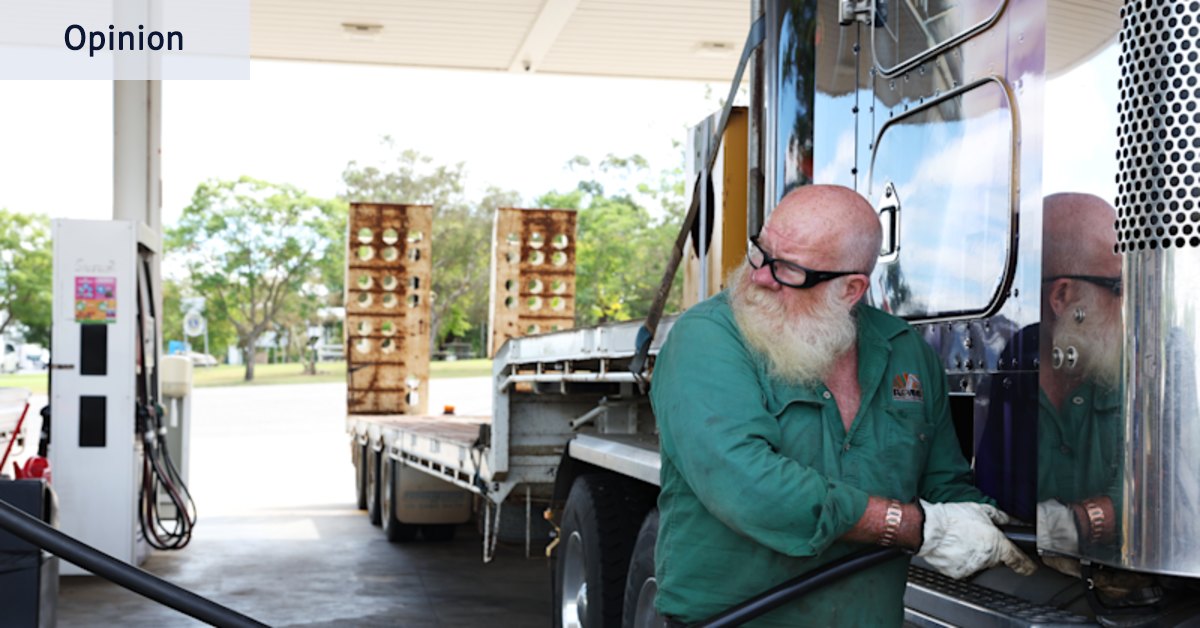
Garbage companies have warned that waste collections may be cancelled as trucks run short. Hundreds of petrol stations are out of at least one type of fuel. Farms have postponed crop seeding because their tractors can’t be refilled. Truckers are getting stranded at drained outback filling stations. Charter fishing boats operating out of Sydney Harbour face squeezed margins.
The government is dismissing talk of rationing, but has relaxed safety regulations to draw more supplies in from overseas. The market looks worryingly tight.
For all that, you can blame decades of complacency and misguided subsidies. Other countries shouldn’t assume they’re immune. Fuel shortages are already prompting talk of emergency conditions in the Philippines and South Korea, while the knock-on effects in Australia could hit global supplies of food and raw materials.
Things would have been far better if successive governments hadn’t spent years incentivising wasteful consumption.
Some of this diesel dependency is close to inevitable. Mining is a voracious consumer of the fuel. It’s a versatile power source for the energy-hungry trucks and machinery used at remote work sites. Farmers use it to power their harvesters, tractors and pumps for similar reasons.
Part of this is down to geography. Australia has a population not much greater than that of Florida, spread across a continent almost as big as the US.
As a result, an outsized trucking industry hauls goods on two-, three- or even four-trailer road trains between major cities that are rarely much less than 1000 kilometres apart.
Bad policy has made the problem far worse than it should be, though. Despite some of the world’s biggest reserves of coal and natural gas, Australia is an insignificant oil producer, and depends on imports from Asia for about 90 per cent of its diesel.
Stockpiles are currently sufficient for just 30 days. That’s the lowest among members of the International Energy Agency, which requires at least 90 days of inventory. With the Strait of Hormuz closed and major suppliers China, Japan and South Korea limiting exports to prevent local shortages, that has left Australia’s safety net looking distinctly threadbare.
Things would have been far better if successive governments hadn’t spent years incentivising wasteful consumption. Industrial users get tax rebates to cover the cost of their diesel use, a program that has grown to become one of the biggest drains on the budget. The federal government will spend $10.8 billion on diesel rebates in the current fiscal year, more money than goes to the army or navy, and almost as much as is spent on public education.
That windfall acts as a financial brake on attempts to decarbonise. Other countries are surging ahead. At Chile’s Collahuasi mine, one of the world’s biggest copper pits, overhead wires have been installed to allow electric dump trucks to cart rock to the processing plant. At Vale’s S11D in Brazil, part of the world’s largest iron ore complex, electrical machinery crushes ore in the pit and sends it out on conveyors, cutting emissions by three-quarters and costs by 15 per cent. At Canada’s Macassa gold mine, 80 per cent of ore is dug by electric machines, which also reduces the steep cost of ventilating underground tunnels.
On Indian farms, 13 per cent of irrigation pumps are solar-powered. In China, where sales of battery-electric commercial vehicles have been surging lately, more than half of heavy-duty trucks bought in December came with a plug.
In Australia, such innovations sound like science fiction. Battery-powered trucks are only being tentatively tested, and solar pumps were almost unknown until a few years ago. BHP, whose diesel usage accounts for about 63 per cent of its operational emissions, is planning to defer most of its spending to cut diesel dependency into the 2030s. This is what happens when the government is putting its thumb on the scale to favour fossil fuels.
Iron ore miner Fortescue, one of the largest single beneficiaries of the diesel rebate and one of Australia’s most aggressive decarbonise, has called for the measure to be abolished for all but small businesses. Removing the tax break would increase savings from electrifying mining equipment by about 50 per cent, according to Fortescue. The billions of dollars the government would save could be ploughed back into building the transmission, distribution, charging, and battery-swapping infrastructure needed to electrify mine sites and long-haul truck routes.
It shouldn’t take an energy shock for Australia to see how far it has gone wrong with its dependence on dirty, costly, insecure diesel. If the current alarm helps change that short-sightedness, it won’t have come a moment too soon.
David Fickling is a Bloomberg Opinion columnist covering climate change and energy. Previously, he worked for Bloomberg News, the Wall Street Journal and the Financial Times.
Bloomberg
The Business Briefing newsletter delivers major stories, exclusive coverage and expert opinion. Sign up to get it every weekday morning.
