


Last week the Trump administration did something that, even by its standards, was unusual. It agreed to pay a French energy giant nearly a billion dollars to not build something.
In exchange for forfeiting leases covering waters offshore New York and North Carolina, in which TotalEnergies planned to build offshore wind farms, the US Justice Department will reimburse the company the $US928 million ($1.33 billion) it paid for them during the Biden administration.
As part of the deal, TotalEnergies has said it will invest the funds in oil and gas projects in the US, including an LNG export terminal it is already building in Texas, more oil production in the Gulf of Mexico and gas-fired plants, although it is unclear whether that will lead to any increase in its existing plans for US energy investment.
So, in a 180-degree shift from the Biden administration’s energy strategy, the Trump administration will hand over US taxpayer funds to a French company to reduce its investment in US renewable energy and, perhaps, increase its fossil fuel production.
The odd decision to pay a company not to build something that had been permitted and funded – akin to the $1 billion the Andrews government paid to not build the East-West Link project in Melbourne in 2015, or the $590 million or so costs to Victoria of not holding the Commonwealth Games – came after the Trump administration’s five separate attempts to stop other wind-farm developments were defeated in US courts, all within a three-week period, earlier this year.
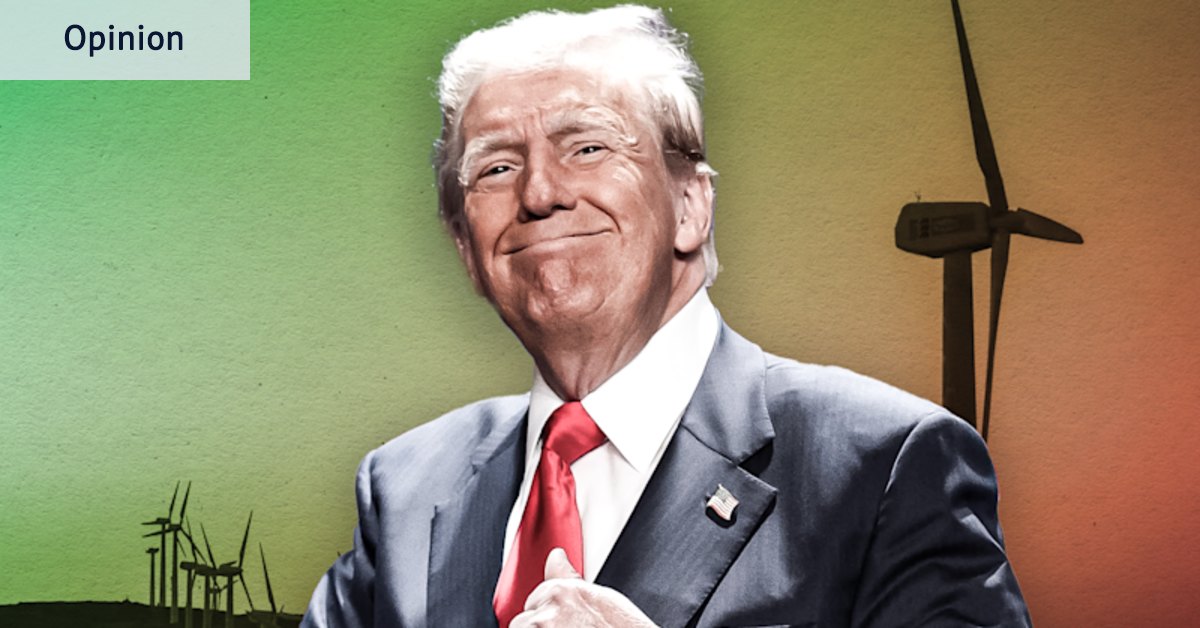
It’s no secret that Donald Trump has an almost visceral dislike of wind turbines or, as he usually refers to them, “windmills”.
That’s often attributed to his failed 2015 attempt to oppose a wind-farm development off the coast of Scotland because it spoiled the view from one of his golf courses.
“The windmill hovering over hole 14 is disgusting and inappropriate,” he is reported to have said.
He has also claimed the noise from turbines causes cancer, that windmills kill birds – “they wipe them all out” – and are “driving the whales crazy”.
His concern for wildlife is curious, given that his administration has weakened habitat protections for threatened and endangered species to facilitate more economic development, particularly energy projects.
In any event, from the very start of his second term as president, he has made it clear that he is opposed to both new and existing wind and solar projects, whether on federal lands or waters or on private property.
“My goal is to not let any windmills be built,” he told a group of oil industry executives last year.
Having failed in the courts to achieve that goal, the administration is now using money, and its ability to litigate and delay, to try to coerce companies into relinquishing their leases or, in some cases, their near-complete projects.
The administration has cited “national security” as its grounds for trying to halt wind-farm developments, even though existing projects were cleared by a permitting process that included a national security screening. The turbines can interfere with radar signals, but their impact can be muted by the design of the turbines and layouts of the farms.
The more credible reason for its opposition to renewables, and wind farms in particular, is Trump’s personal antipathy to them and the administration’s commitment to increasing oil and gas production – the “drill, baby” drill” mantra Trump recited when, in his first days back in office, he signed an executive order declaring a “national energy emergency” that unwound Biden-era restrictions on drilling on federal lands and offshore and fast-tracking permits.
Last year’s One Big Beautiful Bill Act, along with the big tax cuts, included the withdrawal of the incentives for wind and solar projects (and electric vehicles) within Joe Biden’s green-tinged Inflation Reduction Act.
The oil industry was, no doubt coincidentally, a major source of donations to Trump’s election campaign.
The administration’s assault on existing renewables projects comes even as the war on Iran that it initiated has driven up the cost of oil and gas.
While that will produce massive windfall profits for US oil and gas producers, it has added more than $US1 a gallon to the price of US gasoline and $US1.60 a gallon to the price of diesel.
The US might be the world’s largest oil producer and self-sufficient in oil and gas supply, and the domestic price of oil might be tracking 7 or 8 per cent lower than world prices, but the price of its oil and gas is driven by shifts in the global pricing of oil and gas.
In the context of domestic energy security, it would seem irrational to deter private investment in alternate sources of supply that, regardless of whether or not they might produce intermittent supply, produce power at costs (and marginal costs at or near zero) that are unrelated to oil and gas prices.
The fact that they produce clean energy could be regarded, given the nature of the Trump administration and its views on climate change, as a bonus.
The wind farms that TotalEnergies will now not build in New York State and North Carolina, with capacities of 3 gigawatts and 1 gigawatt respectively, were expected to be able to power up to 2.5 million homes and businesses.
At a time when the US electricity grid is under pressure from the massive build-out of energy-intensive data centres to support the boom in artificial intelligence, it would seem foolish to stymie power generation projects either in development or, for some of the projects the administration fought in the courts, nearing completion.
On some estimates, the demand from US data centres, already soaring, will triple over the next decade and the centres will account for more than a third of all electricity demand.
The US grid’s existing capacity is already being stretched to its limits by the surge in data centre construction and demand. If that capacity doesn’t keep up with the demand, it will constrain development of AI in America.
TotalEnergies, and its peers – most of the aspiring developers of wind farms in the US are from offshore, generally Europe – will continue to deploy their expertise in renewables outside the US, where the war in Iran’s exposure of the Strait of Hormuz as a critical choke point for global oil supply will spur further investment.
It will also see – or is already seeing – a scramble by consumers and greater interest from businesses in electric vehicles.
That may not happen to the same extent in the US, at least while Trump remains in the White House, but the war might produce a watershed for the penetration of EVs in countries’ transport fleets and for the acceleration of renewables in power generation.
China, of course, is ahead of the curve, with about than half its power now being generated by renewables and EVs dominating vehicle sales and, increasingly, China’s truck fleets. Wind’s share of China’s energy market is in the mid-teens, even if Trump seems to believe there isn’t a “windmill” in the country.
“They don’t have windmills, they make them and sell them to suckers like Europe, and suckers like the United States before,” he has said.
That’s from someone who’s just agreed to pay nearly a $US1 billion for … nothing.
The Business Briefing newsletter delivers major stories, exclusive coverage and expert opinion. Sign up to get it every weekday morning.
 Stephen Bartholomeusz is one of Australia’s most respected business journalists. He was most recently co-founder and associate editor of the Business Spectator website and an associate editor and senior columnist at The Australian.Connect via email.