


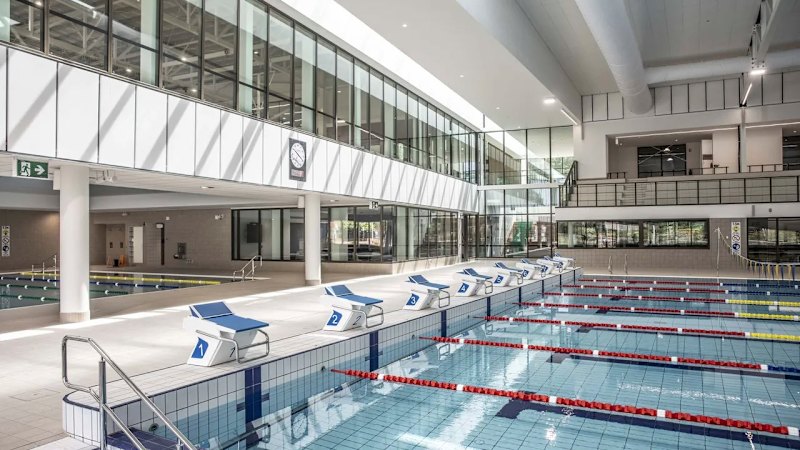

Melbourne’s upmarket private schools are spending hundreds of millions of dollars on building projects as they race to outdo their rivals with new sports centres, galleries and beachside campuses.
An analysis by The Age has found nearly half a billion dollars in capital expenditure will be spent by just eight private schools in 2025 and 2026 alone.
One eastern suburbs girls’ school will soon open a $100 million sports and aquatics complex, while a neighbouring high-fee school bought a beachside campus in Queensland for its outdoor education program in 2024.
Methodist Ladies’ College is just months away from cutting the ribbon on the first stage of its $100 million sports precinct in Kew.
The aquatic centre with 50-metre indoor pool, four diving boards and smaller pool for beginners will open in June, followed by the opening of its indoor sports centre with gymnasium, outdoor courts, athletics hub and underground car park next year.
Principal Julia Shea said the complex would replace the current 40-year-old physical education centre, which was no longer fit for purpose.
She said the project was strategic and reflected on the school’s belief that physical activity had a positive impact on mental wellbeing and academic performance.
Shea said facilities at the school of 2169 students, which charges more than $43,700 for year 12 tuition fees, appealed to families but that they weren’t a major factor for school selection.
“I always say to parents that their daughter will eulogise about a teacher who changed the direction of their life, not look back fondly on the quality of the swimming pool,” she said.
However, Deakin University’s Emma Rowe said school infrastructure was integral to a school making an impression, particularly sporting facilities.
“It’s massive. You can’t underestimate the impact,” she said.
“It gets parents through the door and [then] they have an emotional reaction … and bang, you’ve bought them for seven years.”
Trinity Grammar opens its $15 million sports pavilion at the school’s 25-hectare sports complex in Bulleen in November.
The pavilion was partially funded from rent and capital payments the school received after a portion of its land was used during the construction of the North East Link tollway.
Outside of Melbourne, Geelong Grammar is close to opening a $30 million prep-to-year-4 building on 230 hectares featuring forested areas, wetlands and views over Corio Bay.
The building will open after Easter when the school’s Bostock House junior school moves from Newtown, in central Geelong, to Corio.
Principal Rebecca Cody said the consolidation of the two campuses was a milestone for the 171-year-old school.
“It’s a Timbertop moment,” she said, referring to the school’s year 9 campus in the Victorian Alps where King Charles spent six months in 1966.
Last year, Brighton Grammar opened its $59 million Duigan Centre, a two-storey building with a basement car park and three tennis courts on the roof.
The building’s gallery houses a replica plane in tribute to alumni and the first Australian to build and fly a powered aircraft, John Duigan.
Presbyterian Ladies’ College’s $85 million sports, aquatic and fitness centre opened last March and was followed by Ruyton Girls’ School’s $40 million performing arts centre in August.
Last year also saw Woodleigh School complete its year 10 pavilions, featuring rooftops planted with native grasses, which won an architectural award for projects under $30 million.
Yet to open is Melbourne Grammar’s $55 million humanities building, which headmaster Philip Grutzner said was almost entirely funded by fees and philanthropic donations.
He said when the building opens next year, it will increase the number of classrooms and add a 220-seat amphitheatre and media and broadcasting studio.
Also opening next year is Ivanhoe Girls’ Grammar’s $37 million learning hub with an urban farming terrace, electronics laboratory and studio spaces.
Hawthorn boys’ school Scotch College has added a second outdoor education waterfront property to its portfolio with a campus near Mallacoota.
Fairhaven borders a UNESCO biosphere reserve and will be part of the college’s year 9 outdoor education program from 2028.
“Fairhaven will give the boys the chance to slow down, work the land and think deeply about the men they want to become,” principal Dr Scott Marsh said.
The 70-hectare campus is billed as the centrepiece of the school’s outdoor education program, which includes campuses at Cowes, on Phillip Island, and Healesville, in the Yarra Valley.
Other private schools adding campuses in 2027 and 2028 include Caulfield Grammar, which will open its second standalone junior school campus next year, and Preshil, which will open a secondary campus in Carlton in 2028.
Preshil bought the former piano factory for $19.7 million after selling its Blackhall campus in Kew to its neighbour Carey Baptist Grammar last October.
Carey will use that property to build a year 5 and 6 centre plus a sports and wellbeing facility with an underground car park. The Blackhall campus will replace the school’s Donvale campus in 2028, which will be sold.
The move follows Carey’s 2024 purchase of a property at Mission Beach, Queensland, which is part of a year 10 program focusing on conservation and marine research.
Private schools are also sitting on residential property as part of elaborate masterplans.
In 2024, Trinity Grammar spent $4.9 million on a property adjacent to its senior campus which is currently rented. The purchase was described in a school financial report as a “strategic acquisition to support the masterplan”.
Last year Penleigh and Essendon Grammar settled on a $1.7 million Moonee Ponds mansion, which abuts its girls’ junior campus.
Also planning ahead is Jewish private school Mount Scopus Memorial College. The school ploughed $195 million into a 7.5-hectare slice of Caulfield Racecourse in 2024 with a consolidated campus set to open in 2030.
Independent Schools Victoria chief executive Rachel Holthouse said capital works were a necessary part of running a school.
“From the outside it might look like a flurry of activity,” she said. “But schools are just forever on a cycle of improving existing facilities to bring them up to speed.”
Start the day with a summary of the day’s most important and interesting stories, analysis and insights. Sign up for our Morning Edition newsletter.
 Bridie Smith is an education reporter at The Age. A former desk editor, she has also reported on science and consumer affairs.Connect via X, Facebook or email.